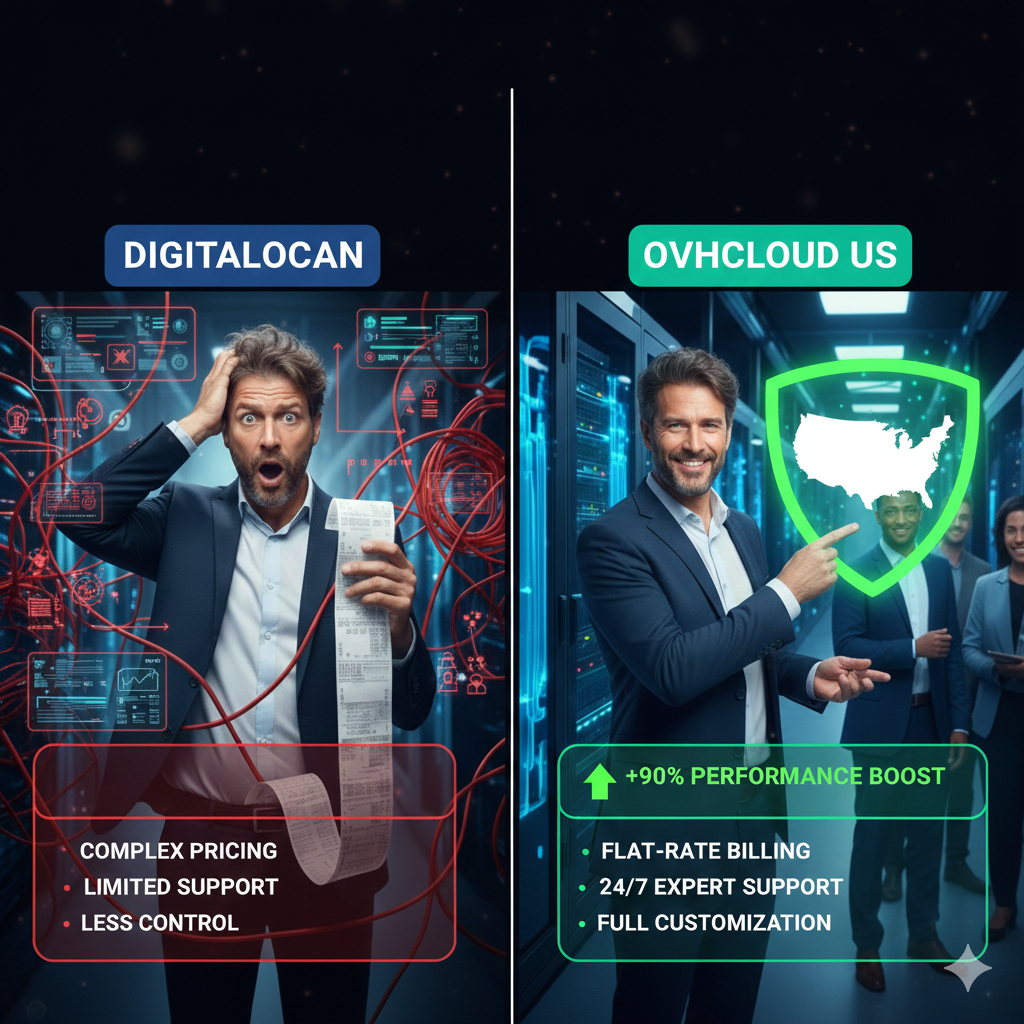
The 2026 Honest Review: Is OVHcloud U.S. Better Than DigitalOcean?
Choosing a cloud provider used to be simple: you either picked AWS and accepted the complexity, or you picked a simpler VPS provider to save your sanity. But as we move through 2026, the gap between “hyperscalers” and “alternative cloud” providers has narrowed significantly.
For developers and startups, the battle for the best balance of performance, price, and usability often comes down to two major players: the developer-favorite DigitalOcean and the infrastructure giant OVHcloud.
DigitalOcean has long been the gold standard for user experience and documentation. However, rising cloud costs and the dreaded “egress fee” have forced many CTOs and developers to look for alternatives. Enter OVHcloud US—the American arm of the European heavyweight—promising massive bandwidth, proprietary hardware, and lower bills.
But is cheap always better? In this comprehensive review, we strip away the marketing jargon to compare infrastructure, pricing models, performance benchmarks, and developer experience. Whether you are scaling a SaaS platform or deploying a high-traffic AI workload, here is the data you need to decide.
OVHcloud US Overview
OVHcloud is distinct in the cloud market because they don’t just rent servers; they build them. They manufacture their own server racks and utilize proprietary water-cooling technology, which drastically reduces energy costs—savings they typically pass on to the customer.
While originally a European entity, OVHcloud US operates as a distinct subsidiary to meet strict American compliance standards. They operate major data centers on both coasts (Vint Hill, Virginia, and Hillsboro, Oregon), providing solid latency coverage across North America.
Their product philosophy is “smart infrastructure.” They offer everything from standard VPS instances to high-performance Bare Metal servers. For users prioritizing raw power per dollar, OVHcloud US hosting is often the first place they look. However, their ecosystem can feel more “industrial” compared to the polished experience of their competitors.
Key Offerings:
- Eco-friendly Data Centers: Vertical integration and water cooling.
- High-Bandwidth Focus: Known for generous (often unmetered) traffic allowances.
- Anti-DDoS: Proprietary protection included standard on all products.
DigitalOcean Overview
DigitalOcean (DO) revolutionized the cloud industry by making it accessible. They coined the term “Droplet” for virtual machines and created a control panel so intuitive that a junior developer could deploy a production server in under 55 seconds.
In 2026, DigitalOcean has matured from a simple VPS provider into a full-service cloud platform. They offer managed databases, Kubernetes (DOKS), storage solutions (Spaces), and a serverless platform (Functions).
DigitalOcean hosting is built on the premise of simplicity. They abstract away the complex networking and infrastructure management that makes AWS or Azure a headache. However, this convenience often comes at a premium. As their product catalog has expanded, so has their pricing structure, leading budget-conscious developers to scrutinize their monthly invoices more closely.
Key Offerings:
- Droplets: Scalable virtual machines (Basic, General Purpose, CPU-Optimized).
- App Platform: A fully managed PaaS for building and deploying apps.
- Community: The internet’s most extensive library of developer tutorials.
Pricing Comparison – Which Is More Cost-Effective in 2026?
When analyzing OVHcloud vs DigitalOcean pricing, the difference isn’t just in the sticker price of the virtual machine; it is in the “total cost of ownership,” specifically regarding bandwidth and add-ons.
Compute Pricing
For standard cloud instances (VPS), OVHcloud generally undercuts DigitalOcean by 10% to 20%. For example, a standard instance with 2 vCPUs and 4GB of RAM will typically cost less at OVHcloud. DigitalOcean charges a premium for their “Premium Intel” and “Premium AMD” droplets, whereas OVHcloud offers similar performance hardware at their base tier.
If you are looking for cheap cloud hosting USA, OVHcloud consistently wins on the raw compute-per-dollar metric.
Storage and Backups
DigitalOcean charges a flat rate per GB for block storage and object storage (Spaces). While reasonable, these costs scale linearly. OVHcloud offers competitive block storage pricing, but their pricing model often includes larger local storage quotas on their VPS instances by default, meaning you might not need to buy add-on block storage as early as you would with DigitalOcean.
The Hidden Cost: Egress
This is the deciding factor for many. DigitalOcean operates on a “pooled bandwidth” model with overage fees that can be punishing if you go viral. OVHcloud acts as a disruptor here, offering unmetered bandwidth on many of their instances. For a media streaming app or a high-traffic API, the savings with OVHcloud can amount to thousands of dollars annually.
Performance and Speed Comparison
Price is irrelevant if the server is slow. To determine fast cloud servers, we look at three metrics: CPU performance, Disk I/O, and Network Latency.
CPU Performance
DigitalOcean utilizes shared CPU resources for their entry-level droplets. This means if a “neighbor” on your physical server is running a heavy process, your performance might dip (the “noisy neighbor” effect). You have to upgrade to Dedicated CPU Droplets to avoid this.
OVHcloud, particularly in their “Essential” and “Elite” ranges, tends to offer guaranteed resources. Furthermore, because OVHcloud offers Bare Metal servers (where you rent the entire physical machine, not a virtual slice), they offer a performance ceiling that DigitalOcean cannot match. For pure, raw processing power, OVHcloud takes the lead.
Network Latency
Cloud hosting performance comparison benchmarks in 2026 show a tight race. DigitalOcean has excellent peering arrangements, ensuring low latency for US-based users. OVHcloud’s US network is robust, but DigitalOcean often edges them out slightly in terms of consistent network speeds across diverse US ISPs, thanks to their longer-established presence in the NYC and SFO regions.
Bandwidth, Egress Fees, and Data Transfer Costs
If your application moves a lot of data, this section is the most important part of this review.
DigitalOcean Bandwidth Costs:
DigitalOcean includes a transfer allowance with every Droplet (e.g., 1TB or 2TB). If you run multiple Droplets, this allowance pools together. However, once you exceed that cap, you are charged per GB. In 2026, these overage fees remain a point of friction for data-heavy startups.
OVHcloud Bandwidth Policy:
OVHcloud is the king of no egress cloud hosting. On most of their VPS and Dedicated Server ranges, they offer unmetered bandwidth with a guaranteed speed (e.g., 500 Mbps or 1 Gbps). You can transfer 10TB, 50TB, or 100TB, and your bill remains exactly the same.
For video streaming platforms, VPN providers, or file-sharing services, OVHcloud is the clear financial winner.
Scalability and Infrastructure Flexibility
How easy is it to grow when your user base explodes?
Vertical Scaling
Both providers allow you to resize instances. DigitalOcean makes this incredibly slick—you can resize a Droplet with a quick reboot. OVHcloud also allows resizing, though the process can sometimes require more manual intervention depending on the specific product line (e.g., moving from VPS to Public Cloud).
Bare Metal Cloud Servers
This is a key differentiator. DigitalOcean does not offer bare metal. If you need direct access to hardware without a hypervisor layer (for maximum performance or specific virtualization needs), you cannot use DigitalOcean.
OVHcloud specializes in bare metal cloud servers. You can spin up a physical server with 128GB of RAM and massive NVMe drives in minutes. This makes OVHcloud a significantly more scalable cloud hosting option for businesses that eventually outgrow virtualization.
Kubernetes
DigitalOcean’s Managed Kubernetes (DOKS) is widely regarded as one of the easiest ways to run K8s. It is beginner-friendly and integrates well with their load balancers. OVHcloud offers Managed Kubernetes as well, certified by the CNCF. It is robust and cheaper, but the learning curve is slightly steeper regarding networking configuration.
Reliability, Uptime, and Support
Uptime SLAs
Both providers offer a cloud uptime guarantee typically ranging from 99.9% to 99.99%, backed by Service Level Agreements (SLAs). If they fail, they issue credits. Historically, both have had regional outages, but both maintain high reliability standards suitable for production workloads.
Customer Support
Here lies the biggest complaint for both providers in the “budget” cloud sector.
- DigitalOcean: Their documentation is world-class. You can usually solve your own problems. However, getting a human on the phone requires an expensive support contract.
- OVHcloud: Support has historically been their weak point. Response times for free-tier support can be slow. Like DigitalOcean, if you want fast answers, you need to pay for a premium support tier.
When evaluating hosting customer support, assume you will be relying largely on your own DevOps skills unless you pay extra.
Security and Compliance Capabilities
Anti-DDoS
OVHcloud shines here. They developed their own “VAC” technology—a massive proprietary mitigation system that scrubs traffic before it hits your server. This is included free of charge. For gaming servers or high-target industries, this is a massive value add.
Compliance
Both providers are GDPR compliant. However, if you have strict US government compliance needs, check the specific certifications. OVHcloud US puts a heavy emphasis on data sovereignty and separation from their international arm to satisfy US regulations.
Keywords: secure cloud hosting, GDPR compliant cloud.
Ease of Use and Developer Experience
If we judge solely on developer friendly cloud hosting, DigitalOcean wins. Their UI (The Cloud Control Panel) is a masterclass in design. It is clean, intuitive, and guides you through complex tasks. Their API is a joy to work with, and third-party tools (like Terraform providers) are mature and well-documented.
OVHcloud has improved their control panel significantly, but it remains complex. Because they offer so many products (Web hosting, VPS, Bare Metal, Public Cloud, Hosted Private Cloud), the dashboard can feel cluttered. Managing networking groups and firewalls in OVHcloud requires a bit more networking knowledge than in DigitalOcean.
Real-World Use Cases and Recommendations
1. The Bootstrapped SaaS
Recommendation: DigitalOcean.
Time is money. The speed at which you can set up a managed database, a Droplet, and a load balancer on DigitalOcean allows you to focus on coding your product, not managing infrastructure.
2. The Media Streaming App
Recommendation: OVHcloud US.
If you are streaming video or audio, DigitalOcean’s bandwidth overages will bankrupt you. OVHcloud’s unmetered bandwidth is non-negotiable here.
3. AI and Machine Learning Workloads
Recommendation: OVHcloud US.
AI models need GPU power. Renting GPU-enabled Bare Metal servers from OVHcloud is generally much more cost-effective than virtualization-based GPU instances on other clouds.
Pros and Cons Summary Table
| Feature | DigitalOcean | OVHcloud US |
|---|---|---|
| Pricing | Moderate/Premium | Low/Budget-Friendly |
| Bandwidth | Metered (Pooled) | Unmetered (Standard) |
| Ease of Use | Excellent (5/5) | Moderate (3/5) |
| Performance | Good (Shared & Dedicated) | Excellent (Bare Metal options) |
| DDoS Protection | Basic included, Advanced paid | Advanced proprietary included |
| Support | Documentation is King | Slow on free tiers |
| Ideal For | Developers, SaaS, Startups | High-traffic, Infrastructure experts |
Which One Should You Choose in 2026?
The decision between OVHcloud and DigitalOcean in 2026 comes down to a trade-off between convenience and cost-efficiency.
Choose DigitalOcean if you are a developer who wants to move fast, values a beautiful UI, and builds applications with standard traffic patterns. It remains the best place to “grow” a startup from zero to one.
Choose OVHcloud US if you are infrastructure-savvy, expect high bandwidth usage, need raw bare-metal power, or simply want the lowest possible bill at the end of the month. It is the superior choice for scaling production workloads where margins matter.
FAQ – OVHcloud vs DigitalOcean
Q1: Is OVHcloud cheaper than DigitalOcean?
Yes, in most configurations. OVHcloud typically offers more RAM and CPU cores for the same price point as DigitalOcean. Additionally, the lack of bandwidth overage fees makes OVHcloud significantly cheaper for high-traffic applications.
Q2: Does OVHcloud have U.S. data centers?
Yes. OVHcloud US operates entirely separate data centers from their European parent company, with locations in Vint Hill, Virginia (East Coast) and Hillsboro, Oregon (West Coast).
Q3: Which cloud provider has better performance?
For shared VPS, they are comparable. However, for maximum performance, OVHcloud wins because they offer Bare Metal servers, allowing you to utilize 100% of the hardware without a virtualization layer slowing you down.
Q4: Does DigitalOcean charge bandwidth fees?
Yes. DigitalOcean Droplets come with a set amount of bandwidth (e.g., 1TB). If you exceed this cap, you are charged a per-gigabyte fee for outbound data transfer.
Q5: Is OVHcloud reliable for production workloads?
Yes. OVHcloud is a major enterprise provider. While their support can be slower than premium managed hosts, their infrastructure uptime is robust and suitable for production environments.
Q6: Which cloud platform is better for startups?
DigitalOcean is generally better for early-stage startups due to its ease of use, managed services (like databases and Kubernetes), and extensive documentation, which allows small teams to move faster.
Conclusion
In 2026, the cloud market is no longer a monopoly. You have powerful choices. While DigitalOcean remains the user-experience champion, OVHcloud US has proven itself as the value and performance powerhouse.
Don’t let your cloud bill be a surprise. If you are ready to stop paying for “convenience” and start paying for raw power, it might be time to switch.
Ready to see how much you can save? Check out the pricing calculators on both platforms today and deploy your first instance.