WordPress Hosting vs Regular Web Hosting: Which Should You Choose in 2026?
Launching a new website is an exciting milestone, but it often starts with a confusing technical hurdle: choosing where your site will live. If you are planning to use the world’s most popular Content Management System (CMS), you are likely stuck debating WordPress hosting vs regular web hosting.
While both options store your website files and make them accessible to visitors, they function very differently under the hood. The choice you make today will impact your site’s speed, security, and how much time you spend fixing technical issues later.
Regular web hosting is like renting an empty apartment; you have a space, but furnishing and maintaining it is up to you. WordPress hosting, particularly managed options, is more like a serviced hotel suite—everything is optimized for your comfort and specific needs.
In this guide, we will break down the differences, compare costs, and help you decide which option is the best hosting for WordPress websites in 2026.
What Is WordPress Hosting?
To understand the debate between WordPress hosting vs regular web hosting, we first need to define the specialist. WordPress hosting is a server environment specifically configured to cater to WordPress websites.
Unlike a generic server that can run any type of software, these servers are tuned to the unique database and code structure of WordPress.
Managed vs Unmanaged WordPress Hosting
You will typically encounter two types: shared (unmanaged) and managed.
Unmanaged WordPress hosting is essentially standard hosting with WordPress pre-installed. It is cheap, but you still handle the heavy lifting.
Managed WordPress hosting is the premium tier. Here, the hosting provider acts as your technical partner. They handle the server administration, allowing you to focus purely on creating content or selling products.
Built-in Features
The biggest draw of WordPress hosting explained simply is the ecosystem of tools included:
- Automatic Updates: The host updates your WordPress core, and often your plugins, to patch security vulnerabilities automatically.
- Server-Level Caching: Instead of relying on plugins, the server caches your pages to load them instantly.
- Enhanced Security: Firewalls are set up specifically to block common WordPress threats, such as brute-force login attacks.
What Is Regular Web Hosting?
Regular web hosting explained in simple terms is a universal service. It is designed to host any type of website builder or code, whether that is WordPress, Joomla, Drupal, Magento, or a custom HTML site you built from scratch.
This is the generalist approach. The servers are set up to be compatible with as many different technologies as possible.
Types of Regular Hosting
Most beginners start with Shared Hosting. This is where hundreds of websites reside on a single server, sharing resources like RAM and CPU. It is the most affordable option but can suffer from performance issues if other sites on the server get busy.
VPS (Virtual Private Server) Hosting and Cloud Hosting are steps up from shared. They offer dedicated resources and better performance but require more technical knowledge to manage effectively.
The Flexibility Advantage
The primary benefit here is freedom. If you plan to run a WordPress blog alongside a separate forum software and a custom-coded app, regular web hosting allows you to do that in one account. WordPress-specific hosts often restrict you to WordPress only.
Key Differences – WordPress Hosting vs Regular Hosting
When analyzing WordPress hosting vs shared hosting, the differences often come down to how much work you want to do yourself versus how much you want the host to do for you.
Performance Optimization
In a regular hosting environment, the server runs standard software (like Apache) that works okay for everything but isn’t perfect for anything.
In a high-quality WordPress hosting environment, the stack is optimized. They might use NGINX or LiteSpeed servers, which handle WordPress database queries much faster. They also typically offer newer versions of PHP (the coding language WordPress uses) sooner than regular hosts.
Maintenance & Updates
With regular hosting, maintenance is your responsibility. If a plugin update breaks your site, you have to fix it. If a new version of WordPress comes out, you have to click the update button (and hope nothing breaks).
With managed WordPress hosting, the provider manages these updates. Many even use AI to test updates in a safe environment before pushing them to your live site.
Security Layers
Regular web hosts provide generic security. They look for general server threats.
Secure WordPress hosting goes deeper. Because the host knows you are running WordPress, they can scan for malware specific to WordPress plugins and themes. They can proactively block IP addresses known for attacking WordPress login pages.
Ease of Use
If you are non-technical, WordPress hosting wins on ease of use. You usually get a dashboard designed for WordPress, allowing you to manage backups, staging sites, and themes easily.
Regular hosting typically uses cPanel or Plesk. These are powerful tools, but they are cluttered with options for email, FTP, and databases that a casual user might find overwhelming.
Pricing Comparison
Price is often the deciding factor for new site owners.
Entry Cost vs Renewal Pricing
Cheap web hosting plans (regular shared hosting) are incredibly inexpensive to start. You can often find deals for under $3 USD per month. However, be aware of renewal rates. That $3/month plan might jump to $12/month when your initial term ends.
WordPress hosting pricing tends to be higher. Managed plans often start around $15 to $30 USD per month. While this seems steep compared to shared hosting, you are paying for the service, not just the server space.
Hidden Fees
Regular hosting often charges extra for things you might consider essential, such as:
- Daily backups
- SSL certificates (though many offer this free now)
- Malware removal services
Managed WordPress hosts usually bundle these into the monthly price, offering better long-term value for money despite the higher sticker price.
Speed & Performance Comparison
In the hosting comparison 2026 landscape, speed is currency. Google uses Core Web Vitals as a ranking factor, meaning slow sites rank lower.
Caching and CDN Differences
Fastest WordPress hosting providers build caching directly into the server architecture. This is significantly faster than using a plugin on a regular host.
Furthermore, top-tier WordPress hosts include a Content Delivery Network (CDN). This stores copies of your images and files on servers around the world, ensuring your site loads quickly for a visitor in London, even if your main server is in New York. On regular hosting, you typically have to set up a CDN like Cloudflare yourself.
Traffic Handling
If your post goes viral, regular shared hosting often throttles your bandwidth or takes your site offline to protect other users on the server. Managed WordPress hosting platforms are built to scale. They can absorb traffic spikes more effectively without crashing your site.
Security, Backups & Support
When your website goes down, the quality of your support team matters more than anything else.
Support Specialization
In a hosting support comparison, WordPress hosting is superior. The support agents are WordPress experts. They know what a “White Screen of Death” is and how to fix a plugin conflict.
On regular hosting, support agents deal with email issues, cPanel errors, and general connectivity. If your WordPress site breaks due to a bad plugin, they will likely tell you, “The server is online; the issue is with your software,” and leave you to fix it.
Backup Frequency
Regular hosts usually offer weekly backups, or charge extra for daily ones. You might also have to manually restore them.
Managed hosts typically offer automatic daily backups (sometimes hourly). Crucially, they offer “one-click restore,” meaning if you make a mistake, you can undo it instantly without needing to touch a single line of code.
Which Hosting Is Best for Different Users?
Still undecided? Here is a breakdown based on user profiles.
Bloggers and Beginners
If you are starting a personal blog, best hosting for beginners is often a high-quality shared hosting plan or an entry-level managed WordPress plan. If you have a budget, go Managed—it saves you from learning technical maintenance.
Business Websites
For a professional brochure site or a service business, uptime is critical. The best hosting for small business websites is Managed WordPress hosting. The security guarantees and automatic backups ensure your business face is always presentable to clients.
eCommerce Stores
If you are running WooCommerce, avoid cheap regular hosting. eCommerce requires significant server power. You need managed WordPress hosting that specializes in WooCommerce to ensure your checkout process is fast and secure.
Developers
If you know how to configure a server, manage security patches, and optimize caching yourself, regular VPS or Cloud hosting offers the most control and the best price-to-performance ratio.
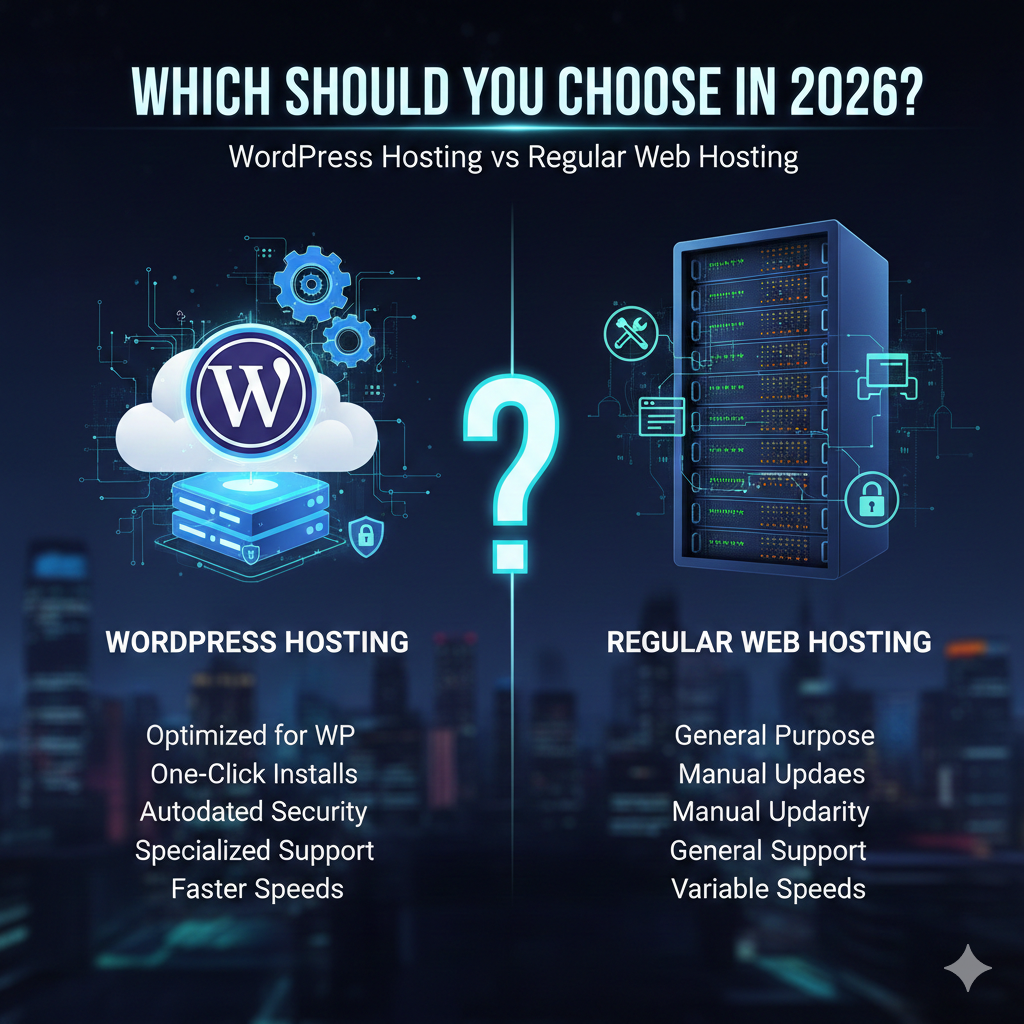
Pros & Cons Summary Table
Here is a quick reference to help you weigh your options.
| Feature | WordPress Hosting (Managed) | Regular Web Hosting (Shared) |
| Pros | • Optimized specifically for WordPress speed • Automatic updates and daily backups • Expert support for plugin/theme issues • Enterprise-grade security | • Most affordable option • Flexible (host non-WP sites) • Access to cPanel and email hosting • Good for low-traffic hobby sites |
| Cons | • Higher monthly cost • Restricted to WordPress only • Banned plugins (some hosts disallow certain plugins) | • Slower performance on average • You are responsible for updates & security • General support (not WP experts) • “Bad neighbor” effect on shared servers |
FAQs – WordPress Hosting vs Regular Web Hosting
Is WordPress hosting worth the extra cost?
For most businesses and serious bloggers, yes. The time you save on maintenance, security configuration, and troubleshooting is worth far more than the price difference. If your site generates income, the reliability of Managed WordPress hosting is an investment, not an expense.
Can I use WordPress on regular web hosting?
Absolutely. WordPress is free software that can be installed on almost any regular web host that supports PHP and MySQL. In fact, most regular hosts offer a “one-click install” for WordPress. The difference is that you will have to manage the optimization and maintenance yourself.
Which hosting is faster for WordPress websites?
Managed WordPress hosting is almost always faster. These environments use server-level caching and database optimizations that standard shared hosting lacks. While you can optimize a regular host to be fast, it requires technical skill and effort.
Do beginners need managed WordPress hosting?
Beginners benefit the most from managed hosting because it removes the technical barrier to entry. You don’t need to worry about security plugins, caching configurations, or backups—the host handles it all so you can focus on learning WordPress.
Can I switch from regular hosting to WordPress hosting later?
Yes. Most managed hosting companies offer free migration services. If you start on cheap regular hosting to save money and your site grows, you can easily move to a premium host later.
Which hosting is better for WooCommerce stores?
WooCommerce is resource-intensive. Regular shared hosting often struggles with the dynamic database requests required for a shopping cart. Managed WordPress hosting (specifically plans designed for WooCommerce) is highly recommended to ensure your checkout doesn’t crash during sales.
Does WordPress hosting improve SEO?
Indirectly, yes. Google favors fast-loading, secure, and always-online websites. Because managed WordPress hosts offer better speed (via caching/CDNs) and high uptime guarantees, your site has a better foundation to rank well compared to a slow, shared hosting environment.
Conclusion
The battle of WordPress hosting vs regular web hosting ultimately comes down to your budget and your technical comfort level.
If you are a developer or a hobbyist on a strict budget who enjoys tinkering with server settings, regular web hosting offers the flexibility and low cost you need.
However, if you are a business owner, a serious blogger, or an eCommerce merchant, your website is a tool, not a project. In 2026, the smart money is on managed WordPress hosting. The superior speed, tight security, and expert support allow you to stop worrying about the server and start focusing on growing your audience. Don’t let technical limitations hold your site back. Evaluate your goals, check your budget, and choose the host that gives you peace of mind.