The Best GDPR-Compliant CRM Hosting Providers for German and EU Enterprises
For enterprises operating within the European Union, and specifically in Germany, the selection of a Customer Relationship Management (CRM) system is no longer solely about features, sales pipelines, or customer engagement metrics. In 2026, the conversation is dominated by digital sovereignty, data residency, and rigorous adherence to the General Data Protection Regulation (GDPR).
With the European Data Protection Board (EDPB) imposing stricter fines and the landscape of international data transfers becoming increasingly complex, the hosting environment of your CRM is just as critical as the software itself. A CRM system holding the personal data of millions of customers is a high-value target for cyber threats and a focal point for regulatory audits.
This guide provides a comprehensive analysis of the best GDPR-compliant CRM hosting providers, the specific legal nuances for German enterprises, and the criteria CIOs must prioritize to ensure their infrastructure is future-proof.
Why GDPR Compliance Matters for CRM Hosting in 2026
The definition of “compliance” has evolved. Years ago, checking a box on a vendor assessment form was sufficient. Today, compliance is a dynamic operational requirement. For German and EU enterprises, the stakes involve massive financial penalties—up to €20 million or 4% of global turnover—and significant reputational damage.
CRM systems are unique because they aggregate Personally Identifiable Information (PII)—names, emails, buying habits, and interaction logs. If your hosting provider fails to secure this data, or if they transfer it to non-adequate jurisdictions without proper safeguards (like Standard Contractual Clauses or the Data Privacy Framework), your organization is liable as the Data Controller.
In the current regulatory climate, authorities are looking closely at the supply chain. If your CRM host (the Data Processor) cannot demonstrate airtight security and legal compliance, your enterprise is exposed to risk.
What Does GDPR Compliance Mean for CRM Hosting?
To select the right partner, IT leaders must understand how GDPR principles translate to hosting infrastructure.
The Processor-Controller Relationship
Under GDPR, your company is the Controller (you decide why and how data is processed), and your CRM hosting provider is the Processor (they process data on your behalf). This relationship must be governed by a robust Data Processing Agreement (DPA). A compliant host will have a pre-signed, comprehensive DPA that explicitly outlines their security measures and liability.
Core Principles in Infrastructure
- Data Minimization: The host should provide tools to archive or delete data that is no longer needed, supporting your retention policies.
- Storage Limitation: You must be able to completely erase data (the “Right to be Forgotten”) from production servers and backups within a reasonable timeframe.
- Accountability: The host must provide audit logs proving who accessed the physical servers and the digital environment.
Key GDPR Requirements for CRM Hosting
When evaluating a provider, “we are GDPR compliant” is a marketing slogan. You need to look for specific technical capabilities.
Data Residency within the EU
This is the gold standard for risk mitigation. The provider should guarantee that data rests in data centers located within the EU/EEA (e.g., Frankfurt, Dublin, Amsterdam, Paris). For German enterprises, a “German Cloud” option is often preferred to satisfy local interpretations of data sovereignty.
Granular Access Controls
The hosting environment must support Role-Based Access Control (RBAC). Not every database administrator at the hosting company should have access to your instance. You need transparency regarding privileged access management (PAM).
Encryption Standards
- At Rest: Data stored on disks must be encrypted (AES-256 is the standard).
- In Transit: Data moving between the user and the server must be encrypted via TLS 1.3.
- Pseudonymization: Advanced hosts offer features to pseudonymize data fields within the database, adding a layer of protection if a physical breach occurs.
Breach Notification Protocols
GDPR mandates that authorities be notified of a breach within 72 hours. Your hosting provider must have a Service Level Agreement (SLA) that commits to notifying you (the Controller) immediately upon detecting an incident, giving you time to report to regulators.
CRM Hosting Models & GDPR Responsibility
The level of control—and therefore the burden of security—shifts depending on the hosting model you choose.
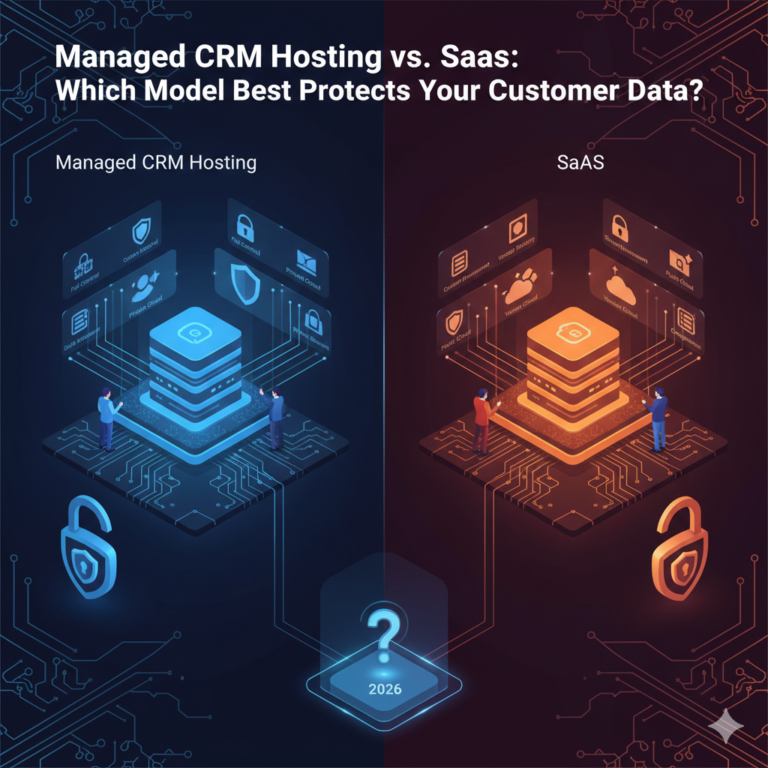
SaaS (Software as a Service)
In a pure SaaS model (e.g., Salesforce, HubSpot), the vendor manages the application, data, runtime, middleware, and OS.
- Pro: Lower maintenance overhead.
- GDPR Implication: You are heavily reliant on the vendor’s compliance posture. You cannot install your own security patches; you must trust theirs.
Managed Hosting / Private Cloud
You license the CRM software but host it in a private cloud environment managed by a third party (e.g., Microsoft Azure, AWS).
- Pro: Greater control over where data sits and network configurations.
- GDPR Implication: Shared responsibility. The host secures the physical infrastructure; you secure the application and endpoints.
Self-Hosted (On-Premises)
You host the CRM on your own servers.
- Pro: Total control. No data leaves your premises.
- GDPR Implication: You bear 100% of the responsibility for physical security, network security, and patching.
Selection Criteria for GDPR-Compliant CRM Hosting
CIOs and Compliance Officers should use this checklist when vetting providers:
- EU Data Centers: Does the provider offer a choice of regions? Can they contractually guarantee data will not be mirrored to the US or Asia for backup purposes without consent?
- Certifications: Look for ISO 27001 (Information Security Management), ISO 27018 (Protection of PII in the cloud), and SOC 2 Type II reports.
- Uptime & Support: A high uptime SLA (99.9%+) ensures availability, which is a component of GDPR security requirements. Support teams should ideally be located in the EU to avoid data access by support staff in non-compliant jurisdictions.
- Penetration Testing: Does the vendor perform regular third-party pen tests? Will they share the executive summary of these audits with you?
- Backup & Deletion: Can they restore data to a specific point in time? Do they have a clear policy for destroying hard drives at the end of their lifecycle?
Top GDPR-Compliant CRM Hosting Providers (2026)
Here is an analysis of the leading providers that cater to the strict compliance needs of the European market.
1. SAP CX (formerly C/4HANA)
Overview: As a German multinational, SAP is the benchmark for enterprise compliance. Their Customer Experience (CX) suite is designed with the most rigorous EU standards in mind.
Compliance Features: Native integration with SAP’s governance structures.
Data Centers: Extensive footprint in Germany (St. Leon-Rot) and across Europe.
Best For: Large enterprises requiring deep ERP integration and German data residency.
2. Microsoft Dynamics 365
Overview: Microsoft has invested billions in its “EU Data Boundary” initiative, allowing customers to keep all data—including telemetry and diagnostic data—within the EU.
Compliance Features: Granular security roles, comprehensive Compliance Manager dashboard.
Data Centers: Germany (Berlin/Frankfurt), France, Ireland, Netherlands.
Best For: Enterprises already invested in the Microsoft 365 ecosystem.
3. Salesforce (Hyperforce)
Overview: While US-based, Salesforce’s “Hyperforce” architecture allows customers to deploy their CRM on public cloud infrastructure (like AWS or Azure) in specific regions.
Compliance Features: Salesforce Shield offers platform encryption and event monitoring.
Data Centers: Frankfurt, Paris, Dublin, London.
Best For: Global enterprises needing a scalable, best-in-class SaaS solution.
4. HubSpot
Overview: HubSpot established an EU data center to address customer concerns. They have matured significantly in the enterprise space.
Compliance Features: GDPR toggle features, cookie consent management, data residency options.
Data Centers: Germany (AWS infrastructure).
Best For: Mid-market to Enterprise companies focused on inbound marketing and sales alignment.
5. SuperOffice
Overview: A Nordic-based CRM provider that prioritizes privacy by design.
Compliance Features: Built specifically for European privacy laws; excellent feature set for managing consent and subscriptions.
Data Centers: Hosted in Europe (Visma IT in Norway and globally via Azure in EU regions).
Best For: B2B companies in Northern Europe seeking a privacy-first alternative.
6. Pipedrive
Overview: Founded in Estonia (one of the most digitally advanced nations), Pipedrive is highly sensitive to GDPR.
Compliance Features: Security dashboard, transparency reports, and strict sub-processor management.
Data Centers: Frankfurt, Germany (AWS).
Best For: Sales-focused organizations and SMEs scaling up.
7. Creatio
Overview: A low-code platform for process management and CRM.
Compliance Features: Offers flexible deployment options, including on-premises and private cloud, giving customers full control over data location.
Data Centers: Frankfurt, London, Dublin.
Best For: Enterprises needing to automate complex business processes alongside CRM.
8. Zoho CRM
Overview: Zoho operates its own data centers, reducing reliance on public cloud providers. They have specific DCs dedicated to EU customers.
Compliance Features: GDPR compliance settings, data encryption, audit logs.
Data Centers: Amsterdam and Dublin.
Best For: Cost-conscious enterprises needing a wide suite of business apps.
9. SugarCRM
Overview: Known for flexibility, SugarCRM allows customers to choose between their cloud or an on-premises deployment.
Compliance Features: SugarIdentity for secure authentication; flexible hosting allows total data control.
Data Centers: Frankfurt, Dublin.
Best For: Organizations that may want to move between cloud and on-premise in the future.
10. Brevo (formerly Sendinblue)
Overview: Headquartered in Paris, Brevo started as marketing automation but has expanded into a full CRM suite.
Compliance Features: French jurisdiction ensures strict adherence to EU laws; servers are ISO 27001 certified.
Data Centers: France and Germany.
Best For: Marketing-heavy organizations and SMEs.
Comparison Table
| Provider | EU Data Centers (Primary) | ISO 27001 / SOC 2 | Deployment Models | Best For |
|---|---|---|---|---|
| SAP CX | Germany | Yes / Yes | Cloud / Hybrid | Large Enterprise / Manufacturing |
| Microsoft Dynamics | Germany, France, Ireland | Yes / Yes | SaaS / Private Cloud | Enterprise / Govt / Finance |
| Salesforce | Germany, France | Yes / Yes | SaaS (Hyperforce) | High-Growth Enterprise |
| HubSpot | Germany | Yes / Yes | SaaS | Scale-ups / Marketing-focus |
| SuperOffice | Norway, EU | Yes / Yes | SaaS / On-Prem | B2B / Privacy-Focus |
| Pipedrive | Germany | Yes / Yes | SaaS | Sales Teams |
| Creatio | Germany, UK | Yes / Yes | SaaS / Private / On-Prem | Process Automation |
| Zoho CRM | Netherlands, Ireland | Yes / Yes | SaaS | Cost-Efficiency |
| SugarCRM | Germany | Yes / Yes | SaaS / On-Prem | Flexibility / Developers |
| Brevo | France, Germany | Yes / Yes | SaaS | Marketing / SMB |
German Enterprise Focus: Special Considerations
Germany has historically had stricter data protection standards than the rest of the EU, dating back to the rigorous Bundesdatenschutzgesetz (BDSG). Even with GDPR harmonizing laws, the German supervisory authorities (Datenschutzbeauftragte) are notoriously active.
The “German Cloud” Preference
For industries like finance (BaFin regulated), healthcare, and insurance, hosting data physically within German borders is often a de facto requirement for risk management. Providers like SAP, Microsoft (via German regions), and T-Systems are often the default choices here because they offer the “Treuhand” (trustee) model or strictly localized guarantees.
Works Council (Betriebsrat) Involvement
In Germany, CRM implementations often require approval from the Works Council because CRMs can be used to monitor employee performance. A GDPR-compliant host must offer features that allow for anonymizing employee usage data to satisfy internal labor agreements.
Implementation & Migration Best Practices
Moving to a compliant host is the perfect time to clean house.
- Data Cleansing: Do not migrate non-compliant data. Delete old leads that haven’t consented to processing.
- DNS & SSL Setup: Ensure your custom domains for the CRM are secured with the latest TLS protocols.
- DPA Execution: Do not upload a single byte of data until the Data Processing Agreement is signed.
- Testing: Perform a “Data Subject Access Request” (DSAR) test. Can the new host quickly retrieve all data for a specific user?
Post-Deployment Compliance Monitoring
Compliance is not a one-time setup.
- Regular Audits: Schedule annual reviews of your host’s SOC 2 reports.
- Incident Response: Run tabletop exercises. If the host goes down or reports a breach, does your team know who to call?
- Log Monitoring: Ensure the host’s API logs are being fed into your SIEM (Security Information and Event Management) system for real-time threat detection.
FAQ
What makes CRM hosting GDPR-compliant?
It requires strict adherence to data protection principles, including encryption, access controls, data residency in approved jurisdictions, and a legal framework (DPA) defining the processor’s responsibilities.
Is cloud CRM hosting GDPR compliant?
Yes, provided the cloud provider implements necessary security measures and ensures data is stored within the EU or a country with an adequacy decision.
Do GDPR-compliant CRM hosts require EU data centers?
While not explicitly mandated by the text of GDPR if other safeguards are in place, having EU data centers is the most effective way to ensure compliance and avoid legal complexities regarding data transfers.
How do I verify CRM hosting provider GDPR compliance?
Review their Data Processing Agreement (DPA), request their ISO 27001 and SOC 2 Type II audit reports, and verify their data center locations.
What security certifications should a GDPR CRM host have?
At a minimum, ISO 27001 (Information Security) and ISO 27018 (Cloud Privacy). SOC 2 Type II is also a strong indicator of operational maturity.
Can US-based CRM hosts be GDPR compliant?
Yes, if they participate in the Data Privacy Framework (the successor to Privacy Shield) or use Standard Contractual Clauses (SCCs) and offer EU data residency options.
How does GDPR impact CRM data transfers outside the EU?
Transfers to non-adequate countries are restricted. They require strict legal mechanisms (like SCCs) and often a Transfer Impact Assessment (TIA) to ensure the data remains protected.
What is a Data Processing Agreement (DPA) and why it matters?
A DPA is a legally binding contract between you and the host. It mandates that the host will only process data on your instructions and maintains security standards. Without it, using the CRM is illegal under GDPR.
How often should CRM compliance be audited?
Internal audits should happen at least annually, or whenever there is a significant change in the software or data volume.
Is encryption required for GDPR-compliant CRM hosting?
GDPR calls for “appropriate technical and organizational measures,” citing encryption specifically as a method to mitigate risk. In practice, it is a requirement for any enterprise CRM.
Conclusion
Choosing a GDPR-compliant CRM hosting provider is one of the most significant strategic decisions for German and EU enterprises in 2026. The right partner protects you from regulatory wrath, builds trust with your customers, and provides a stable foundation for growth.
For large enterprises with complex needs, SAP CX and Microsoft Dynamics 365 offer the robust infrastructure required. For agile organizations and sales-focused teams, Pipedrive and HubSpot offer excellent compliance features without the heavy lifting of legacy systems.
Next Steps:
- Map your current data flows.
- Audit your existing DPA.
- Challenge your shortlist of providers to prove their data residency capabilities.
Compliance is a journey, not a destination. Choose a host that is ready to travel that road with you.