
Deploying High-Performance Apps in the U.S.: Inside OVHcloud Dedicated Servers
The U.S. digital market is a battleground of speed and reliability. For businesses running performance-critical applications—from real-time gaming to high-frequency trading—milliseconds matter. As user expectations for seamless digital experiences continue to climb toward 2026, relying on shared resources or standard cloud VMs often isn’t enough. When latency spikes or noisy neighbors on a public cloud interfere with your workload, your reputation and revenue are on the line.
High-performance hosting isn’t just a luxury; it’s an operational necessity. To achieve consistent, raw compute power, many organizations are turning back to the fundamentals: dedicated hardware. This article explores how OVHcloud dedicated servers provide the infrastructure backbone needed to deploy high-performance apps in the U.S., offering a deep dive into architecture, benchmarks, and real-world deployment strategies.
What Are Dedicated Servers and Why They Matter for Performance
In an era dominated by cloud buzzwords, the dedicated server remains the heavyweight champion of performance. Unlike virtual machines (VMs) where resources like CPU, RAM, and I/O are shared among multiple tenants, a dedicated server gives you exclusive access to the physical machine. This is “bare metal” architecture at its finest.
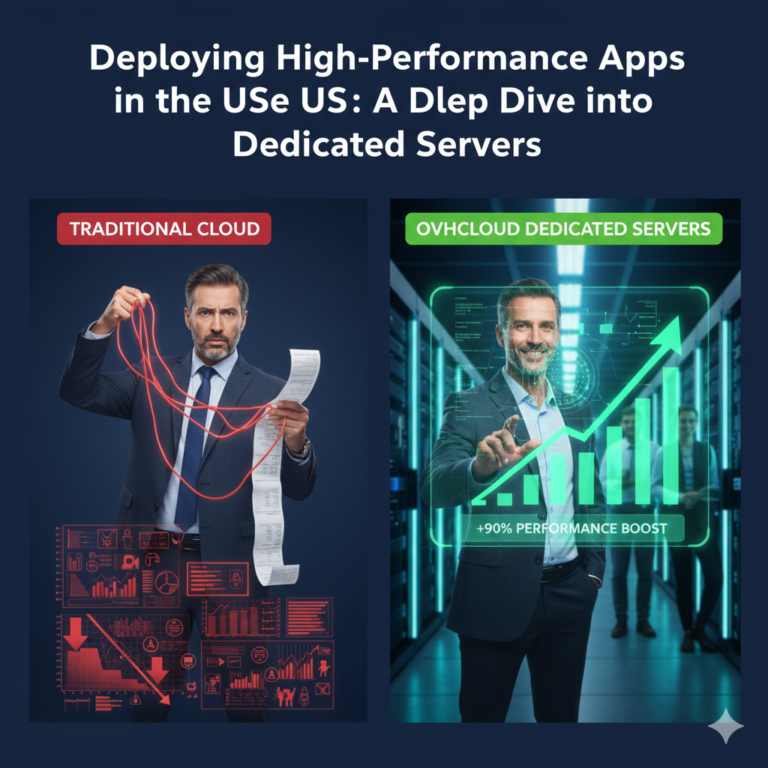
Full hardware control means no virtualization overhead. The hypervisor layer used in public clouds consumes a percentage of the machine’s resources to manage virtual instances. With bare metal servers for performance, your operating system interacts directly with the hardware. This direct line eliminates the “noisy neighbor” effect, ensuring that your application gets 100% of the processor cycles and memory bandwidth you pay for. For workloads that demand predictable, stable performance, dedicated server hosting offers an unrivaled advantage.
OVHcloud Dedicated Server Infrastructure Overview
OVHcloud has established itself as a global hyperscaler with a distinct approach to infrastructure. Central to their value proposition is a vertically integrated model where they build their own servers and manage their own fiber optic network.
For U.S. customers, OVHcloud USA data centers (located in Hillsboro, OR, and Vint Hill, VA) provide strategic geographic coverage on both the East and West coasts. This dual-coast presence allows businesses to deploy workloads closer to end-users, significantly reducing latency across the continent.
Their infrastructure is built on custom-built hardware. By designing server chassis and cooling systems in-house (notably their water-cooling technology), OVHcloud optimizes energy efficiency and performance density. This proprietary design connects directly to a massive global network backbone with over 30 Tbps of capacity, ensuring that OVHcloud dedicated servers can handle massive traffic surges without bottlenecking.
Hardware Configurations and Customization Options
One size rarely fits all in high-performance computing. OVHcloud offers a diverse range of configurations tailored to specific workload needs.
Processing Power
At the heart of high performance dedicated servers are the CPUs. OVHcloud partners with Intel and AMD to offer the latest generation processors. Whether you need high clock speeds for single-threaded applications (like gaming servers) or high core counts for virtualization and containerization (using AMD EPYC processors), there is a SKU to match.
Memory and Storage
RAM options range from standard 32GB modules up to massive 1TB+ configurations for in-memory database processing. Storage is equally critical. To eliminate I/O bottlenecks, servers can be equipped with enterprise-grade NVMe drives. NVMe storage offers significantly higher read/write speeds compared to standard SSDs or SATA drives, making it essential for data-intensive applications.
GPU Acceleration
For AI training, rendering, or complex transcoding, GPU dedicated servers are available. These machines integrate powerful NVIDIA GPUs, offloading heavy computational tasks from the CPU to accelerate processing times dramatically.
Network Performance and Bandwidth Capabilities
Raw compute power is useless if you can’t deliver data to your users quickly. Fast dedicated server hosting depends heavily on network quality. OVHcloud distinguishes itself with unmetered bandwidth on many of its ranges, a rarity in the U.S. market where egress fees are standard.
The network architecture is designed for low latency. By peering with major ISPs and internet exchanges across North America, OVHcloud ensures that data takes the shortest path to the user. This is critical for low latency hosting USA requirements, specifically for applications like VoIP or multiplayer gaming where lag is noticeable.
Furthermore, every server comes with built-in Anti-DDoS protection. This isn’t just a standard firewall; it’s a specialized vacuuming and mitigation infrastructure that detects and scrubs malicious traffic instantly, ensuring legitimate traffic keeps flowing even during an attack.
Performance Benchmarks and Real-World Results
Marketing claims are one thing; numbers are another. When conducting OVHcloud performance benchmarks, the results consistently highlight the benefits of bare metal.
CPU and Processing
In standard Geekbench and Cinebench tests, bare metal servers typically outperform virtualized equivalents by 10-15% due to the lack of hypervisor overhead. For computationally heavy tasks, this difference translates to faster completion times for batch jobs and rendering.
Disk I/O
Testing dedicated server speed test metrics on NVMe drives reveals staggering throughput. Sequential read/write speeds often exceed 3000 MB/s, vastly superior to network-attached storage (NAS) or standard cloud block storage, which is often throttled based on volume size or IOPS limits.
Network Stability
iperf3 tests conducted between U.S. data centers and residential ISPs show consistent throughput near the advertised port speeds (often 1Gbps to 10Gbps public bandwidth). This stability is crucial for maintaining application responsiveness under load.
Deployment Architecture for High-Performance Applications
To fully leverage dedicated server architecture, you need a smart deployment strategy. You rarely run a mission-critical app on a single box.
Load Balancing:
Distribute incoming traffic across multiple dedicated servers using the OVHcloud Load Balancer. This ensures no single server is overwhelmed and provides redundancy if one node fails.
Containerization:
While bare metal provides the power, containers provide the agility. Many architects deploy Kubernetes clusters directly on bare metal (using tools like Rancher or OpenShift) to deploy high performance applications. This setup gives you the raw speed of the hardware with the orchestration benefits of the cloud.
Scaling Strategy:
Horizontal scaling (adding more servers) is seamless with OVHcloud’s vRack technology. vRack allows you to connect servers across different data centers into a single private VLAN. You can securely communicate between your database server on the East Coast and your app server on the West Coast without traversing the public internet.
Security, Compliance, and Reliability
Security is paramount for enterprise deployments. Secure dedicated hosting on OVHcloud starts at the physical layer. Their data centers maintain strict access controls and compliance certifications (like ISO 27001, SOC 2 Type II, and HIPAA compliance readiness), making them suitable for sensitive industries.
Enterprise server security is bolstered by the default Anti-DDoS protection mentioned earlier. For data integrity, backup strategies are flexible. You can utilize 500GB of free backup storage included with most dedicated servers or configure automated backups to an S3-compatible Object Storage bucket within the same ecosystem.
Monitoring is also simplified. Through the OVHcloud control panel or API, you can track hardware health, bandwidth usage, and set up alerts for anomalies, ensuring high availability and reliability.
Cost Efficiency Compared to Hyperscalers
One of the most compelling arguments for OVHcloud is the OVHcloud pricing model. Major public cloud providers (hyperscalers) typically charge for compute time, storage usage, and notoriously, network egress (data leaving the cloud). These costs can be unpredictable and scale linearly with your success.
OVHcloud offers a transparent, flat-pricing model for dedicated servers. You pay a monthly fee for the hardware, and in most cases, bandwidth is unmetered.
TCO Analysis:
When comparing cheap dedicated servers USA options against cloud instances, the Total Cost of Ownership (TCO) often favors dedicated servers for steady-state workloads. If your application runs 24/7 and consumes significant bandwidth, an OVHcloud dedicated server can be 30-50% cheaper than a comparable EC2 or Azure instance once egress fees are factored in.
Use Cases That Benefit Most from OVHcloud Dedicated Servers
Certain workloads thrive on bare metal. Here are the prime candidates for high performance hosting workloads:
SaaS Providers
Best hosting for SaaS applications often involves a predictable cost structure and high reliability. Dedicated servers provide the stable environment needed to host multi-tenant databases and application layers without performance jitter.
Gaming
Game servers require high clock speeds and ultra-low latency. The specialized “Game” range from OVHcloud is specifically tuned for this, featuring overclocked processors to handle the physics and logic of modern multiplayer games.
Media Streaming
Transcoding and delivering video requires massive CPU power and bandwidth. Unmetered bandwidth makes OVHcloud an ideal choice for streaming platforms that would otherwise be crushed by egress fees.
AI and Big Data
Training machine learning models requires the parallel processing power of GPUs. Dedicated servers allow data scientists to run training jobs for days without worrying about hourly usage spikes.
How to Deploy on OVHcloud Dedicated Servers (Step-by-Step)
Ready to get started? Here is a high-level guide to deploy OVHcloud server infrastructure.
- Provisioning: Log in to the OVHcloud control panel. Select your desired data center (e.g., Vint Hill or Hillsboro) and server configuration. The automated delivery system usually provisions the server in under 120 seconds.
- OS Installation: Once delivered, use the control panel to install your operating system. OVHcloud provides templates for popular distributions like Ubuntu, CentOS, Debian, and Windows Server. You can also upload a custom ISO.
- Network Setup: Configure your public IPs. If you are building a cluster, set up the vRack private network to enable secure communication between your servers.
- Security Hardening: Change default SSH ports, configure
iptablesorufwfirewalls, and set up your SSH keys for secure access. - Application Deployment: SSH into your server and begin installing your application stack (e.g., Docker, Nginx, Database).
This streamlined process makes it easy to setup dedicated server environments that are production-ready in minutes, not days.
When to Choose Dedicated Servers vs Cloud VMs
The choice depends on your priorities.
Choose Dedicated Servers if:
- You need maximum raw performance and IOPS.
- You have a predictable, steady-state workload.
- You want to avoid the “noisy neighbor” effect.
- You need to control costs by avoiding bandwidth egress fees.
Choose Cloud VMs if:
- Your workload is highly variable and bursty (needing auto-scaling).
- You need to spin up resources for only a few hours.
- You prefer managed services (like RDS or managed Kubernetes) over managing the OS yourself.
FAQ – OVHcloud Dedicated Servers
Q1: Are OVHcloud dedicated servers fast enough for production workloads?
Yes. With the latest Intel and AMD processors and NVMe storage, they offer bare-metal performance that typically exceeds virtualized cloud instances, making them ideal for production.
Q2: Does OVHcloud have U.S. data centers?
Yes, OVHcloud operates data centers in Vint Hill, Virginia (East Coast) and Hillsboro, Oregon (West Coast) to provide nationwide coverage.
Q3: How much does an OVHcloud dedicated server cost?
Pricing varies by configuration, but entry-level servers can start around $60-$80/month, with high-end enterprise machines ranging from $200 to over $500/month. The key advantage is the flat monthly rate.
Q4: Can I scale dedicated servers easily?
While you cannot “resize” a physical server like a VM, you can easily scale horizontally by adding more servers to your cluster and connecting them via vRack.
Q5: Are OVHcloud servers secure and DDoS protected?
Absolutely. Every dedicated server includes standard Anti-DDoS protection at no extra cost, protecting your infrastructure from varied attack vectors.
Q6: Which applications need dedicated servers instead of cloud VMs?
Applications such as high-traffic databases, game servers, big data analytics, AI training, and media rendering farms benefit most from the dedicated resources of bare metal.
Conclusion
Deploying high-performance applications in the U.S. market demands an infrastructure that is robust, fast, and cost-effective. While the public cloud offers flexibility, it often comes at the cost of performance consistency and budget predictability.
OVHcloud dedicated servers offer a powerful alternative. By combining cutting-edge hardware, a massive global network, and U.S.-based data centers, they provide the foundation needed for speed and reliability. Whether you are running a SaaS platform, a gaming studio, or a data-intensive enterprise app, bare metal gives you the control you need to succeed.
Don’t let virtualization overhead slow you down. If your workload demands uncompromising speed and stability, it is time to evaluate your infrastructure strategy.
Ready to experience the power of bare metal? Explore the full range of OVHcloud dedicated servers and start deploying your high-performance environment today.