
Is OVHcloud the Most Cost-Effective Cloud Alternative to Big Tech in 2026?
Cloud computing bills have become one of the largest line items for digital businesses. As we move further into 2026, the era of “growth at all costs” has firmly shifted to “efficiency at all costs.” For years, the default strategy for startups and enterprises alike was to sign up with the “Big Three”—Amazon Web Services (AWS), Microsoft Azure, or Google Cloud Platform (GCP).
However, as infrastructure bills climb and complex pricing structures eat into margins, organizations are increasingly exploring alternatives. The hyperscalers offer incredible power, but that power comes with a premium price tag that often includes egress fees, support costs, and confusing billing tiers.
This shift in the market has brought providers like OVHcloud into the spotlight. Known for its distinct approach to pricing and infrastructure, OVHcloud presents itself as a robust, cost-effective alternative. But does the math actually work out? This article breaks down the total cost of ownership, performance trade-offs, and pricing models to determine if OVHcloud is truly the best financial choice for your business this year.
What Does “Cost-Effective Cloud” Really Mean?
When businesses look for cost effective cloud hosting, they often make the mistake of looking only at the hourly rate of a virtual machine (VM). While the sticker price of a server is important, it is rarely the number that causes CFOs to panic at the end of the month.
To truly understand value, you must look at the cloud total cost of ownership (TCO). TCO includes every variable that contributes to your final bill, as well as the operational overhead required to manage it.
Total Cost of Ownership
TCO isn’t just compute power. It includes storage costs (block and object), networking costs (load balancers and public IPs), and the often-overlooked cost of data movement. A provider might offer a cheap CPU hourly rate but charge an exorbitant amount to move data in and out of that server.
Hidden Fees and Predictability
The biggest enemy of a cost-effective strategy is unpredictability. If a sudden spike in traffic leads to a 300% increase in your bill due to unmetered bandwidth charges, the solution is not cost-effective. True value comes from pricing transparency—knowing exactly what you will pay at the end of the month, regardless of whether your site goes viral or you run a massive data backup.
Why Big Tech Cloud Pricing Is Getting Expensive
The major hyperscalers offer technological marvels, but their pricing models have become increasingly difficult to navigate. Several factors are driving the sentiment that AWS pricing complexity and Azure costs are becoming unsustainable for mid-sized workloads.
The Problem with Egress Fees
For many businesses, egress fees (data transfer out) are the primary driver of cloud cost overruns. Most Big Tech providers charge a fee for every gigabyte of data that leaves their data center. If you run a media streaming service, a SaaS platform with high user interaction, or a data-heavy application, these fees can sometimes exceed the cost of the servers themselves.
Complex Billing and Vendor Lock-In
The complexity of billing is a feature, not a bug. With thousands of SKUs and pricing tiers that change based on region, reserved instance commitments, and spot availability, optimizing costs on Big Tech platforms often requires hiring a dedicated FinOps team. Furthermore, proprietary services (like specific database engines or serverless functions) create vendor lock-in, making it technically difficult and financially punitive to leave once you realize the costs are too high.
OVHcloud Overview and Pricing Model
OVHcloud operates differently than its US-based competitors. As a European leader with a massive global footprint, they have historically focused on bare metal and standardized cloud instances with a simplified pricing structure.
Flat Pricing and Predictability
The core of the OVHcloud pricing strategy is predictability. Unlike the pay-per-second fluctuations common elsewhere, many OVHcloud instances are billed on a monthly basis or a predictable hourly rate that doesn’t spike unexpectedly. This allows growing businesses to forecast their runway with much higher accuracy.
Included Bandwidth
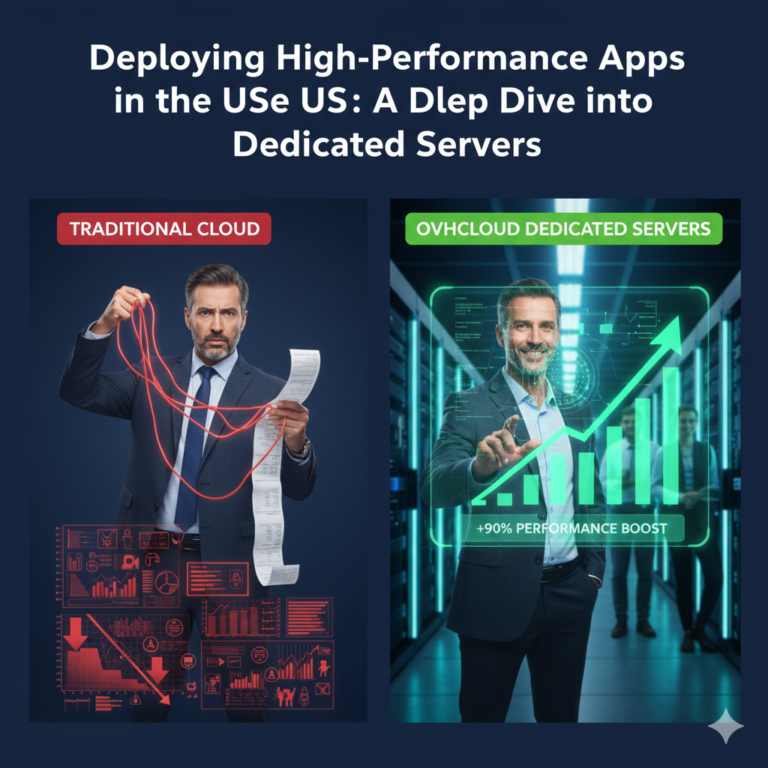
Perhaps the most significant differentiator is bandwidth. For the vast majority of their cloud and bare metal server ranges, OVHcloud includes unmetered public bandwidth. This eliminates the “egress tax” that plagues users of other platforms. For a company pushing terabytes of traffic, this single feature can reduce the monthly infrastructure bill by 30% to 50% immediately.
Global Infrastructure
OVHcloud hosting isn’t a budget option that relies on a single data center. They operate dozens of data centers across four continents. They manufacture their own servers and use proprietary water-cooling technology, which lowers their energy costs—savings they pass on to the customer in the form of lower competitive pricing.
OVHcloud vs AWS vs Azure vs Google Cloud (Cost Comparison)
When performing a cloud pricing comparison, it helps to break it down by resource type. While exact prices fluctuate, the structural differences in 2026 remain consistent.
Compute Pricing
In a head-to-head comparison of general-purpose instances (e.g., 4 vCPUs, 16GB RAM), OVHcloud consistently undercuts the on-demand pricing of the Big Three.
- Big Tech: Often requires a 1-year or 3-year upfront commitment (Reserved Instances) to get a competitive rate.
- OVHcloud: Offers prices similar to or lower than Big Tech’s “reserved” rates, but without requiring the long-term contract lock-in.
Bandwidth and Data Transfer
This is where the OVHcloud vs AWS pricing battle is decided.
- Big Tech: You typically pay per GB after the first 100GB. For high-traffic applications, this scales indefinitely.
- OVHcloud: Usually offers unlimited traffic on public bandwidth (with some bandwidth speed caps depending on the tier, but no per-GB volume charge).
Storage Costs
Object storage and block storage on OVHcloud are generally priced lower per GB than the standard tiers of US competitors. Furthermore, API call charges (requests made to storage) are often simpler or included, whereas high-frequency access on other platforms can generate surprising costs.
Performance and Reliability Comparison
A low price is useless if the server is offline. Can OVHcloud performance match the giants?
Network Throughput and Latency
Because OVHcloud manages its own global fiber optic network, they offer impressive speeds. For users targeting specific regions (especially Europe and North America), latency is comparable to any top-tier provider. The dedicated bandwidth guarantees on their higher-tier instances ensure that “noisy neighbors” don’t eat up your network speed.
Uptime
OVHcloud offers Service Level Agreements (SLAs) competitive with the industry standard, typically ranging from 99.9% to 99.99% depending on the service. While Big Tech may offer slightly more redundancy options for “five nines” availability (99.999%) through complex multi-region setups, OVHcloud’s reliability is more than sufficient for standard production workloads and fast cloud hosting requirements.
Scalability and Flexibility for Growing Businesses
One concern startups have is whether a scalable cloud hosting provider like OVHcloud can handle rapid growth.
Resource Scaling
OVHcloud offers Public Cloud instances based on OpenStack. This means you can scale compute and storage resources up or down instantly via API or control panel, just as you would with AWS EC2. You are not stuck with a static server; you have the flexibility to react to demand.
Automation and Infrastructure as Code
For DevOps teams, cloud infrastructure growth requires automation. Because OVHcloud’s Public Cloud is built on standard open-source technologies, it integrates seamlessly with industry-standard tools like Terraform and Ansible. You can manage your OVHcloud infrastructure using code, ensuring that your switch to a cost-effective provider doesn’t force you to abandon modern deployment practices.
Security, Compliance, and Data Privacy
In 2026, data sovereignty is a massive boardroom topic.
GDPR and Data Sovereignty
As a European-headquartered company, OVHcloud has privacy in its DNA. It is a GDPR compliant cloud by default, not as an afterthought. For businesses operating in Europe or handling the data of EU citizens, OVHcloud offers a distinct advantage: they are not subject to the US CLOUD Act in the same way US providers are. This makes them a top choice for legal and healthcare entities prioritizing data privacy.
Certifications
OVHcloud maintains a robust list of certifications, including ISO/IEC 27001, SOC 1 and 2 Type II, and PCI DSS compliance for specific environments. This ensures that secure cloud hosting is accessible even at a lower price point.
Hidden Costs and Trade-Offs to Consider
To provide a balanced view, we must acknowledge where OVHcloud might lag behind the hyperscalers.
Ecosystem Limitations
AWS and Azure have thousands of managed services—from advanced machine learning APIs to niche IoT tools. OVHcloud focuses on Infrastructure-as-a-Service (IaaS) and Platform-as-a-Service (PaaS) basics (Kubernetes, Databases). If your application relies heavily on proprietary, managed AI tools specific to AWS, migrating to OVHcloud will require re-engineering.
Support Tiers
While OVHcloud support has improved, the “white glove” enterprise support service from AWS or Azure is more mature. OVHcloud relies more heavily on self-service and community documentation for their lower-tier plans. You pay less, but you are expected to know how to manage your Linux environment.
Who Should Choose OVHcloud in 2026?
Based on the pricing and performance analysis, three distinct groups stand to gain the most.
Startups and Scale-ups
For bootstrapped or Series A companies, runway is everything. Being the best cloud hosting for startups often means finding a provider that doesn’t penalize growth. OVHcloud allows startups to burn cash on product development rather than cloud bills.
SaaS Companies
SaaS platforms often have high egress requirements due to user interactions and data delivery. The bandwidth savings alone make OVHcloud a compelling cheap cloud provider USA alternative for software companies.
Media and Streaming Workloads
Any business delivering video, audio, or large files will find the bandwidth costs of Big Tech prohibitive. OVHcloud’s unmetered pipes make it the logical home for media-heavy workloads.
How to Estimate Your Cloud Savings with OVHcloud
Ready to see the numbers? Here is how to reduce cloud costs practically.
- Audit Your Egress: Look at your current cloud bill. How much are you paying for “Data Transfer Out”? Write that number down. On OVHcloud, that number likely drops to zero.
- Compare Compute Tiers: Match your current instance (e.g., m5.large) with the equivalent OVHcloud Public Cloud instance. Note the hourly difference.
- Use a Cloud Cost Calculator: Input your requirements into an online cloud cost calculator specific to OVHcloud to see the projected monthly total.
- Migration Planning: Factor in the one-time cost of migration engineering. Even with that cost, the ROI timeline is often less than six months.
FAQ – OVHcloud Cost Comparison (High-Intent SEO)
Q1: Is OVHcloud cheaper than AWS?
In almost all scenarios involving general compute and high bandwidth usage, yes. OVHcloud’s compute instances are typically priced lower than AWS on-demand rates, and the inclusion of unmetered bandwidth can result in total monthly bills that are 30-50% lower than AWS for traffic-heavy applications.
Q2: Does OVHcloud charge egress fees?
For the majority of their Public Cloud and Dedicated Server products, OVHcloud does not charge for egress (outgoing data transfer). This is a major contrast to AWS, Azure, and Google Cloud, which charge per GB after a small free allowance.
Q3: Is OVHcloud reliable for production workloads?
Yes. OVHcloud manages a global network of data centers with robust SLAs. They are widely used by large enterprises, SaaS platforms, and retailers for critical production workloads. Their infrastructure includes anti-DDoS protection standard with all servers.
Q4: Can startups easily migrate from AWS to OVHcloud?
If your architecture is built on standard open-source technologies (Linux, Kubernetes, MySQL/PostgreSQL, Docker), migration is relatively straightforward. However, if you are heavily reliant on proprietary AWS tools (like DynamoDB or AWS Lambda), you will need to refactor your application to use open standards before migrating.
Q5: Which cloud provider is best for budget-conscious teams?
OVHcloud is widely considered one of the best options for budget-conscious teams due to its transparent pricing model, lack of hidden fees, and predictable monthly billing caps.
Q6: What are the hidden costs of cloud hosting?
Common hidden costs include data egress fees, API request charges for storage, premium support contracts, and costs associated with unattached IP addresses or load balancers. OVHcloud minimizes these by bundling many features into the base price.
Making the Switch in 2026
The cloud landscape in 2026 demands that businesses be smarter with their capital. While Big Tech clouds offer an endless buffet of services, many businesses are realizing they are paying for a buffet when all they really need is a solid, reliable meal.
OVHcloud offers a compelling alternative: powerful infrastructure, transparent pricing, and freedom from the egress fees that drain budgets. If your goal is to maximize performance while minimizing overhead, it’s time to stop paying the hyperscaler premium.
Don’t just guess how much you could save. Take a closer look at your current invoice, identify your bandwidth costs, and compare them against the flat-rate structure of OVHcloud. Your bottom line will thank you.