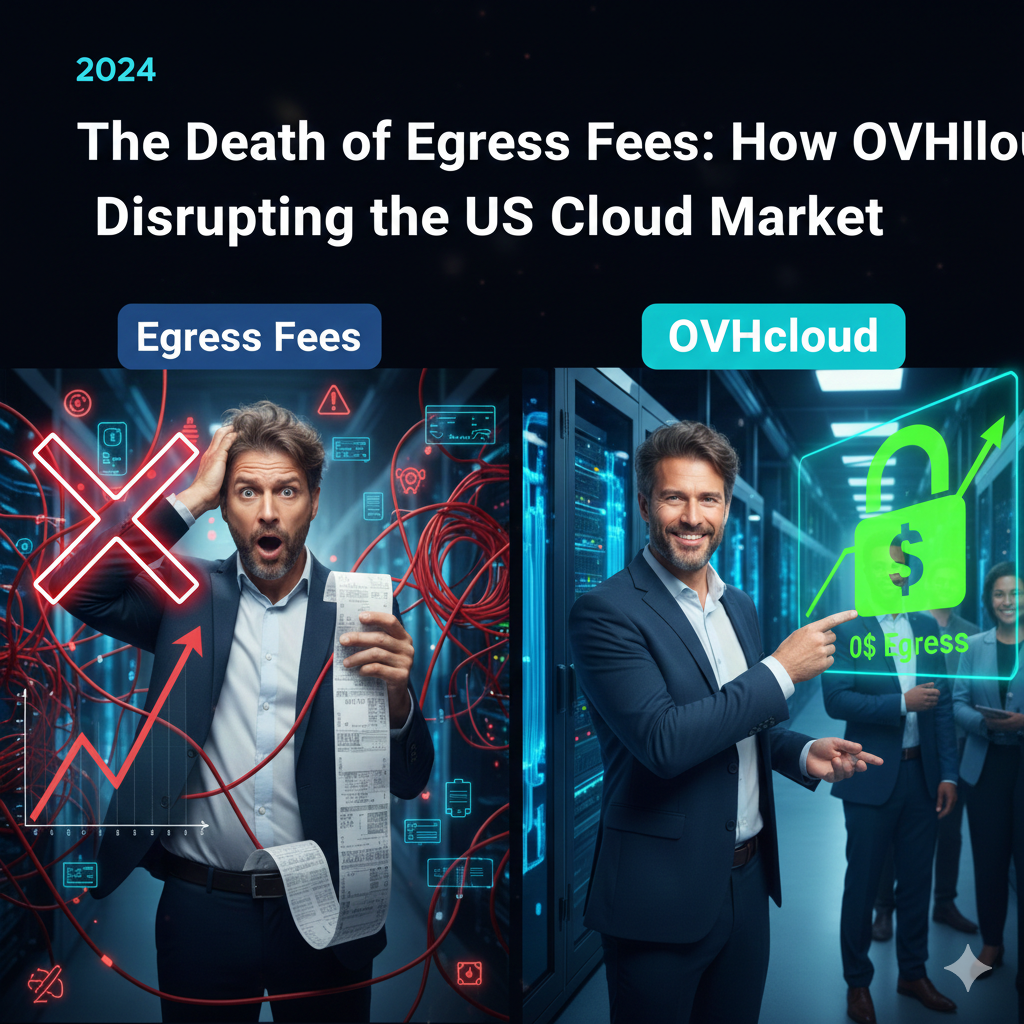
The End of Egress Fees: How OVHcloud Is Disrupting the U.S. Cloud Market
For many businesses moving to the cloud, the initial pitch is intoxicating. Scalability, flexibility, and the promise of pay-as-you-go pricing seem like the perfect recipe for modern infrastructure. But then the first bill arrives. Buried beneath the expected compute and storage charges is a line item that often catches finance teams off guard: data transfer fees.
These fees, known as egress fees, have become a notorious pain point for organizations relying on major cloud providers. As data consumption grows—driven by streaming, SaaS applications, and big data analytics—so does the cost of moving that data out of the cloud. For some, bandwidth costs can rival the price of the servers themselves.
This pricing model has long been accepted as the status quo, but the landscape is shifting. Providers like OVHcloud are challenging the industry standard by offering a different approach: included bandwidth and zero egress fees. This article explores why egress fees exist, how they impact your bottom line, and how OVHcloud’s disruption of the U.S. market offers a path toward predictable cloud pricing and significant cost savings.
What Are Egress Fees in Cloud Computing?
To understand the disruption, we first need to define the problem. What are egress fees? In simple terms, they are charges applied when data leaves a cloud provider’s network. While most providers allow you to upload data (ingress) for free, they charge you when that data is downloaded or transferred to the internet or another region.
Cloud bandwidth costs are typically calculated based on the volume of data transferred, usually measured in gigabytes (GB) or terabytes (TB). The more successful your application becomes—meaning more users are accessing your content or downloading your data—the more you pay. This essentially acts as a tax on success, punishing businesses for growth.
Why Egress Fees Drive Cloud Bill Shock
The unpredictability of egress fees is a major driver of “cloud bill shock.” Unlike fixed costs such as reserved instances or storage blocks, bandwidth usage fluctuates. A viral marketing campaign, a sudden spike in user activity, or a software update can cause data transfer numbers to skyrocket overnight.
For streaming platforms and SaaS workloads, where data is constantly flowing out to end-users, these unexpected cloud costs can be devastating. A video streaming startup, for instance, might budget for storage and compute but fail to anticipate the massive cost of serving high-definition video to thousands of concurrent viewers. This volatility makes financial forecasting a nightmare for CTOs and CFOs who value stability.
How Major Cloud Providers Charge for Egress
The “Big Three” hyperscalers—AWS, Azure, and Google Cloud—all operate on similar bandwidth billing models. While their specific rates vary by region and volume, the core mechanic remains the same: you pay for what goes out.
- AWS Egress Fees: AWS charges for data transfer out to the internet, typically starting after the first 100GB per month. Rates vary depending on the region, but for high-volume users, these costs add up quickly.
- Azure: Microsoft Azure follows a similar tiered structure, charging for outbound data transfer based on zones and volume.
- Google Cloud: Google also charges for network egress, with pricing that differs based on whether the traffic is destined for the internet or other Google Cloud services.
When you conduct a cloud pricing comparison, it becomes clear that while compute instances might be competitively priced across providers, bandwidth is often where the hidden margins lie. For data-intensive applications, this component of the bill can become the largest single expense.
What Makes OVHcloud Different
Enter OVHcloud. Unlike its hyperscale competitors, OVHcloud has built its value proposition around transparency and predictability. The key differentiator? A business model that largely eliminates the concept of egress fees for the vast majority of its customers.
OVHcloud pricing is designed to be simple. For most dedicated servers and cloud instances, unmetered bandwidth is included in the monthly price. This means a business can push terabytes or even petabytes of data without triggering a variable surcharge.
This “no egress fees cloud” approach is a radical departure from the industry norm. It shifts the risk of bandwidth fluctuation away from the customer and back to the provider. By owning its own global fiber-optic network, OVHcloud can manage bandwidth costs internally rather than passing high markups on to the user.
How OVHcloud’s No-Egress Model Saves Businesses Money
The impact of removing egress fees goes beyond just a cheaper bill; it changes how businesses operate. When you reduce cloud costs by eliminating variable bandwidth charges, you gain financial certainty.
Real Cost Examples
Consider a media company distributing 50TB of content per month. On a hyperscaler, the egress fees alone could amount to thousands of dollars monthly, fluctuating wildly based on viewership. With OVHcloud, that cost is effectively zero, included in the base price of the server.
Predictable Monthly Spend
For finance teams, this predictability is invaluable. Budgeting becomes a straightforward exercise when you know exactly what your infrastructure will cost, regardless of traffic spikes. This allows businesses to reinvest those savings into R&D, marketing, or hiring, rather than keeping a slush fund for unexpected bandwidth overages. Cheap cloud hosting doesn’t have to mean low quality; in this context, it means efficient, transparent pricing.
Impact on U.S. Startups and SaaS Companies
For startups and scaling SaaS companies, cash flow is oxygen. Every dollar spent on infrastructure is a dollar not spent on product development or customer acquisition. The best cloud hosting for startups is one that scales without penalty.
OVHcloud’s model offers a distinct advantage here. Startups often operate on thin margins while chasing aggressive growth. If a SaaS platform suddenly gains traction, the last thing the founders need is a punitive bill for serving their new customers. By using cloud hosting for SaaS that includes bandwidth, these companies can protect their profit margins. They can scale their user base freely, knowing that their infrastructure costs will grow linearly with server capacity, not exponentially with data usage.
Performance and Reliability Without Bandwidth Penalties
skeptics might ask: “If the bandwidth is free, is it slow?” The answer lies in infrastructure ownership. OVHcloud owns a massive global network with dozens of points of presence (PoPs) worldwide.
This control allows for high network throughput and low latency. Because they aren’t renting fiber from third-party carriers in the same way some virtual private server (VPS) providers do, they can guarantee performance.
Fast cloud hosting isn’t just about CPU cycles; it’s about how quickly you can deliver data to your users. OVHcloud performance benchmarks often show competitive, if not superior, speeds for public cloud and dedicated server workloads, proving that you don’t need to pay a premium for reliable connectivity.
OVHcloud vs AWS: Egress Cost Comparison
Let’s put this into perspective with a hypothetical scenario. Imagine a business transferring 10TB of data per month to the internet from servers located in the U.S. East region.
- Hyperscaler Scenario: On a major platform like AWS, after the free tier allowance, you are paying per GB. At standard rates (often around $0.09 per GB for the first 10TB), this could result in a monthly bill of approximately $900 just for bandwidth.
- OVHcloud Scenario: With a comparable instance on OVHcloud, that 10TB of transfer is included. The cost for egress is $0.
Savings Estimate: That is a savings of nearly $11,000 per year, purely by avoiding AWS bandwidth fees.
When you scale this up to 100TB or 1PB, the discrepancy becomes astronomical. This OVHcloud vs AWS pricing gap is the primary reason why data-heavy industries are beginning to migrate workloads away from the Big Three.
Is No-Egress Cloud Right for Every Business?
While the benefits are compelling, is a no-egress cloud provider the right choice for everyone?
Who Benefits Most:
- Streaming Services: Video and audio platforms where outbound traffic is the core product.
- Big Data & Analytics: Companies that process large datasets and need to move results to clients or other systems.
- Content Delivery: Websites with heavy image or file assets.
- Gaming Servers: Multiplayer games requiring constant data synchronization with players.
Possible Trade-offs:
For organizations deeply retrenched in proprietary ecosystems (using AWS Lambda, DynamoDB, or Google’s specialized AI tools), moving entirely to a new provider might be complex. The trade-off is often between the convenience of managed proprietary services versus the raw cost efficiency of infrastructure. However, many businesses are adopting a multi-cloud strategy—keeping core logic on a hyperscaler while offloading bandwidth-heavy workloads to OVHcloud to optimize costs.
How to Switch to a No-Egress Cloud Provider
Migrating to a provider like OVHcloud requires planning, but the long-term ROI makes it a worthy investment.
- Audit Your Traffic: Start by analyzing your current bill. How much are you actually spending on data transfer? Identify which applications are the heaviest offenders.
- Cost Forecasting: Use the pricing calculators provided by OVHcloud to estimate your new monthly spend. Compare this against your current average to build a business case.
- Migration Planning: Develop a cloud migration strategy. You don’t have to move everything at once. Start by moving static assets, backups, or non-critical, bandwidth-heavy workloads.
- Test Performance: Spin up instances and benchmark network performance to ensure it meets your latency requirements.
By taking these steps to migrate to OVHcloud, you can systematically dismantle the barriers that egress fees have placed on your growth.
FAQ – Egress Fees & OVHcloud
Q1: What are egress fees in cloud computing?
Egress fees are charges billed by cloud providers when data is transferred out of their network to the internet or another region. They are usually calculated on a per-GB basis.
Q2: Does OVHcloud really have no egress fees?
Yes, for the majority of its dedicated servers, VPS, and Public Cloud instances, OVHcloud includes unmetered bandwidth, meaning you do not pay extra for data transfer out.
Q3: How much can businesses save on bandwidth costs?
Savings depend on volume, but businesses with high data transfer needs (TB/month) can often save thousands of dollars monthly compared to hyperscale providers.
Q4: Why does AWS charge for data egress?
AWS and other major providers charge for egress to cover infrastructure costs and bandwidth capacity, but it also serves as a lock-in mechanism, making it expensive to leave their ecosystem.
Q5: Is OVHcloud reliable for high-traffic workloads?
Absolutely. OVHcloud operates its own global fiber-optic network with terabits of capacity, ensuring high availability and speed even for demanding workloads.
Q6: Which cloud provider is cheapest for data transfer?
Among major reputable providers, OVHcloud is consistently one of the cheapest for data transfer due to its inclusive bandwidth model, often beating AWS, Azure, and Google Cloud significantly.
Breaking Free from the Bandwidth Tax
The era of accepting high egress fees as a necessary evil is coming to an end. As businesses scrutinize their IT budgets and look for ways to optimize cloud spend, the model championed by providers like OVHcloud is proving that high performance and low costs can coexist.
Disruption in the U.S. cloud market is not just about cheaper servers; it’s about fair pricing structures that allow companies to grow without penalty. Whether you are a startup looking to extend your runway or an enterprise seeking to cut waste, reevaluating your bandwidth strategy is a crucial step.
Don’t let egress fees hold your data hostage. Evaluate your current cloud spend, calculate your potential savings, and explore how a no-egress model can unlock your business’s true potential.