How Secure Is Rackspace Email? Full Security Breakdown for Businesses
Email remains the primary communication channel for practically every business operation. From sending invoices to discussing sensitive strategy, your inbox holds the keys to your company’s kingdom. Unfortunately, this makes it the number one target for cybercriminals.
When evaluating an email host, you aren’t just looking for uptime and storage; you are looking for a fortress. Rackspace has been a major player in the hosting industry for years, but as cyber threats evolve, many business owners are asking: Is Rackspace email security robust enough for the modern threat landscape?
This guide provides a comprehensive breakdown of the security layers within the Rackspace email ecosystem. We will explore how it handles encryption, what it does to stop phishing, and whether it meets the compliance needs of regulated industries. By the end, you will have a clear picture of whether Rackspace provides the secure business email environment your organization requires.
Why Business Email Security Is Critical in 2026
The days of worrying only about a “Nigerian Prince” scam are long gone. The threat landscape has shifted dramatically, and business email security is now a board-level concern.
Cybercriminals have industrialized their attacks. We are seeing a massive surge in AI-driven phishing campaigns where bots write convincing, personalized emails that bypass traditional filters. These attacks don’t just aim to annoy you; they aim to bankrupt you. Ransomware is frequently deployed through innocent-looking email attachments, locking companies out of their data until a heavy fee is paid.
Financial risks are higher than ever. Business Email Compromise (BEC) attacks, where a hacker impersonates a CEO or vendor to authorize fraudulent wire transfers, cost businesses billions annually. If your email host lacks sophisticated email security threats detection, a single click by a distracted employee could compromise your entire network.
What Makes an Email Platform Secure?
Before diving into Rackspace specifically, it is helpful to understand the anatomy of a secure business email solution. A truly secure platform relies on four pillars:
- Encryption: This ensures that data is unreadable to unauthorized eyes, both when it is sitting in your inbox and when it travels across the internet.
- Spam Filtering: Effective security must filter out noise and malicious links before they reach the user.
- Authentication: Protocols like SPF, DKIM, and DMARC verify that the sender is who they say they are, preventing spoofing.
- Compliance: The platform must meet legal standards (like HIPAA or GDPR) regarding how data is handled and stored.
If a provider fails in any of these email security features, the entire system is vulnerable. Let’s look at how Rackspace measures up.
Rackspace Email Security Overview
Rackspace positions its email hosting as a premium, business-class solution, and its security architecture reflects that. Unlike free, ad-supported email services, Rackspace email security is built on a paid model that prioritizes data privacy and uptime.
The platform operates on a “defense-in-depth” strategy. This means there isn’t just one wall protecting your data; there are multiple overlapping layers of security. The architecture includes gateway defense, internal scanning, and user-facing controls. Rackspace secure email hosting is designed to filter out threats at the server level before they ever reach your device, reducing the load on your local network and minimizing the chance of user error.
Rackspace Anti-Spam and Phishing Protection Explained
The most visible part of email security is how well it keeps junk out of your inbox. Rackspace employs a multi-tiered approach to hygiene.
AI Filtering and Heuristics
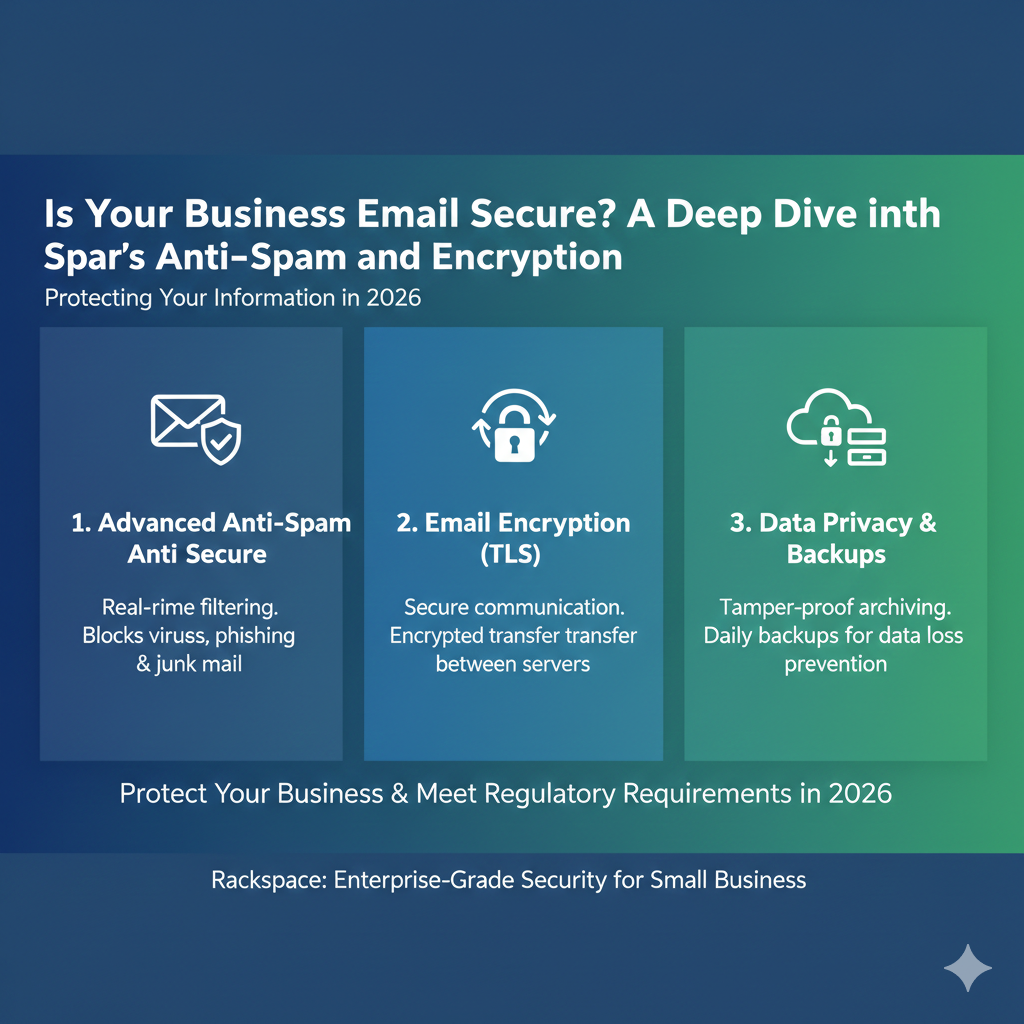
Rackspace anti spam systems go beyond simple keyword blocking. They utilize heuristic analysis—a method that looks for suspicious characteristics in an email’s code and structure. If an email originates from a known bad IP address or contains obfuscated links typical of phishing protection email scams, the system flags it.
Threat Intelligence
The platform leverages global threat intelligence networks. When a new spam campaign is identified halfway across the world, Rackspace’s filters update to recognize the signature of that attack. This real-time updating is crucial for blocking zero-day threats.
Quarantine Controls
Administrators have granular control over how aggressive the filtering should be. Suspicious emails are routed to a quarantine area rather than the inbox. This allows users or IT admins to review potential false positives safely without executing any malicious code.
Email Encryption in Rackspace (In-Transit and At-Rest)
Data privacy is non-negotiable. Rackspace handles email encryption business requirements through standard, robust protocols.
TLS Encryption (In-Transit)
Rackspace supports Transport Layer Security (TLS). When you send an email from a Rackspace account to another server that supports TLS (which is most major providers like Gmail or Outlook), the connection is encrypted. Think of this like sending your mail in an armored truck rather than a clear plastic bag. If a hacker intercepts the data stream while the email is moving, they cannot read the content.
Data Storage Encryption (At-Rest)
While the specifics can vary based on whether you are using their Hosted Exchange or standard Rackspace Email, the infrastructure is designed to protect data stored on their servers. Physical security at Rackspace data centers is also a component of this “at-rest” protection, ensuring that hard drives cannot be physically stolen or accessed.
End-to-End Options
For businesses requiring military-grade privacy where even the host cannot read the email, Rackspace supports integration with third-party encryption services. This allows for specific policies, such as automatically encrypting any email that contains a credit card number or social security number.
Malware and Ransomware Defense Capabilities
Ransomware often enters an organization through a malicious attachment—a PDF that isn’t really a PDF, or a Word doc with a weaponized macro.
Rackspace provides distinct email malware protection by scanning every attachment that passes through its gateways. The system uses constantly updated virus definitions to identify known malware signatures.
For advanced threats, the system employs techniques similar to sandboxing. It analyzes what an attachment attempts to do when opened. If a file tries to execute a script or connect to an external server to download a payload, Rackspace blocks it immediately. This ransomware email security layer is vital for protecting endpoints that might not have updated antivirus software installed.
User-Level Security Features
Even the best server security fails if a user sets their password to “password123.” Rackspace provides tools to help admins enforce better hygiene.
Two-Factor Authentication (2FA)
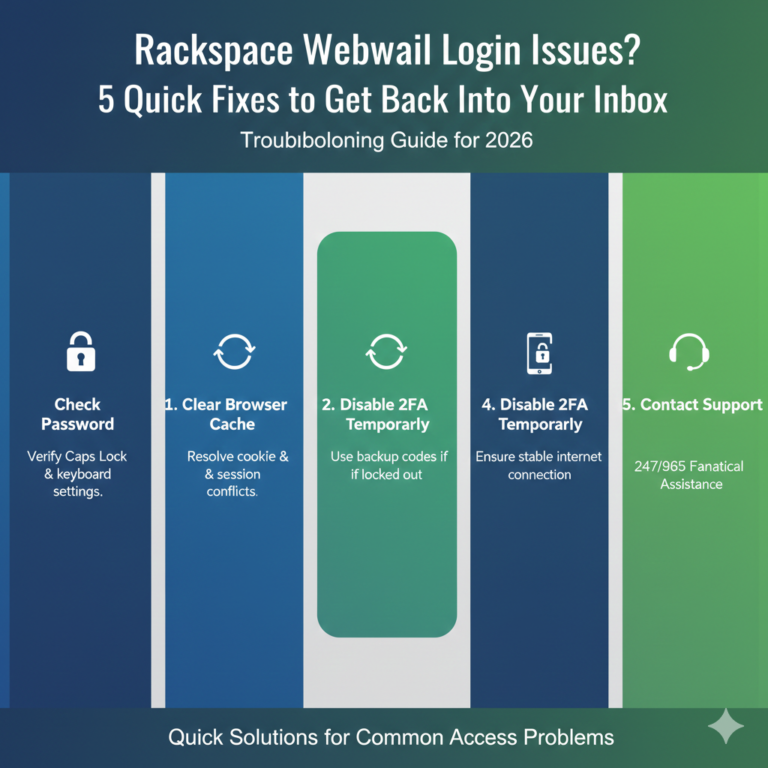
Rackspace supports email two factor authentication (2FA). This is perhaps the single most effective step a business can take to secure email login processes. Even if a hacker phishes a user’s password, they cannot access the account without the second factor (usually a code from a mobile app).
Password Policies
Administrators can enforce strict password complexity rules, requiring users to change passwords periodically and use a mix of characters.
Account Monitoring
Admins have visibility into mailbox access. If a user in London suddenly logs in from North Korea five minutes later, the system logs this anomaly, allowing the admin to lock the account and investigate.
Compliance and Data Protection Readiness
For industries like healthcare, finance, and law, security isn’t just about safety; it’s about legality. Rackspace offers compliant business email solutions tailored to these needs.
GDPR and Privacy
Rackspace has aligned its processes with GDPR requirements, offering data processing addendums that clarify how data is handled, processed, and deleted.
HIPAA
For US healthcare providers, Rackspace offers HIPAA-compliant email hosting (specifically via their Microsoft Exchange offerings). This ensures that Protected Health Information (PHI) is handled with the specific physical and digital safeguards required by federal law.
Retention Policies
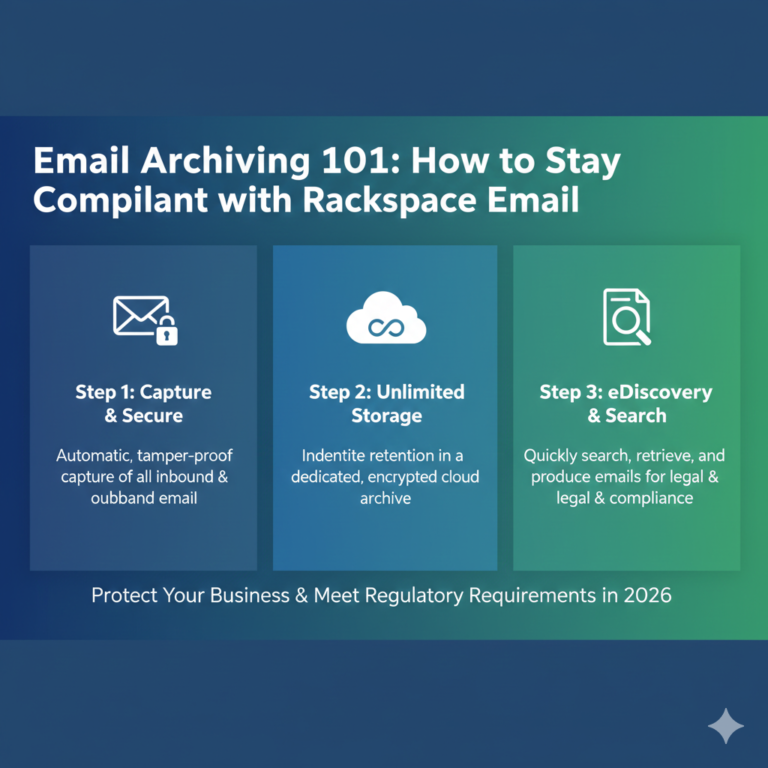
Email security compliance often mandates that businesses keep records for several years. Rackspace offers archiving solutions that create an immutable copy of every email sent and received. This protects the business against data loss and ensures you can respond to e-discovery requests during legal proceedings.
How Rackspace Compares to Other Secure Email Providers
Choosing the best secure business email often involves comparing Rackspace against the tech giants.
Rackspace vs. Google Workspace
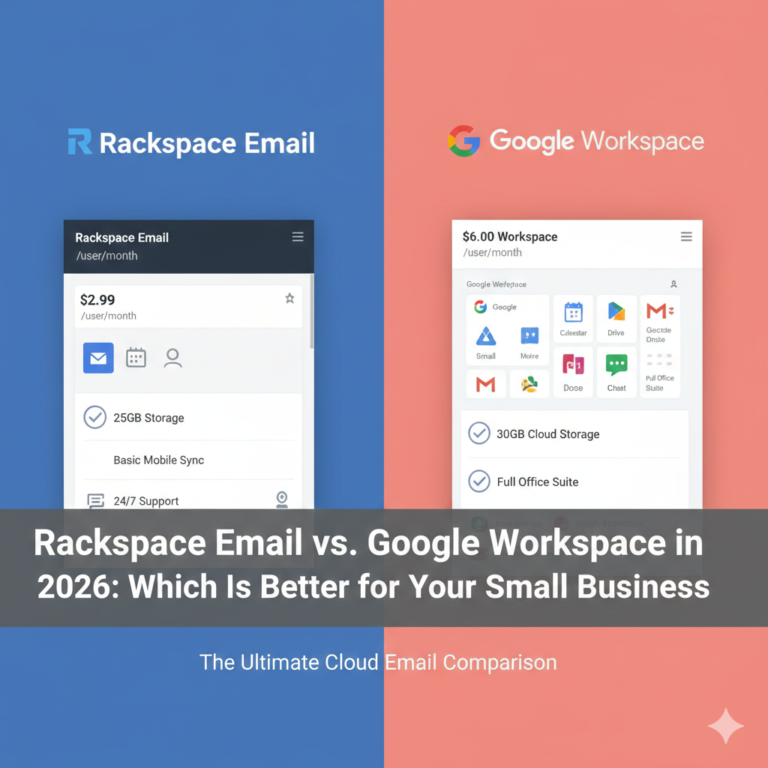
Google Workspace is excellent for collaboration (Docs, Sheets). However, Google scans email content for various purposes. Rackspace offers a more traditional, privacy-focused hosting experience where you are the customer, not the product. Rackspace is often preferred by businesses that want “just email” without the complexity of the Google ecosystem.
Rackspace vs. Microsoft 365
Microsoft 365 is the gold standard for enterprise integration. Rackspace actually sells hosted Microsoft Exchange, giving you the backend security of Microsoft with the “Fanatical Support” of Rackspace. If you go with pure Rackspace Email (not Exchange), you lose some calendar integration features but gain a simpler, lower-cost, and highly secure secure email provider comparison alternative.
Rackspace vs. Proton Business
Proton is built entirely on privacy and encryption. If your threat model involves state-level actors, Proton might be the choice. However, for 99% of businesses, Rackspace offers a better balance of usability, compatibility with standard mail clients (like Outlook or Apple Mail), and security.
Best Practices to Maximize Rackspace Email Security
Buying the subscription is only step one. To get the most out of Rackspace, you need to configure it correctly.
- Enforce 2FA Universally: Do not make it optional. Require it for every employee.
- Tighten Spam Filters: In the control panel, set spam filtering to “high” and review the quarantine report daily until you trust the system.
- Employee Training: Tech cannot fix human error. Train your staff to recognize phishing attempts that might slip through.
- Regular Audits: Review your list of active accounts monthly. Delete mailboxes for former employees immediately to close security gaps.
- Use Archiving: Enable email archiving to protect against accidental deletion or malicious insider activity.
Who Should Choose Rackspace for Secure Business Email?
Rackspace is a strong contender for specific types of organizations:
- SMBs: Small to medium businesses that need professional, branded email without the high cost of enterprise suites.
- Regulated Industries: Companies needing HIPAA compliance or strict archiving without managing their own servers.
- Budget-Focused Businesses: Organizations that want premium security features but don’t need a full suite of office apps.
FAQ – Rackspace Email Security (High-Intent SEO)
Q1: Is Rackspace email secure for business use?
Yes. Rackspace utilizes enterprise-grade security, including premium spam filtering, virus scanning, and TLS encryption, making it a highly secure choice for business communication.
Q2: Does Rackspace encrypt emails?
Rackspace supports TLS encryption for emails in transit. For stored emails, security depends on the specific hosting plan, but data centers are physically secured. End-to-end encryption can be achieved via third-party integrations.
Q3: How does Rackspace block spam and phishing?
Rackspace uses a multi-layer scanning process involving heuristic analysis, IP reputation filtering, and real-time threat intelligence to identify and quarantine spam and phishing attempts.
Q4: Does Rackspace support two-factor authentication?
Yes, Rackspace supports two-factor authentication (2FA) for both webmail access and the control panel, adding a critical layer of protection against password theft.
Q5: Is Rackspace email GDPR compliant?
Rackspace has implemented measures to ensure their services comply with GDPR regulations, including data processing agreements and privacy protections for EU citizens.
Q6: How can I improve email security in Rackspace?
You can improve security by enforcing strong password policies, enabling 2FA for all users, utilizing the email archiving service, and educating employees on how to spot phishing attacks.
Conclusion
Securing your business communication is not a luxury; it is a necessity for survival. Rackspace provides a robust, layered security environment that handles the heavy lifting of spam filtering, malware detection, and encryption. While no system is 100% impenetrable, Rackspace offers a mature, stable platform that mitigates the vast majority of modern cyber risks.
If you are looking for a solution that balances cost, usability, and rigorous protection, Rackspace is a formidable choice.
Ready to secure your inbox? Evaluate your current exposure and consider upgrading to a dedicated, secure email hosting solution today.