
What Is Dedicated Server Hosting in 2026
Infrastructure is the backbone of any serious digital enterprise. Whether you’re running a high-traffic ecommerce store, a SaaS platform with thousands of concurrent users, or a data-heavy enterprise application, the server you choose directly impacts performance, security, and ultimately, revenue.
As we move through 2026, the demands on web infrastructure have never been higher. AI integration, real-time data processing, and global user bases require robust hardware. This has led many businesses to move away from shared environments and toward dedicated server hosting. But with this move comes a significant financial consideration.
Pricing for dedicated servers varies wildly—from under $100 to well over $1,000 per month. Why is there such a discrepancy? Is the premium price tag worth it? And perhaps most importantly, what are the hidden costs that providers often bury in the fine print?
This guide breaks down the true cost of dedicated server hosting in 2026. We will explore pricing tiers, analyze the factors that drive up costs, and help you determine exactly how much you should budget to get the performance your business needs without overspending.
See also: The Evolution of Web Hosting: From Shared Servers to Cloud Infrastructure
What Is Dedicated Server Hosting?
Before diving into the financials, it is crucial to understand what you are actually paying for. Dedicated server hosting is an internet hosting option in which a physical server (or servers) is dedicated to a single business customer.
Unlike shared hosting, where you fight for resources with hundreds of other websites, or VPS (Virtual Private Server) hosting, where a physical server is virtually partitioned, a dedicated server gives you exclusive access to the bare metal.
Why is it more expensive?
You are renting the entire physical machine. The hosting provider has to cover the cost of the hardware (CPU, RAM, storage drives), power consumption, cooling, physical security, and network connectivity. Because you aren’t splitting these costs with other tenants, the base price is naturally higher.
Who typically needs it?
- High-Traffic Ecommerce: Sites like Magento or WooCommerce stores that need to handle traffic spikes without crashing.
- SaaS Platforms: Applications requiring consistent uptime and low latency.
- Enterprises: Companies with strict compliance requirements (HIPAA, GDPR) that need isolated environments.
- Gaming Servers: Multiplayer games requiring minimal lag and maximum processing power.
Dedicated Server Hosting Cost in 2026: Quick Overview
If you are looking for a quick answer, the landscape of dedicated server hosting cost 2026 can be categorized into three broad tiers.
- Entry-Level: $80 – $150 per month
- Mid-Range: $150 – $350 per month
- High-End / Enterprise: $400 – $1,500+ per month
These ranges fluctuate based on hardware specifications, bandwidth allocations, and the level of support provided. It is also worth noting that in 2026, component shortages and increased energy costs have led to a slight uptick in base prices compared to previous years, making efficiency more important than ever.
Dedicated Server Pricing by Plan Type
To budget effectively, you need to match your specific requirements to the right tier. Here is a detailed breakdown of dedicated server pricing based on performance levels.
Entry-Level Dedicated Servers ($80 – $150/mo)
These servers usually feature older generation CPUs (like Intel Xeon E3 or older Ryzen models) and standard SATA hard drives or basic SSDs. RAM is typically limited to 16GB or 32GB.
- Best for: Small to medium business websites, development environments, and game servers for small communities.
- Performance: Reliable for steady traffic but may struggle with massive concurrent user spikes or heavy database queries.
Mid-Range Dedicated Servers ($150 – $350/mo)
This is the “sweet spot” for most growing businesses. You can expect current-generation processors (Intel Xeon Silver/Gold or AMD EPYC), 64GB to 128GB of RAM, and fast NVMe storage.
- Best for: Active ecommerce sites, marketing agencies hosting multiple client sites, and large databases.
- Performance: Excellent handling of dynamic content and multitasking.
High-End / Enterprise Dedicated Servers ($400 – $1,500+/mo)
These are powerhouses. We are talking about dual or quad-processor configurations, 256GB to 1TB+ of RAM, and redundant storage arrays (RAID 10) with enterprise-grade NVMe drives.
- Best for: Big data analytics, machine learning model training, massive SaaS platforms, and streaming services.
- Performance: Uncompromised speed and reliability with extensive redundancy to prevent downtime.
Bare Metal Dedicated Servers
The term “bare metal” is often used interchangeably with dedicated servers, but it emphasizes the lack of a virtualization layer. Pricing for hourly bare metal (cloud-like billing for dedicated hardware) often starts around $0.20 to $0.50 per hour. This offers flexibility for short-term projects where you need raw power for a few days rather than a full month.
Factors That Affect Dedicated Server Hosting Cost
When you are configuring your server, you will notice the price ticker jumping up and down. Understanding these dedicated server cost factors prevents sticker shock at checkout.
1. CPU & Hardware Specs
The processor is the engine of your server. A server with a 64-core AMD EPYC processor will cost significantly more than one with a 4-core Intel Xeon. Clock speed (GHz) and core count are the primary cost drivers here.
2. RAM & Storage Type
- RAM: DDR5 RAM is the current standard for high performance but costs more than older DDR4.
- Storage: NVMe SSDs are significantly faster than standard SATA SSDs or HDDs. If you need 4TB of NVMe storage for a database, expect to pay a premium compared to 4TB of HDD storage used for backups.
3. Bandwidth & Data Transfer
Most providers offer a set amount of bandwidth (e.g., 10TB or 20TB) or a specific port speed (e.g., 1Gbps unmetered). Upgrading to a 10Gbps dedicated uplink can add hundreds of dollars to your monthly bill.
4. Data Center Location
Real estate and electricity costs vary by region. Hosting a server in a prime location like New York City, London, or Tokyo is generally more expensive than hosting in Dallas or Frankfurt. However, choosing a location near your users reduces latency, which is often worth the extra cost.
5. Management Level
Do you want to manage the server yourself, or do you want the host to handle updates and security? (More on this in the next section).
6. Security & Compliance
DDoS protection is standard on many plans, but advanced mitigation for enterprise attacks costs extra. Furthermore, compliant hosting environments (PCI-DSS for payments, HIPAA for health data) require specific infrastructure configurations that increase the price.
Managed vs Unmanaged Dedicated Server Costs
One of the biggest decisions affecting your budget is the level of management.
Unmanaged Hosting
You rent the hardware, and the provider ensures the lights stay on and the network stays connected. The rest—OS installation, security patches, software updates, and troubleshooting—is up to you.
- Cost: Base price (Cheapest option).
- Ideal for: Tech-savvy companies with an in-house IT team or DevOps engineers.
Managed Hosting
The provider handles the technical heavy lifting: monitoring, updates, security patching, and automated backups.
- Cost: Adds $50 to $150+ per month to the base server price.
- Ideal for: Businesses that want to focus on growth rather than server administration.
Which offers better value?
If you have to hire a freelance sysadmin to fix a server crash at 3 AM, that emergency bill could cost more than a year of managed hosting fees. For businesses without dedicated IT staff, the managed dedicated server hosting cost is almost always worth the investment for peace of mind and business continuity.
Hidden Fees in Dedicated Server Hosting
The advertised monthly price is rarely the final amount on your invoice. Be vigilant about these common extra charges.
Setup & Provisioning Fees
Some legacy providers still charge a one-time “setup fee” ranging from $50 to $200 to physically rack and configure the server. Most modern cloud-based dedicated providers have waived this, but it still exists in the industry.
Control Panel Licenses
To manage your websites easily, you will likely want cPanel/WHM or Plesk. These are third-party software licenses.
- cPanel: Can cost between $30 and $60/month depending on the number of accounts.
- Plesk: Typically runs $15 to $45/month.
Backup & Security Add-ons
Base prices rarely include off-site backups. If your server fails, you need a recovery point. Backup services often cost $0.05 to $0.10 per GB. Additionally, advanced firewall configurations or malware scanning are usually paid add-ons.
Bandwidth Overage Charges
If your site goes viral and you exceed your 10TB limit, you will be charged for overages. These fees can be exorbitant. If you anticipate volatile traffic, look for unmetered plans.
Software Licensing
Running Windows Server instead of Linux? You will pay a licensing fee based on the number of cores, which can add $20 to $100+ per month. Microsoft SQL Server licenses can push this even higher.
Dedicated Server Hosting Cost Comparison
To understand if dedicated is the right financial move, we must compare it to the alternatives.
Dedicated vs VPS Hosting
- VPS Pricing: $20 – $100/mo.
- Dedicated Pricing: $80 – $300/mo.
- Verdict: VPS is cheaper and great for scaling. However, a high-end VPS often costs more than an entry-level dedicated server while offering less raw power because of the virtualization overhead.
Dedicated vs Cloud Hosting (AWS/Azure/Google)
- Cloud Pricing: Pay-as-you-go (highly variable).
- Verdict: Cloud offers infinite scalability, but it is notoriously expensive for consistent, high-load workloads. If you run a database 24/7 at 100% CPU usage, a dedicated server is often 50% cheaper than a comparable AWS EC2 instance.
Is Dedicated Server Hosting Worth the Cost in 2026?
With the rise of cloud computing, is renting a physical box still relevant? The answer is a resounding yes, provided you have the right use case.
ROI for Businesses
For high-revenue ecommerce stores, page load speed correlates directly with conversion rates. A dedicated server ensures that resources are never stolen by “noisy neighbors,” keeping load times instant. If a faster server increases your conversion rate by even 0.5%, the server often pays for itself in days.
Performance & Security
For applications requiring high disk I/O (input/output), dedicated hardware outperforms virtualized environments. Furthermore, the single-tenant environment eliminates the security risks associated with shared hosting vulnerabilities (like hypervisor escapes).
How to Reduce Dedicated Server Hosting Costs
If you need the power but want to stick to a budget, here are strategies to find cheap dedicated server hosting without sacrificing quality.
- Commit to Long-Term Billing: Paying annually can save you 10-20% compared to month-to-month billing.
- Avoid Over-Provisioning: Don’t buy a 64-core monster if you only need 16 cores. Monitor your current resource usage and buy slightly above that, not 10x above it.
- Choose Linux over Windows: Unless you specifically require ASP.NET or MSSQL, choose a Linux OS (Ubuntu, CentOS, Debian) to avoid expensive licensing fees.
- Look for “Outlet” or “Clearance” Servers: Providers often discount older hardware. An Intel Xeon from two years ago is still incredibly powerful and can be 40% cheaper than the newest model.
Best Dedicated Server Hosting Providers by Budget
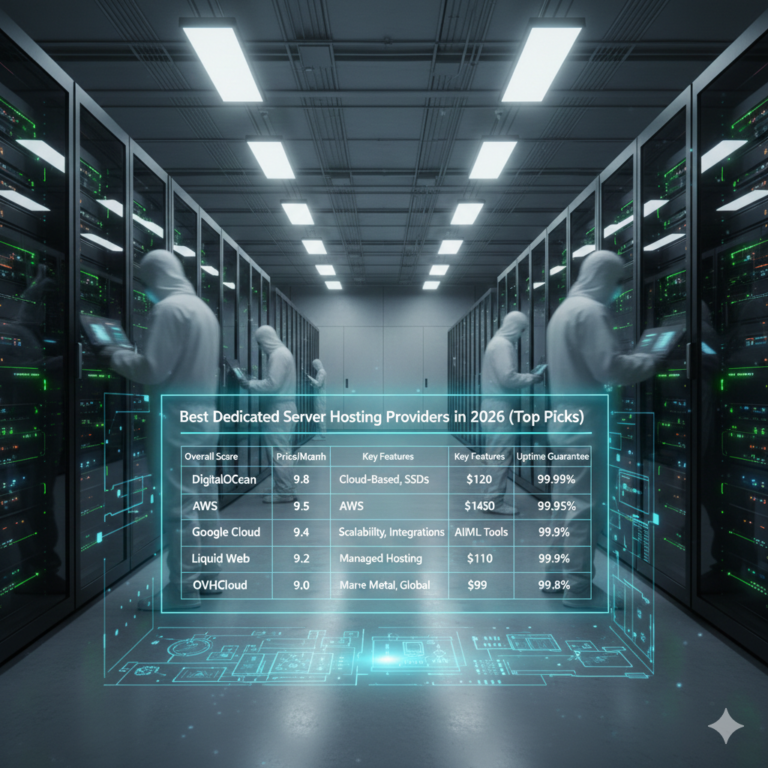
Based on best dedicated server hosting 2026 reviews and current pricing structures, here are top recommendations:
- Best Budget Option:Liquid Web or InterServer. Great for getting started with decent hardware at a low price point.
- Best Value-for-Money:KnownHost or A2 Hosting. These offer a great balance of managed support, modern hardware, and reasonable pricing.
- Best Premium/Enterprise Provider:Rackspace or Hetzner (EU). For when you need custom clusters, 100% uptime SLAs, and massive infrastructure.
Frequently Asked Questions (FAQ)
Q1. How much does dedicated server hosting cost in 2026?
Most businesses should budget between $150 and $300 per month for a reliable, modern dedicated server. Entry-level options exist around $80, while enterprise clusters can exceed $1,000.
Q2. What is the cheapest dedicated server hosting available?
You can find budget servers (often with older hardware) for as low as $50 to $70 per month from providers like OVHcloud or WholesaleInternet. Be aware that support is usually minimal at this price point.
Q3. Why is dedicated server hosting so expensive?
You are paying for exclusive use of enterprise-grade hardware, electricity, cooling, and data center space. Unlike shared hosting, the provider cannot split these costs across 500 customers; you bear the full cost of the machine.
Q4. Is managed dedicated server hosting worth the extra cost?
Yes, if you do not have a sysadmin on your team. Managed services cover security patches, updates, and monitoring. The cost of one data breach or extended downtime due to a misconfiguration far outweighs the monthly management fee.
Q5. Are there hidden fees in dedicated server hosting?
Common hidden fees include control panel licenses (cPanel/Plesk), backup storage, bandwidth overages, and Windows OS licensing. Always read the “Add-ons” section before checkout.
Q6. Can I upgrade or downgrade my dedicated server plan?
Upgrading usually involves physically moving your data to a new server, which requires downtime (unlike Cloud/VPS scaling). Downgrading is similar. It is not as flexible as cloud hosting, so choose your initial specs carefully.
Q7. Is dedicated hosting cheaper than cloud hosting long term?
For stable, predictable workloads (like a corporate database or a steady-traffic website), dedicated hosting is often cheaper than cloud hosting. Cloud hosting excels at variable traffic, but you pay a premium for that flexibility.
Final Verdict: Choosing the Right Dedicated Server Plan
Navigating the costs of dedicated hosting requires balancing your budget with your performance needs. In 2026, the market is competitive, but hardware costs are high.
- Small Business/Dev: Start with an entry-level unmanaged server ($80-$120) if you have the skills, or a mid-range VPS.
- Growing Ecommerce: Invest in a managed mid-range server ($200-$350). The speed and uptime are vital for your revenue.
- Enterprise: Focus on redundancy and support ($500+). The cost of the server is negligible compared to the cost of downtime.
Before you buy, create a checklist: verify the CPU generation, check the RAM type, confirm the storage is NVMe, and double-check the bandwidth limit. By understanding the full pricing structure—including those pesky hidden fees—you can secure a powerful infrastructure foundation for your business without blowing your budget.