
What Is Reseller Hosting? How It Works, Pricing & Profit Guide
Have you ever thought about starting your own web hosting company without the headache of buying expensive servers or hiring a 24/7 IT team? It sounds like a tech dream, but it is a very real business model called reseller hosting.
This approach has become a popular way for web designers, agencies, and aspiring entrepreneurs to build a recurring revenue stream. Instead of just building a website and handing it off, you can host it for your client and charge a monthly fee. It allows you to become a “one-stop shop” for your customers, deepening your relationship with them while boosting your bottom line.
In this guide, we will break down exactly what reseller hosting is, how the business model works, and the steps you need to take to launch your own hosting brand. Whether you are a freelancer looking for side income or an agency scaling your services, this guide covers everything from pricing strategies to technical setups.
What Is Reseller Hosting?
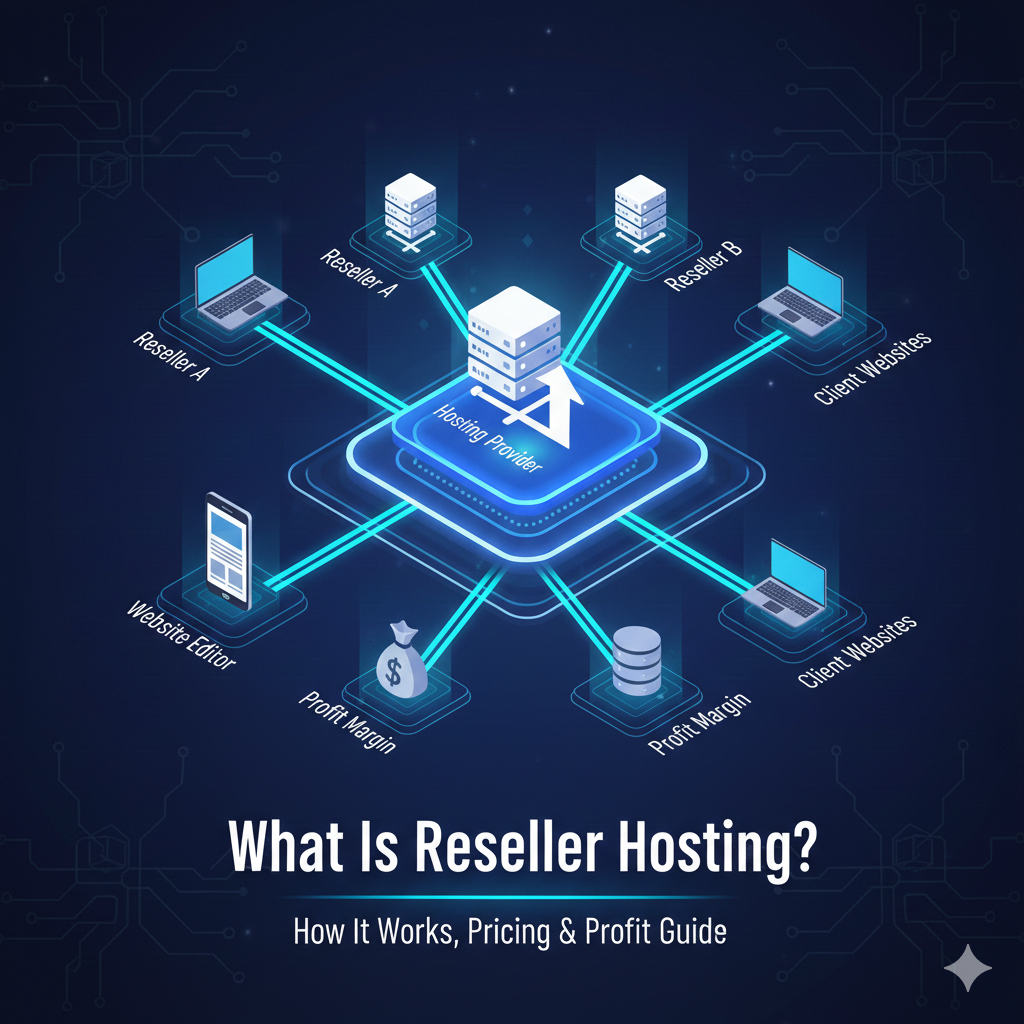
At its core, reseller hosting is a service provided by a web hosting company that allows individuals or businesses to sell hosting services as their own. Think of it like wholesaling in the retail world. You buy hosting resources (like disk space and bandwidth) in bulk from a large provider at a wholesale price, and then you resell those resources to your own clients at a markup.
The Role of the Reseller
When you sign up for a reseller hosting plan, you are essentially renting a portion of a server. You then carve that portion up into smaller packages for your customers. Your clients generally won’t know you are renting space from a larger company because most reseller plans are “white-label.” This means you can put your own branding, logo, and pricing on the control panels your clients use.
See also: The Evolution of Web Hosting: From Shared Servers to Cloud Infrastructure
Difference From Shared and VPS Hosting
To understand the reseller hosting meaning fully, it helps to compare it to other common types:
- Shared Hosting: You are a tenant in an apartment building. You have your own room, but you share resources (like the hallway or water supply) with everyone else. You generally cannot sublet your room.
- VPS Hosting: You own a condo within a building. You have more control and dedicated resources, but managing it requires more technical skill.
- Reseller Hosting: You are the landlord of the apartment floor. You rent the whole floor from the building owner and then lease individual apartments to tenants, collecting rent from each one.
How Does Reseller Hosting Work?
The mechanics of how reseller hosting works are surprisingly straightforward. You act as the middleman between the data center and the end-user. Here is the typical workflow:
- Select a Provider: You choose a hosting parent company (like SiteGround, HostGator, or InMotion) and purchase a reseller package.
- allocate Resources: You receive a set amount of storage (e.g., 100GB) and bandwidth (e.g., 1TB).
- Create Packages: Using a master control panel (usually Web Host Manager or WHM), you create custom hosting plans. For example, you might create a “Basic Plan” with 5GB of storage and a “Pro Plan” with 20GB.
- Add Clients: When you get a new customer, you create a new account for them within your WHM. This generates a separate cPanel (control panel) for that client.
- Bill Clients: You charge your client a monthly or annual fee. You pay your fixed cost to the parent host, and the difference is your profit.
This reseller hosting business model is low-risk because you don’t have to worry about server maintenance, hardware upgrades, or data center security. The parent host handles the heavy lifting, while you focus on sales and basic support.
See also: Types of Web Hosting Explained: How to Choose the Right Solution
Types of Reseller Hosting
Not all reseller plans are created equal. Depending on your technical skills and business goals, you might choose different infrastructures.
Shared Reseller Hosting
This is the most common and affordable entry point. You resell space on a shared server. It is perfect for beginners and small agencies managing standard business websites. The cost is low, but you are limited by the resources of that single shared server.
VPS Reseller Hosting
If you have clients with high-traffic sites or complex applications, VPS reseller hosting offers more power. You get a Virtual Private Server, which you can then partition for your clients. This requires a bit more technical knowledge but offers better performance and stability.
Cloud Reseller Hosting
Cloud hosting uses a network of servers rather than a single physical machine. If one server goes down, another picks up the slack. Reselling cloud hosting is a great selling point because it typically offers better uptime and scalability.
White-Label Reseller Hosting
This isn’t a separate infrastructure, but a feature. White label reseller hosting is crucial if you want to build your own brand. It ensures that the parent company’s name doesn’t appear on the client’s control panel, billing statements, or support tickets.
Features You Get With Reseller Hosting
To run a successful reseller hosting business, you need specific tools. Most providers bundle these into their plans.
WHM Control Panel
Web Host Manager (WHM) is your command center. It allows you to create cPanel accounts for clients, set storage limits, suspend accounts (if they don’t pay), and monitor server usage.
Client Billing Software (WHMCS)
Managing recurring payments manually is a nightmare. Most reseller plans include a license for billing software like WHMCS or Blesta. These tools automate invoicing, tax calculations, and even account creation. When a client pays on your website, WHMCS automatically sets up their hosting space.
Private Nameservers
Instead of telling your clients to point their domains to ns1.big-hosting-company.com, private nameservers allow them to use ns1.your-brand.com. This reinforces your professional image.
Technical Support (For You)
While you are responsible for providing first-line support to your customers, the parent host provides support to you. If a server goes down, you contact them to fix it.
See also: What Is Web Hosting
How Much Does Reseller Hosting Cost?
One of the biggest attractions of this model is the low barrier to entry. You don’t need thousands of dollars to start.
Monthly Pricing Ranges
Cheap reseller hosting plans can start as low as $15 to $30 per month. These usually support 20-40 client accounts. High-end plans with more resources and better performance can range from $60 to $150 per month.
Startup Costs vs. Profit Potential
Let’s look at a hypothetical pricing breakdown to understand the margins.
| Expense / Income Source | Cost / Revenue | Notes |
|---|---|---|
| Cost: Reseller Plan | $30 / month | Includes 50 cPanel accounts |
| Cost: Domain Name | $15 / year | One-time annual cost for your business site |
| Revenue: Client Fees | $15 / month per client | You charge this for hosting + maintenance |
| Total Revenue (20 Clients) | $300 / month | Assuming you sell to 20 clients |
| Net Profit | $270 / month | Revenue minus the hosting cost |
As you can see, you only need two or three clients to break even. Every client after that is pure profit.
See also: Shared Hosting Vs Vps Vs Cloud Hosting Which Is Best In 2026
Pros and Cons of Reseller Hosting
Before diving in, it is vital to weigh the benefits against the potential downsides.
Advantages (Pros)
- Recurring Revenue: Unlike one-off web design fees, hosting provides steady monthly income.
- Low Barrier to Entry: You can start a business for the price of a nice dinner.
- Scalability: It is easy to upgrade your plan as you get more clients.
- Customer Retention: Clients are less likely to leave you if you handle their site and their hosting.
Limitations (Cons)
- Dependency: You are reliant on the parent host’s performance. If their servers go down, your clients call you, not them.
- Support Responsibility: You are the first point of contact. If a client breaks their email or website, you have to help them fix it.
- Competition: The hosting market is saturated. Competing strictly on price with giants like GoDaddy is difficult; you need to compete on service and niche expertise.
Who Should Use Reseller Hosting?
This service isn’t for everyone, but it is a perfect fit for specific professionals.
- Web Designers & Developers: Stop sending your clients to third-party hosts. Host them yourself to simplify their life and increase your revenue.
- Digital Agencies: Bundle hosting with SEO or maintenance packages to increase the lifetime value of your clients.
- Entrepreneurs: If you are good at marketing and sales, you can build a hosting brand from scratch without needing deep technical knowledge.
- IT Consultants: Offer hosting as part of a broader IT management service for small local businesses.
How to Start a Reseller Hosting Business (Step-by-Step)
Ready to launch? Here is a simplified roadmap to getting your reseller hosting setup off the ground.
1. Choose a Reliable Provider
Do not just look for cheap reseller hosting. Look for uptime guarantees, responsive support, and white-label capabilities. Check reviews specifically for their reseller support responsiveness.
2. Select Your Plan
Start small. You don’t need the “Ultimate” plan on day one. Pick a plan that allows you to host 10-20 sites comfortably. You can always upgrade later.
3. Set Your Pricing
Don’t undersell yourself. If you compete on being the cheapest, you will attract difficult clients. Instead, bundle services. Offer “Managed WordPress Hosting” where you handle updates and backups, allowing you to charge a premium.
4. Configure Your Branding
Set up your private nameservers and customize your WHM and control panel with your logo. Configure your billing software (WHMCS) to match your brand colors.
5. Establish Support Channels
Decide how you will help clients. Will you offer email support? A ticketing system? Phone support? Be clear about your hours of operation so clients know what to expect.
Best Reseller Hosting Providers (2026 Preview)
While the landscape changes, a few names consistently rise to the top as the best reseller hosting providers.
- SiteGround: Excellent for agencies who want premium support and high performance. Their “GoGeek” and Cloud plans are popular for resellers.
- InMotion Hosting: Known for high resource limits and including a free WHMCS license with most plans.
- A2 Hosting: Famous for speed. Their “Turbo” servers are a great selling point if your clients care about site load times.
- HostGator: One of the oldest players in the game. Good for beginners who need a very affordable starting point.
FAQs – Reseller Hosting
Is reseller hosting profitable in 2026?
Yes, but the money is rarely in the raw hosting alone. The real profit comes from value-added services. If you just sell space, margins are thin. If you sell “Hosting + Monthly Maintenance + Security Checks,” the margins are excellent.
Do I need technical skills for reseller hosting?
You don’t need to be a server administrator, but you should know your way around a control panel (cPanel/WHM), understand DNS settings, and know how FTP works. If you are totally new to websites, there will be a learning curve.
How much money can I make with reseller hosting?
It varies wildly. A freelancer with 20 clients paying $20/month makes an extra $400/month. A dedicated agency with 500 clients could be generating $10k+ in monthly recurring revenue.
What is white label reseller hosting?
This feature allows you to sell hosting under your own brand name. The backend provider (like HostGator or SiteGround) remains invisible to your client.
Which reseller hosting is best for beginners?
Look for providers that include a free WHMCS license and 24/7 support. InMotion Hosting and GreenGeeks are often cited as beginner-friendly because they bundle necessary software.
Can I resell WordPress hosting?
Absolutely. In fact, specializing in WordPress hosting is a great way to market your business. You can pre-install WordPress for clients and offer specific WordPress security tweaks.
Is reseller hosting legal?
Yes, completely. Hosting companies create these plans specifically for people to resell. It is a legitimate and recognized business model.
Start Your Hosting Journey
Reseller hosting offers a unique opportunity to build a scalable business with relatively low risk. By leveraging the infrastructure of established giants, you can offer professional-grade services to your own network of clients.
Whether you are a developer looking to monetize your client base or an entrepreneur seeking a digital startup idea, the tools are readily available. The key is not just selling server space, but selling reliability, convenience, and trust.
Ready to take the next step?