Web Hosting Cost Guide 2026: Pricing, Factors & Real Budgets
Launching a website in 2026 is exciting, but navigating the financial landscape of web infrastructure can feel like walking through a minefield of hidden fees and confusing tiers. Whether you are starting a personal blog, a small business site, or a high-traffic eCommerce store, understanding the true cost of getting online is critical for your bottom line.
By 2026, web hosting pricing has evolved significantly. While entry-level costs remain competitive due to market saturation, the shift toward AI-integrated management, green energy data centers, and advanced security protocols has influenced the average market rates. A simple “cheap” plan might cost you more in the long run if it lacks essential features or hits you with a steep renewal hike.
This comprehensive web hosting cost guide 2026 breaks down exactly what you should expect to pay. We will explore the factors driving costs, compare different hosting types, and expose the hidden fees that catch many site owners off guard. By the end, you will have a clear, data-driven roadmap to budgeting for your digital presence.
What Affects Web Hosting Costs in 2026?
Before looking at specific price tags, it is helpful to understand why hosting costs vary so wildly. Why does one plan cost $2.99 per month while another costs $299? The difference usually comes down to infrastructure, resources, and service levels.
Hardware and Data Centers
The physical machinery powering your website is the biggest cost driver. High-performance servers using NVMe SSD storage (which is faster than standard SSDs) cost more to maintain. Additionally, data centers that prioritize green energy or have Tier 4 certification (guaranteeing 99.995% uptime) pass those infrastructure costs on to the consumer.
Bandwidth and Storage
Think of bandwidth as the pipe that delivers your website to visitors, and storage as the size of the warehouse holding your files.
- Unmetered Bandwidth: Many shared plans offer this, but they still have “fair use” policies.
- Cap-Based Pricing: Cloud and VPS plans often charge based on exact usage. If you have a viral post or a sudden sales spike, your costs increase.
Support Level
This is often where budget hosts cut corners.
- Standard Support: Ticket-based systems with 24-48 hour response times.
- Premium Support: 24/7 live chat, phone support, and access to engineers who can help fix code-level issues. If you aren’t technical, paying extra for managed support is often worth the investment.
Location and Server Region
Data residency laws and local infrastructure costs influence pricing. Hosting a server in a premium data center in New York or London often costs more than a server in a region with lower power and real estate costs. However, choosing a server close to your audience is vital for speed.
Essential Add-ons
Base prices are rarely the final price. To run a secure, modern website, you often need:
- SSL Certificates: Essential for security (and SEO rankings).
- CDNs (Content Delivery Networks): To speed up global load times.
- Automated Backups: Critical for disaster recovery.
- Security Suites: Malware scanning and firewalls.
Typical Web Hosting Pricing Ranges
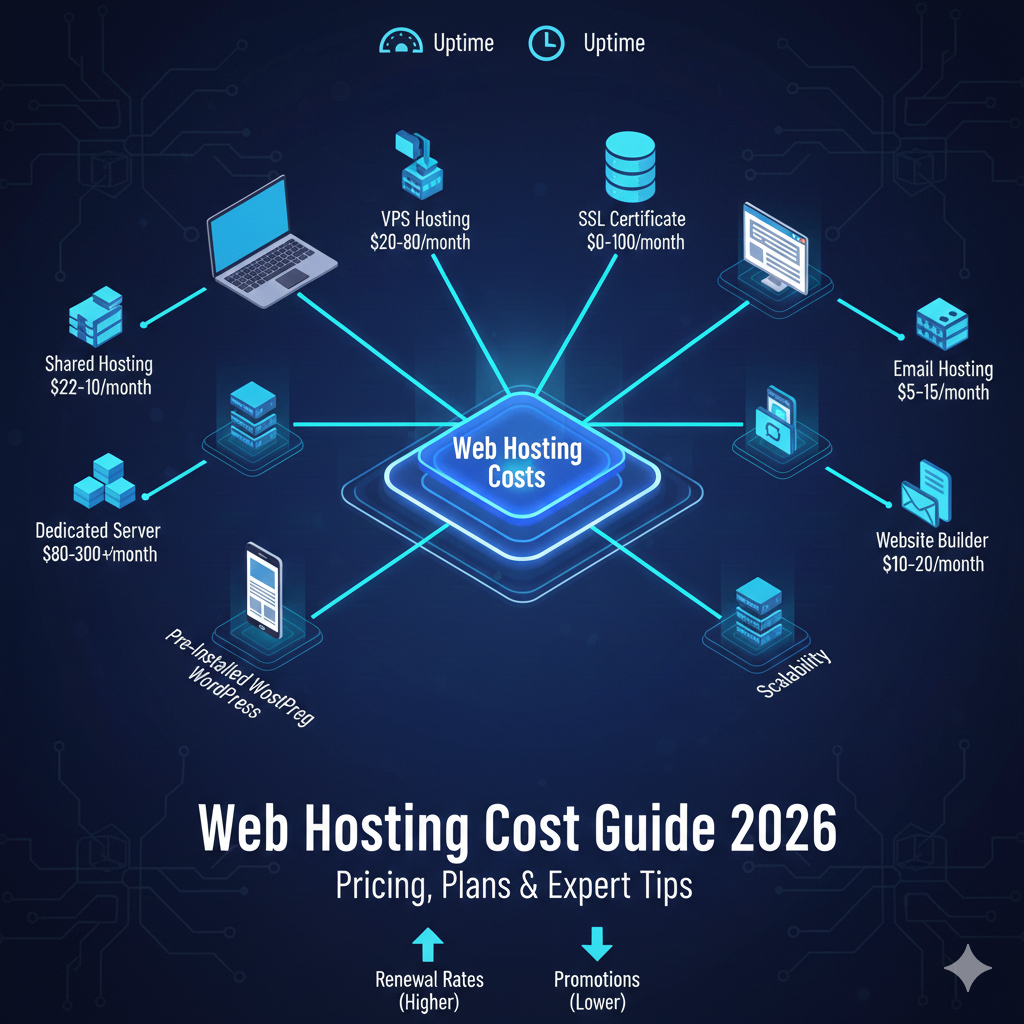
Understanding the average web hosting prices 2026 requires categorizing the different types of hosting. Each tier serves a different purpose and comes with a distinct price bracket.
| Hosting Type | Monthly Cost Range | Best For |
|---|---|---|
| Shared Hosting | $2.00 – $12.00 | Beginners, personal blogs, low traffic |
| Cloud Hosting | $5.00 – $50.00+ | Growing sites, startups, fluctuating traffic |
| Managed WordPress | $10.00 – $100.00+ | WordPress users needing speed & support |
| VPS Hosting | $20.00 – $120.00+ | Developers, complex apps, medium business |
| Dedicated Hosting | $80.00 – $300.00+ | Enterprise, massive traffic, strict security |
Shared Hosting ($2–$12/mo)
Shared hosting cost 2026 remains the most accessible entry point. You share a server with hundreds of other websites. It is cheap and easy, but performance can suffer if your “neighbors” on the server get a lot of traffic.
- Pros: Extremely affordable, beginner-friendly.
- Cons: Slower speeds, security risks, limited resources.
Cloud Hosting ($5–$50+/mo)
Cloud hosting has become the standard for modern websites. Instead of one physical server, your site draws resources from a network of servers. This structure allows for easy scaling—if you need more RAM or CPU, you can add it instantly.
- Pros: High reliability, scalable, pay-for-what-you-use models.
- Cons: Pricing can be unpredictable if traffic spikes.
VPS Hosting ($20–$120+/mo)
Virtual Private Server (VPS) hosting gives you a dedicated slice of a server. You aren’t competing for resources like in shared hosting. VPS hosting pricing varies based on how much RAM and how many CPU cores you lease.
- Pros: Root access, dedicated resources, better stability.
- Cons: Requires some technical knowledge to manage effectively.
Dedicated Hosting ($80–$300+/mo)
This is the penthouse suite of hosting. You rent an entire physical server. No sharing, total control, and maximum power. This is strictly for large eCommerce stores or enterprise-level applications.
- Pros: Ultimate performance and security control.
- Cons: Expensive and requires a server administrator.
Managed WordPress Hosting ($10–$100+/mo)
Specific to the WordPress ecosystem, these plans handle updates, caching, and security for you. While pricier than standard shared hosting, the time saved on maintenance often justifies the cost for small businesses.
Real Example Price Comparisons (2026 Data)
To give you a realistic view of web hosting cost comparison in 2026, let’s look at how pricing structures actually work. A major point of confusion for new buyers is the difference between the “Introductory Price” and the “Renewal Price.”
Most hosts offer a steep discount (up to 70% off) for your first term. When that term ends, the price reverts to the standard rate.
Scenario: The 3-Year Plan Trap
- Host X Shared Plan: Advertised at $2.95/mo.
- The Catch: You must pay for 36 months upfront ($106.20).
- The Renewal: After 3 years, the price jumps to $11.95/mo. Your next bill will be over $430.
Scenario: Cloud Scaling
- Host Y Cloud Plan: Starts at $10/mo for 1GB RAM.
- The Growth: Your site traffic doubles. You need to upgrade to 4GB RAM.
- The Reality: Your price doesn’t just double; it often quadruples to $40/mo.
Comparison Table: First Year vs. Renewal
| Provider Type | Intro Price (Monthly eq.) | Renewal Price (Monthly eq.) | Increase % |
|---|---|---|---|
| Budget Shared | $2.99 | $12.99 | ~330% |
| Mid-Tier Cloud | $12.00 | $12.00 (Often flat rate) | 0% |
| Premium Managed | $35.00 | $35.00 | 0% |
| Cheap VPS | $6.00 | $12.00 | 100% |
Data Note: These figures are estimates based on market trends observed in leading hosting providers (e.g., Bluehost, SiteGround, DigitalOcean) as of 2026.
When researching cheap hosting pricing comparison, always check the “Term of Service” for the renewal rate. If a deal looks too good to be true, check the renewal column.
Annual vs. Monthly Billing — What Saves More?
When you reach the checkout page, you are often presented with a choice: pay month-to-month, or commit to 1, 2, or 3 years. The difference in total hosting payment cycle cost is substantial.
The Annual Discount Strategy
Hosting companies crave stability. They want to lock you in. To do this, they offer massive discounts for long-term commitments.
- Monthly Billing: Usually has no discount and often includes a “setup fee.”
- Example: $15.00/mo x 12 = $180/year.
- Annual Billing: Often 30-40% cheaper.
- Example: $10.00/mo (billed as $120 upfront). Savings: $60.
- Triennial (3-Year) Billing: The deepest discounts (50-70%).
- Example: $5.00/mo (billed as $180 upfront). Savings over 3 years vs monthly: $360.
The Risks of Long Contracts
While the annual vs monthly hosting cost math favors long contracts, there are risks:
- Lock-in: If the host’s performance degrades after six months, you have already paid for three years. Getting a refund is difficult after the initial 30-day money-back guarantee.
- Upfront Cash Flow: Paying $200+ upfront can be a burden for a bootstrapped startup compared to $15/mo.
Recommendation: For new sites, a 12-month term is usually the sweet spot between securing a discount and maintaining the flexibility to switch hosts if necessary.
Hidden Hosting Costs You Must Know
The sticker price is rarely what you end up paying. To create a web hosting cost guide 2026 that is actually useful, we have to look at the hidden fees. These are the “upsells” that appear in your cart or become necessary a few months down the line.
1. Domain Registration and Privacy
Many hosts offer a “Free Domain for 1 Year.” However:
- Renewal: The domain renewal fee might be higher than dedicated registrars (e.g., $20 vs $12).
- Privacy Protection: This keeps your name and address out of the public WHOIS database. Some hosts charge $10-$15/year for this; others include it for free.
2. Migration Fees
If you are moving from one host to another, some companies charge a “white glove” migration fee, ranging from $30 to $150, to move your files and database safely.
3. Backup and Restore Fees
Basic backups might be free, but “one-click restore” functionality is often a paid add-on. If your site breaks and you need to roll back to yesterday’s version immediately, you might find yourself forced to pay a fee to unlock that backup.
4. Security Add-ons
While basic firewalls are usually included, premium security features like advanced malware removal and SiteLock often cost extra ($20-$50/year).
5. Email Hosting
In 2026, fewer web hosts are including unlimited free email accounts. Many now upsell Google Workspace or Microsoft 365 integration, which adds $6-$12 per user/month to your bill.
Web Hosting for Different Website Types
A generic how much does web hosting cost answer doesn’t work because different sites consume resources differently. Here is a breakdown by use case.
Personal Blogs and Portfolios
Budget: $3 – $10 per month.
You don’t need heavy machinery here. A solid shared hosting plan or a basic website builder plan is sufficient. Focus on a host that offers a free SSL and a user-friendly interface.
Small Business Websites
Budget: $10 – $30 per month.
Speed and uptime are your reputation. Avoid the cheapest shared tiers. Look for “Business Shared” or entry-level Cloud hosting. Best affordable hosting for small business usually includes daily backups and priority support.
eCommerce Stores (WooCommerce/Shopify)
Budget: $30 – $100+ per month.
Hosting cost for eCommerce is higher because you are processing transactions. You need:
- PCI Compliance (security standard for payments).
- High performance (slow load times kill sales).
- Staging environments (to test changes before going live).
Managed WooCommerce hosting is highly recommended here.
High-Traffic Portals and Media Sites
Budget: $100 – $500+ per month.
If you have 100,000+ visitors a month, shared hosting will crash. You need a robust VPS or a Dedicated Server. At this level, you are also paying for bandwidth and premium CDNs to serve images and video quickly.
Tips to Save Money on Web Hosting
You don’t always have to pay full price. Here are strategic ways to lower your hosting renewal cost and initial spend.
- Skip the unnecessary add-ons: When checking out, uncheck boxes for “SiteLock,” “SEO Tools,” or “Email Marketing.” You can usually find free plugins or better third-party tools for these later.
- Buy domains separately: Register your domain with a dedicated registrar (like Namecheap or Cloudflare). It is often cheaper to renew, and it keeps your assets decentralized (so if you get locked out of your host, you don’t lose your domain).
- Wait for Black Friday/Cyber Monday: If you can time your launch, late November offers the absolute lowest prices of the year, often locking in discounts for 36 months.
- Ask for a discount: Before your plan renews at the higher rate, contact support. Tell them you are considering moving to a competitor. Agents often have the authority to apply a retention discount.
- Use a caching plugin: Improving your site’s efficiency means it uses fewer server resources. This allows you to stay on a cheaper, lower-tier plan for longer before being forced to upgrade.
FAQs – Web Hosting Cost Guide 2026
How much does web hosting cost in 2026?
On average, expect to pay $3–$10/month for basic shared hosting, $15–$50/month for cloud or VPS hosting, and $80+/month for dedicated servers. Remember that first-term discounts often mask the higher renewal price.
Why is managed WordPress hosting more expensive?
Managed WordPress hosting includes specialized services: automatic updates, server-level caching configured specifically for WordPress, and support staff who are WordPress experts. You are paying for time saved and better performance, not just the server space.
How much bandwidth and storage do I really need?
For a new text-based blog or small business site, 10GB of storage and decent bandwidth is plenty. You only need unlimited or high-tier storage if you host large video files or high-resolution image galleries directly on the server (which is generally not recommended; use a video host like YouTube or Vimeo instead).
Is cloud hosting pricier than shared hosting?
Generally, yes. Cloud hosting starts around $10/mo, whereas shared can be found for under $3/mo. However, cloud hosting offers better reliability. If one server fails, your site stays up by drawing from others in the network, making it worth the extra cost for business sites.
Do hosting renewal prices go up every year?
Typically, the price jumps once after your initial term expires (e.g., from $2.99 to $11.99). After that, reputable hosts usually keep the price stable, though inflation-based increases of 5-10% every few years are becoming common in the industry.
Can I start with cheap hosting and upgrade later?
Absolutely. This is the smart way to scale. Start with a quality shared plan. Once your traffic hits 10,000+ visitors a month or your site starts slowing down, request a migration to a VPS or Cloud plan. Good hosts make this process seamless.
What’s the typical first-year hosting cost vs renewal?
For a standard shared plan, you might pay $35–$50 for the first year (introductory rate). The renewal for that same plan for the second year will likely cost $120–$150. Always budget for the renewal price, not the intro price.
Conclusion
Choosing the right hosting plan is a balancing act between your current budget and your future growth. In 2026, the market offers incredible power for relatively low prices, provided you know where to look and what to avoid.
Summary of Key Takeaways:
- Budget carefully: Look past the introductory headline price. Check the renewal rates.
- Know your needs: Don’t pay for a Dedicated Server if a Cloud plan handles your traffic just fine.
- Watch for fees: Backups, security, and email often cost extra.
- Commit wisely: Annual plans save money, but lock you in.
If you are just starting out, a reliable shared hosting plan is your best bet. If you are running a business where downtime equals lost revenue, invest in Managed WordPress or Cloud hosting.
Don’t let analysis paralysis stop you. The cost of hosting is a small price to pay for the potential of building your own corner of the internet.