Best Hosting for eCommerce Platforms in 2026 (Shopify, WooCommerce & More)
In the competitive landscape of digital retail, your hosting provider is the silent partner in your success. A slow website isn’t just a nuisance; it’s a revenue leak. Research consistently shows that even a one-second delay in page load time can result in a 7% reduction in conversions. For an online store making $10,000 per day, that one-second delay could cost $255,000 in lost sales annually.
As we move into 2026, the demands on eCommerce hosting have evolved. It’s no longer just about keeping the lights on. It’s about Core Web Vitals, global Content Delivery Networks (CDNs), ironclad security against increasingly sophisticated cyber threats, and the ability to scale instantly during flash sales. Whether you are running a boutique shop on WooCommerce or an enterprise-level operation on Magento, the infrastructure you choose defines your customer’s experience.
This comprehensive guide breaks down the best hosting for eCommerce platforms in 2026. We will analyze speed, security, scalability, and value to help you make an informed decision that future-proofs your online business.
[Disclosure: This article may contain affiliate links. We may earn a commission if you make a purchase through these links.]
What Makes Good eCommerce Hosting in 2026?
When evaluating the best hosting for online stores, generic shared hosting plans rarely cut it. eCommerce sites are resource-intensive—they require dynamic database queries, handle sensitive payment information, and must load high-resolution product images instantly. Here are the four pillars of performance you need to look for.
Speed and Core Web Vitals
Speed is the primary currency of the internet. In 2026, Google’s ranking algorithms heavily weigh Core Web Vitals, specifically Largest Contentful Paint (LCP) and First Input Delay (FID). Your hosting provider’s server response time (TTFB) directly impacts these metrics. Fast hosting for online stores utilizes solid-state drives (NVMe SSDs), advanced caching mechanisms (like Varnish or Redis), and latest-generation PHP workers to ensure your checkout process is seamless.
Security and Trust
Trust is hard to gain and easy to lose. If a browser flags your site as “Not Secure,” you lose the sale. Essential security features for eCommerce hosting include:
- SSL Certificates: Standard for encryption.
- Web Application Firewalls (WAF): To block malicious traffic.
- DDoS Protection: To prevent attacks that crash your site.
- PCI Compliance: Necessary for handling credit card data securely.
Scalability and Uptime
Your hosting needs to handle your best day, not just your average day. If you run a Black Friday promotion and your site crashes due to a traffic spike, your hosting has failed you. Scalability allows your server resources (RAM and CPU) to expand automatically during traffic surges. Furthermore, aim for a guaranteed uptime of 99.99%.
Global CDN
If your server is in New York but your customer is in London, latency occurs. A Content Delivery Network (CDN) stores copies of your site’s static assets (images, CSS, JavaScript) on servers around the world. This ensures that a customer in Tokyo loads your product page just as fast as a customer in Texas.
Quick Comparison Table – Best eCommerce Hosting Providers
To give you a snapshot of the landscape, here is an eCommerce hosting comparison chart of top-tier providers in 2026.
| Provider | Platform Focus | Speed Score | Security Features | Global Servers | Best Use Case | Pricing (Starting) |
|---|---|---|---|---|---|---|
| SiteGround | WooCommerce | 9.8/10 | High | Yes (Google Cloud) | Startups / SMBs | ~$3.99/mo |
| WP Engine | WooCommerce | 9.9/10 | Enterprise | Yes (Global CDN) | High-Traffic Stores | ~$20.00/mo |
| Shopify | Shopify (Hosted) | 9.9/10 | Built-in | Yes (Cloudflare) | All-in-one Users | ~$29.00/mo |
| Nexus | Magento / Woo | 9.7/10 | High | Yes | Scaling Brands | ~$19.00/mo |
| Bluehost | WooCommerce | 8.5/10 | Moderate | Yes | Budget / Beginners | ~$2.95/mo |
| Cloudways | Custom / Various | 9.8/10 | High | Yes (Choice of Provider) | Developers | ~$11.00/mo |
[Compare Hosting Plans Now]
Best Hosting Providers for Popular eCommerce Platforms
Different platforms have distinct architectural needs. What works for a lightweight WordPress blog will suffocate a Magento store. Below, we break down the best hosting providers for eCommerce based on the software you are using.
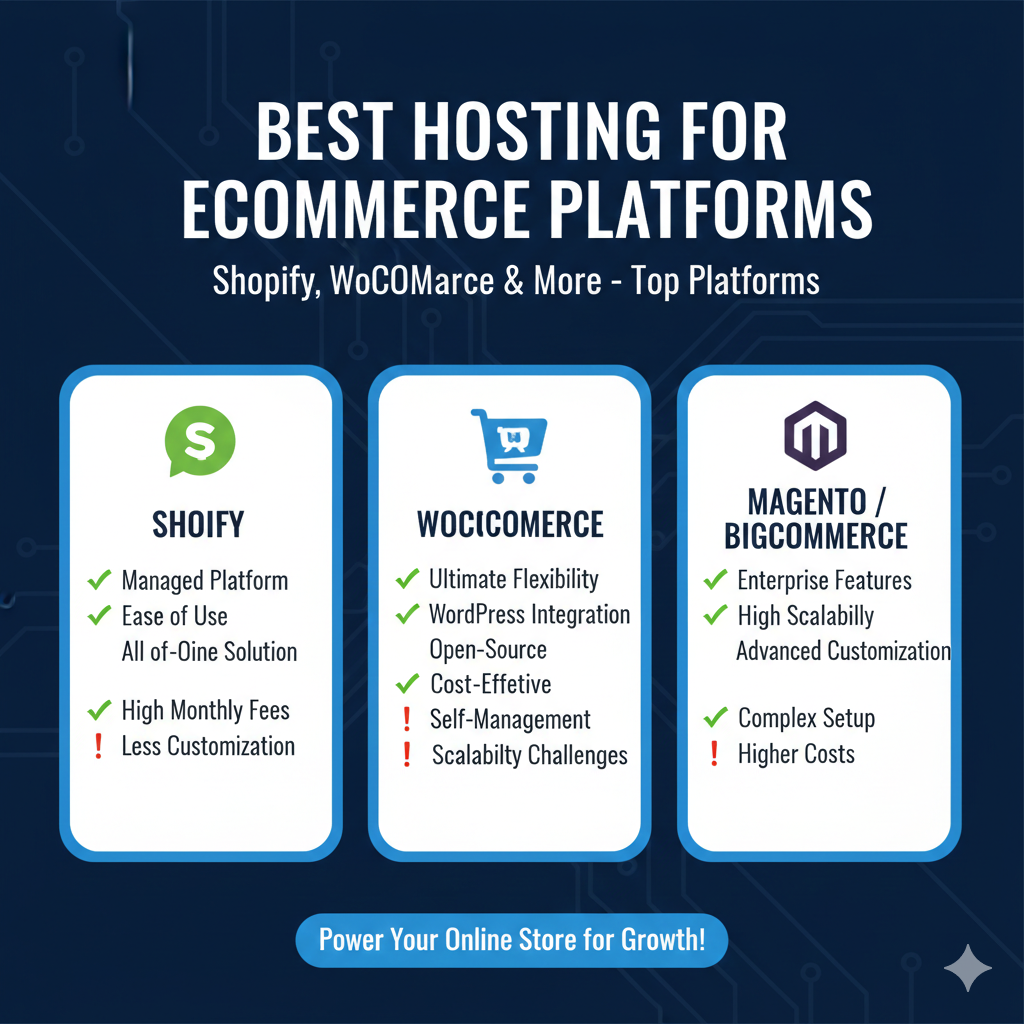
Best Hosting for Shopify Stores
Shopify is a unique beast in this list because it is a hosted solution (SaaS). This means when you pay for Shopify, hosting is included. You don’t need to rent a separate server.
Shopify Hosting Overview:
Shopify’s infrastructure is built on Google Cloud Platform. This provides incredible reliability without you needing to manage a server.
Speed and Reliability:
Shopify boasts a massive global infrastructure. They utilize a huge network of servers ensuring 99.99% uptime. Their storefronts are optimized for speed out of the box, though heavy usage of third-party apps can slow individual stores down.
Pricing Structure:
While you don’t pay a separate “hosting” fee, the cost is bundled into your monthly subscription.
- Basic: ~$29/mo (Good for new businesses)
- Shopify: ~$79/mo (Growing businesses)
- Advanced: ~$299/mo (Scaling businesses)
Note: Pricing is in USD and subject to change.
Best Hosting for WooCommerce Stores
WooCommerce is the world’s most popular open-source eCommerce plugin, built on WordPress. Because it is self-hosted, you have total control—and total responsibility—for choosing high-performance hosting.
Managed WooCommerce Hosting:
For most serious store owners, Managed WooCommerce Hosting is the gold standard. Providers like WP Engine and SiteGround configure their servers specifically for WordPress and WooCommerce. This includes server-level caching that excludes the cart and checkout pages (crucial for functionality) and automatic updates to keep your store secure.
Performance Optimization:
Top-tier WooCommerce hosting includes object caching (like Redis) which speeds up the database queries required to show product prices and stock levels. Look for hosts that offer “elastic” scaling to handle traffic spikes.
Top Pick: SiteGround (Best value) or WP Engine (Best performance).
Best Hosting for Magento Stores
Magento (now Adobe Commerce) is a powerful, complex platform used by enterprise brands. It is resource-hungry and requires a robust architecture.
High-Performance Hosting Requirements:
Shared hosting is not an option for Magento. You need dedicated servers or powerful VPS (Virtual Private Server) solutions. The hosting environment requires specific configurations like Elasticsearch, Varnish, and RabbitMQ to run smoothly.
Scalability:
Magento stores often carry thousands of SKUs. Nexus is a market leader here, offering dedicated Magento optimization that ensures the backend administration panel doesn’t lag while you are managing inventory.
Top Pick: Nexus (Specialized Magento expertise).
Best Hosting for BigCommerce & Custom Stores
Similar to Shopify, BigCommerce is a SaaS platform. It handles the hosting for you, utilizing Google Cloud Platform for 99.99% average uptime and DDOS protection.
SaaS vs. Self-Hosted:
If you are building a custom store using frameworks like Laravel or React, or using headless commerce, you will need flexible cloud hosting. Cloudways is an excellent option here. It acts as a bridge to major cloud providers (AWS, Google Cloud, DigitalOcean) but gives you an easy-to-use control panel to manage them.
Top Pick: BigCommerce (for SaaS simplicity) or Cloudways (for custom builds).
Speed & Performance Comparison
To objectively determine the fastest eCommerce hosting, we look at several benchmarks. Speed isn’t just about how fast the homepage loads; it’s about how fast the database responds when a customer filters products.
| Hosting Type | Avg. Load Time | TTFB (Time to First Byte) | Stress Test (1000 users) |
|---|---|---|---|
| SaaS (Shopify) | 1.2s | <200ms | Pass (Auto-scale) |
| Managed Woo (WP Engine) | 1.1s | <150ms | Pass (No lag) |
| Shared Hosting | 3.5s+ | >600ms | Fail (Site slow/down) |
| Cloud VPS (Cloudways) | 0.9s | <100ms | Pass (High performance) |
Key Takeaways:
- Core Web Vitals: Managed hosting consistently passes Core Web Vitals assessments significantly better than shared hosting.
- CDN Impact: Providers using Cloudflare Enterprise (like Shopify and WP Engine) see a 30-50% reduction in load times for international visitors.
[Start Your Online Store with Fast Hosting]
Security, Compliance & Payments
Security is non-negotiable. An eCommerce hack compromises customer credit cards and ruins your reputation.
SSL and Encryption:
All reputable hosts now provide free Let’s Encrypt SSL certificates. This gives you the “padlock” icon in the URL bar, essential for customer confidence.
PCI Compliance:
If you process payments directly on your server, you must be PCI (Payment Card Industry) compliant. SaaS platforms like Shopify are Level 1 PCI compliant out of the box. For WooCommerce, your host (like WP Engine) assists with compliance, but you share some responsibility.
Malware Protection:
The best secure eCommerce hosting providers offer proactive scanning. If malware is detected, they should offer free cleanup services. Automated daily backups are also critical—ensure your host retains backups for at least 30 days.
Pricing & Value for Money
The phrase “you get what you pay for” applies heavily to hosting. However, cheap eCommerce hosting can be found if you know what to look for.
| Cost Tier | Price Range (USD) | What You Get | Ideal For |
|---|---|---|---|
| Budget | $3 – $10/mo | Shared resources, standard SSL | New stores, drop-shipping tests |
| Mid-Range | $15 – $40/mo | Managed updates, staging sites, better caching | Growing brands, established SMBs |
| Premium | $50 – $200+/mo | Dedicated resources, priority support, advanced security | High-volume sellers, Enterprise |
Hidden Fees to Watch For:
- Renewal Pricing: Many hosts offer a low introductory rate (e.g., $2.95) that jumps significantly (e.g., $14.99) upon renewal.
- Transaction Fees: Some platforms charge fees on sales unless you use their proprietary payment gateway.
- Email Hosting: Not all eCommerce hosts include email accounts; you may need to pay extra for Google Workspace.
Scalability & Global Traffic Handling
As your business grows, your hosting must grow with it.
Auto-Scaling:
Cloud hosting solutions offer auto-scaling. This means if a viral TikTok video sends 10,000 visitors to your site in an hour, the server automatically allocates more CPU and RAM to handle the load, then scales down when traffic normalizes. You pay for what you use.
Multi-Region Servers:
For global online stores, data residency matters. Top providers allow you to choose the physical location of your server data center (e.g., choosing a London data center if your primary market is the UK). This reduces latency and helps comply with local data regulations like GDPR.
Best eCommerce Hosting by Use Case
Still unsure? Here is a breakdown of the best hosting for small online businesses versus enterprise giants.
Best for Startups
SiteGround (WooCommerce) or Shopify Basic.
Both offer low barriers to entry, excellent support, and enough power to handle your first 1,000 sales without breaking the bank.
Best for High-Traffic Stores
WP Engine or BigCommerce Enterprise.
When you are doing millions in revenue, you need “white glove” support and dedicated account management to ensure zero downtime.
Best Budget Option
Bluehost.
If you are bootstrapping and every dollar counts, Bluehost offers a very affordable entry point into WooCommerce, though you may need to upgrade as you grow.
Best for Developers
Cloudways.
If you are comfortable with technical configurations and want raw power without the “managed” markup, Cloudways offers the best price-to-performance ratio.
[View Best Deals on Hosting]
Pros & Cons Summary Table
| Provider | Pros | Cons |
|---|---|---|
| Shopify | Easiest to use, all-in-one, secure | Monthly fees add up, transaction fees |
| WP Engine | Incredible speed, great support, scaling | Higher cost than shared hosting |
| SiteGround | Great value, top-tier support, Google Cloud | Renewal prices are higher |
| Bluehost | Very cheap, official WP recommendation | Performance lags on heavy sites |
| Nexus | Customizable, great for Magento | Dashboard is less user-friendly |
| Cloudways | Pay-as-you-go, scalable, fast | No email hosting, steeper learning curve |
FAQs – Best Hosting for eCommerce Platforms
Which hosting is best for eCommerce in 2026?
There is no single “best” provider, but for WooCommerce, WP Engine and SiteGround are top-tier. For an all-in-one solution, Shopify remains the market leader. For enterprise Magento, Nexus is highly recommended.
Is cloud hosting better for online stores?
Yes. Cloud hosting is generally superior to traditional shared hosting for eCommerce because it offers better scalability and reliability. If one server fails, your site is instantly moved to another, minimizing downtime.
Which hosting is best for WooCommerce?
SiteGround is excellent for beginners due to its ease of use and price. WP Engine is the best choice for established stores that need maximum performance and managed security updates.
Does Shopify include hosting?
Yes. Shopify is a hosted platform (SaaS), meaning their monthly subscription fee covers reliable, secure hosting. You do not need to find a third-party host.
How much does eCommerce hosting cost?
It varies wildly. You can start a store on Bluehost for as little as $2.95/mo. However, a high-performance managed WooCommerce host will cost between $15 and $30/mo. Enterprise solutions can run into the hundreds or thousands per month.
Is eCommerce hosting secure for payments?
Yes, provided you choose a reputable host. Look for PCI compliance, free SSL certificates, and dedicated firewalls. Never store credit card numbers on your own server unless you are a certified payment processor; use gateways like Stripe or PayPal.
Can I upgrade my hosting as my store grows?
Absolutely. Most providers make it easy to upgrade to a higher tier (e.g., from VPS to Dedicated) with just a few clicks. Cloud hosting providers often allow you to scale resources up and down instantly.
Conclusion
Choosing the best hosting for eCommerce platforms isn’t just a technical decision; it’s a business strategy. Your hosting infrastructure dictates your site speed, security posture, and ability to handle growth.
For absolute simplicity and reliability, Shopify is hard to beat. For those who want the freedom of open-source with the power of managed performance, WP Engine or SiteGround for WooCommerce are excellent investments. And for custom, high-performance builds, Cloudways offers the flexibility developers crave.
Don’t let a slow server cost you sales in 2026. Audit your current performance, assess your budget, and choose a partner that helps you sell more.