Cloud Hosting vs VPS Uptime Compared: Reliability Explained
Every website owner dreads the notification. It might come as a frantic email from a customer, a ping from a monitoring tool, or a sudden drop in sales metrics. Your site is down.
In the digital economy, downtime is more than just a technical glitch; it is a direct hit to revenue and brand reputation. When users cannot access your services, they do not just wait patiently; they move on to competitors. For businesses relying on their online presence, the stability of their hosting infrastructure is the bedrock of their operation.
Two of the most popular hosting solutions for growing businesses are Virtual Private Servers (VPS) and cloud hosting. Both offer significant upgrades over basic shared hosting, providing dedicated resources and better performance. However, when the conversation turns specifically to uptime and reliability, the architectural differences between these two technologies create distinct outcomes.
Choosing between them requires looking beyond the price tag and marketing jargon. You need to understand how each handles hardware failure, maintenance, and traffic spikes. This guide explores the mechanical differences between cloud and VPS hosting to help you decide which architecture offers the stability your business demands.
Background and Uptime Fundamentals Explained
Before dissecting the specific architectures, we must establish a baseline for what “reliability” actually means in the context of web hosting.
What uptime means in web hosting
Uptime is the percentage of time a specific machine or service is available and operational. While it sounds simple, the mathematics of uptime reveal why small percentages matter.
In the hosting industry, reliability is often referred to by the number of “nines.”
- 99% Uptime: This sounds high, but it allows for 3.65 days of downtime per year. For an e-commerce store, losing nearly four days of trade is unacceptable.
- 99.9% Uptime: This is the industry standard for decent hosting. It equates to about 8.76 hours of downtime annually.
- 99.99% Uptime: Often called “four nines,” this signifies high availability, allowing for only 52.56 minutes of downtime per year.
- 99.999% Uptime: The gold standard, or “five nines,” allows for less than 6 minutes of downtime a year.
How hosting providers measure and report uptime
Providers measure uptime using external monitoring nodes that “ping” the server at regular intervals (often every minute). If the server fails to respond, it is flagged as down.
However, how this is reported to the customer can vary. Some providers measure uptime across their entire network, meaning if their network is up but your specific server is down, it might not count against their guaranteed statistics. Others measure it at the server level. Furthermore, “scheduled maintenance” is rarely counted as downtime in these reports, even if your site is inaccessible during that window. Understanding these nuances is vital when comparing the reliability promises of VPS and cloud providers.
VPS Hosting Uptime Architecture
To understand the reliability of a Virtual Private Server, you have to look at how it is built. A VPS is created using virtualization technology to split a single powerful physical server into multiple isolated virtual environments.
Single-node dependency and virtualization
The traditional VPS architecture relies on a “parent” physical server. A hypervisor (software that creates and runs virtual machines) sits on top of the physical hardware and allocates resources—RAM, CPU, disk space—to your specific VPS.
This architecture creates a single point of failure. Because your virtual server resides on one specific piece of physical hardware, your uptime is inextricably linked to the health of that machine. If the parent server’s power supply fails, the motherboard malfunctions, or the RAM corrupts, every VPS hosted on that machine goes offline instantly.
While the software layer (your OS and applications) is isolated from other users, the hardware layer is not. You are essentially renting a dedicated apartment in a large building. If the building’s foundation cracks, your apartment is affected, regardless of how well you maintain the interior.
Redundancy options in managed VPS environments
To mitigate the risks of single-node dependency, many managed VPS providers implement RAID (Redundant Array of Independent Disks). This ensures that if one hard drive fails, the data is preserved on another, and the server can usually keep running.
However, RAID only protects storage. It does not protect against CPU, motherboard, or power failures. Some premium VPS providers keep spare hardware on standby. In the event of a catastrophic hardware failure, they can physically move your hard drives to a new machine or restore your server from a backup to new hardware. While this restores service, it involves inevitable downtime—ranging from minutes to hours—while the migration or restoration takes place.
Cloud Hosting Uptime Architecture
Cloud hosting takes a fundamentally different approach to infrastructure. Rather than relying on a single physical machine, cloud hosting utilizes a cluster of servers working together as a single system.
Distributed infrastructure and failover
In a true cloud environment, your data typically lives on a Storage Area Network (SAN)—a centralized, high-speed storage system—while the computing power (CPU/RAM) is provided by a pool of hypervisors.
This separation of compute and storage allows for instant failover. If the physical server providing your CPU resources fails, the cloud management system detects the issue immediately. Because your data is safely stored on the SAN (which itself has redundancy), the system can instantly boot your virtual machine on a different, healthy physical server within the cluster.
This process often happens automatically and without human intervention. In many cases, the failover is so fast that the website visitor never realizes a failure occurred. This “self-healing” capability is the primary reason cloud hosting generally offers superior uptime compared to traditional VPS.
Load balancing and multi-zone availability
Cloud architecture supports advanced load balancing. If a sudden surge in traffic hits your website, a cloud setup can distribute that traffic across multiple servers to prevent any single node from becoming overwhelmed and crashing.
Furthermore, major cloud providers operate out of data centers with multiple “availability zones.” These are physically separate sections within a data center (or different data centers entirely) with independent power, cooling, and networking. A cloud architecture can be configured to replicate your data across these zones. If a fire or power outage takes out an entire section of the data center, your hosting can failover to a different zone, keeping your site online.
Key Factors That Influence Hosting Reliability
Beyond the basic architecture, several operational factors determine whether your site stays up or goes dark.
Hardware redundancy and network design
Reliability starts at the component level.
- VPS: Usually relies on the redundancy of a single box (dual power supplies, RAID storage). The network uplink is typically limited to the cable plugged into that specific rack.
- Cloud: Built on N+1 redundancy. This means for every component required to run the system, there is at least one backup ready to take over. The network design is usually fully mesh-routed, meaning if one internet provider or switch fails, traffic is automatically rerouted through an alternative path.
Maintenance, updates, and fault isolation
Every server needs updates. Operating system patches, security fixes, and hardware firmware updates are a fact of life.
- VPS Maintenance: often requires a reboot. If the host node needs a kernel update, your VPS must be restarted, resulting in planned downtime.
- Cloud Maintenance: often utilizes “live migration.” This technology allows the host to move your running virtual machine from one physical server to another without shutting it down. The provider can then update the original server while your site remains online on the new host.
Fault isolation is also superior in the cloud. In a VPS environment, a “noisy neighbor” (another customer on the same server) experiencing a massive DDoS attack could saturate the physical network card, affecting your uptime. In a cloud environment, software-defined networking usually isolates these issues much more effectively, protecting your uptime from the problems of others.
Service-level agreements and monitoring
The Service Level Agreement (SLA) is the guarantee the provider gives regarding uptime.
- VPS SLAs: Typically guarantee power and network ping availability. They rarely guarantee that the hardware itself won’t fail, only that they will replace it within a certain timeframe if it does.
- Cloud SLAs: Often guarantee higher percentages (99.99% or more) and cover the availability of the compute and storage instances. Because the architecture is more robust, providers are willing to back it with stronger financial penalties if they fail to meet the target.
Why This Uptime Comparison Matters Globally
For businesses operating across borders, uptime is not just about the server being “on”; it’s about accessibility.
Impact of downtime on international businesses
If you run a local bakery, a 2:00 AM server reboot might not matter. But if you are a SaaS company with clients in London, New York, and Tokyo, it is always business hours somewhere. A VPS rebooting for maintenance during the night in New York cuts off customers working through the afternoon in Tokyo.
Cloud hosting’s ability to perform updates without downtime (via live migration) is crucial for global businesses that cannot afford “maintenance windows.”
Reliability considerations for global user bases
Distance creates latency, which can look like downtime to a user if the connection times out. Cloud hosting makes it easier to deploy Content Delivery Networks (CDNs) or replicate your infrastructure to different geographic regions. While a VPS is stuck in one location, cloud resources can be spun up in Asia, Europe, and the Americas simultaneously, ensuring that if a trans-Atlantic fiber cable is cut, your Asian and European users can still access the local versions of your site.
Current Trends in Hosting Reliability
The gap between VPS and cloud is shifting as technology evolves.
Increased use of multi-region deployments
Previously reserved for tech giants, multi-region deployment is becoming accessible to smaller enterprises. Modern cloud platforms allow users to click a button and deploy their application to three different continents. If an entire region goes offline (a rare but possible event), traffic is automatically routed to the remaining healthy regions. Traditional VPS cannot compete with this level of geographical redundancy without complex, custom engineering.
Automation and proactive failure detection
Artificial Intelligence and machine learning are entering the data center. Cloud providers now use predictive analytics to monitor hardware health. If a drive shows signs that it might fail in the next week, the system automatically moves data off that drive and marks it for replacement before it actually breaks. This moves reliability from “reactive” (fixing it after it breaks) to “proactive” (fixing it before it impacts the user).
Expert Insights and Data-Backed Analysis
When analyzing industry data, distinct patterns emerge regarding stability.
Industry uptime benchmarks and observed patterns
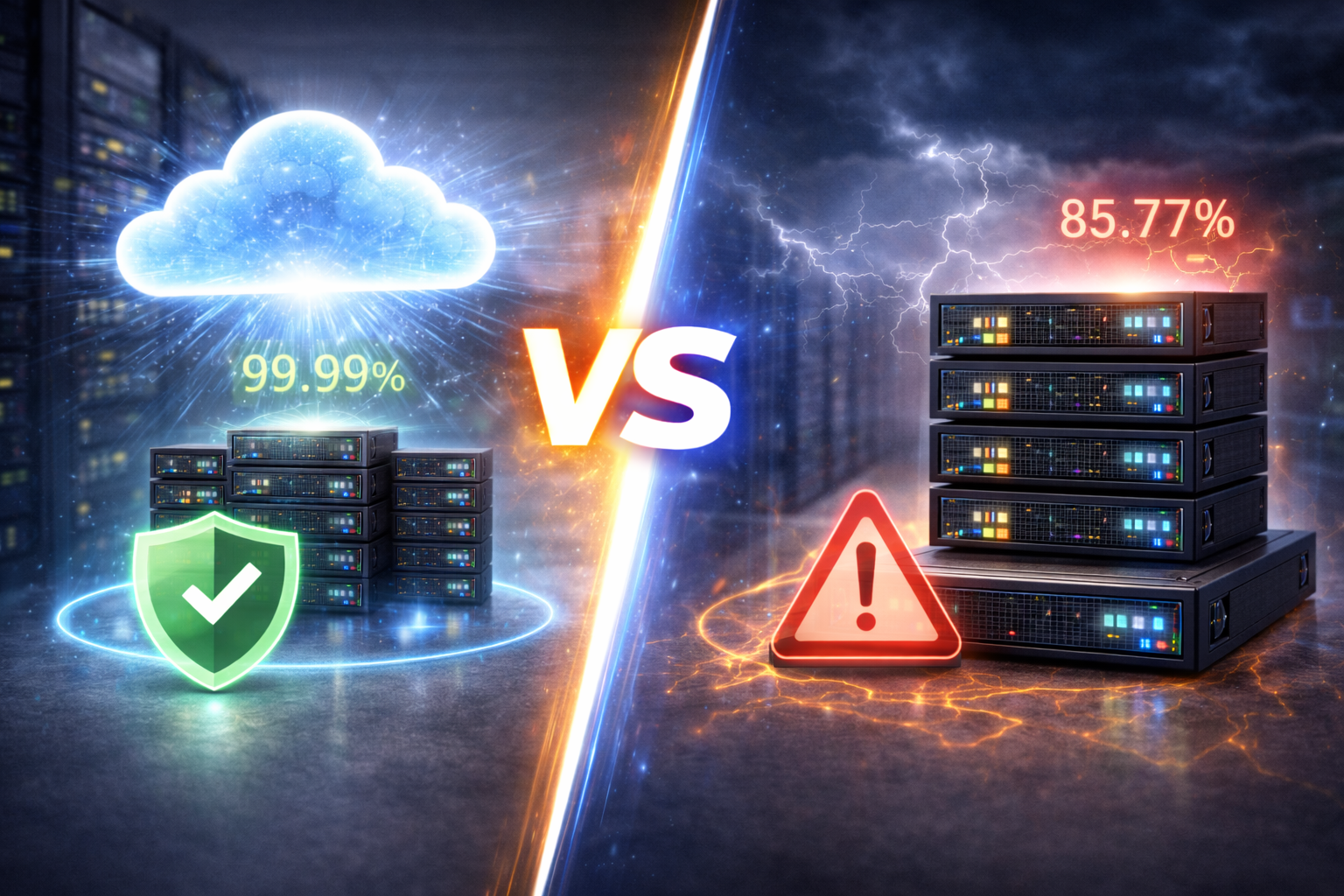
Data suggests that while premium VPS providers can achieve 99.9% uptime, they struggle to consistently hit 99.99% over a multi-year period due to inevitable hardware maintenance and isolated failures. Cloud infrastructure, properly configured, consistently charts in the 99.99% to 99.999% range.
However, complexity introduces its own risks. A poorly configured cloud environment—where security groups are set wrong or load balancers aren’t calibrated—can suffer from downtime caused by human error. A VPS, being simpler, sometimes wins on stability simply because there are fewer moving parts for the user to break.
Common causes of downtime in VPS and cloud setups
- VPS Downtime: Primarily caused by hardware degradation, scheduled maintenance, and resource exhaustion (running out of RAM).
- Cloud Downtime: Primarily caused by misconfiguration, failed deployments, or region-wide outages at the provider level (e.g., an AWS or Azure region going down).
What to Watch Next
The landscape of hosting reliability is not static.
Advances in self-healing infrastructure
We are moving toward “serverless” paradigms where the concept of a specific server disappears entirely for the user. In this model, the code runs on whatever resources are available and healthy. This represents the ultimate evolution of uptime, where the failure of underlying hardware becomes completely invisible to the application deployment.
Changes in uptime guarantees and SLAs
As competition heats up, providers are differentiating themselves via SLAs. We are seeing a trend where providers offer “100% uptime SLAs.” While this doesn’t mean downtime is impossible, it means the provider is so confident in their redundant architecture that they are willing to pay out for even a minute of lost service.
Making the Right Choice for Your Business
Deciding between cloud hosting and a VPS for uptime comes down to your tolerance for risk and your budget.
If your application is mission-critical—meaning every minute of downtime costs you significant money or reputation—cloud hosting is the superior choice. The architecture’s ability to self-heal, migrate live, and eliminate single points of failure provides a safety net that a single VPS cannot match.
However, if you are running an informational site, a blog, or a development environment where a 20-minute outage once a year is an annoyance rather than a disaster, a high-quality VPS is often the more cost-effective solution. A managed VPS with RAID storage still offers excellent reliability for the vast majority of standard use cases.
Ultimately, uptime is an investment. Cloud hosting acts as an insurance policy against hardware failure. By understanding the architectural differences, you can choose the policy that best fits the value of your online presence.
Frequently Asked Questions
Is cloud hosting always more reliable than VPS?
Generally, yes. Cloud hosting eliminates the single point of failure inherent in VPS hosting (the physical server). However, a low-quality cloud provider with poor network management can still be less reliable than a high-quality VPS provider using top-tier hardware.
Can a VPS achieve high uptime with proper setup?
Yes. A VPS can achieve very high uptime, especially if the provider uses enterprise-grade hardware and you implement your own failover measures, such as keeping a backup server ready. However, achieving “five nines” (99.999%) is exceptionally difficult on a standard VPS.
How do SLAs differ between cloud and VPS providers?
Cloud SLAs usually cover the availability of the entire service and offer higher uptime guarantees (often 99.99%). VPS SLAs often focus on network and power availability, with looser terms regarding hardware replacement times.
What uptime level is acceptable for business websites?
For most standard business websites, 99.9% (allowing ~9 hours of downtime/year) is acceptable. for e-commerce sites or SaaS platforms generating continuous revenue, you should aim for 99.99% (allowing ~52 minutes of downtime/year).