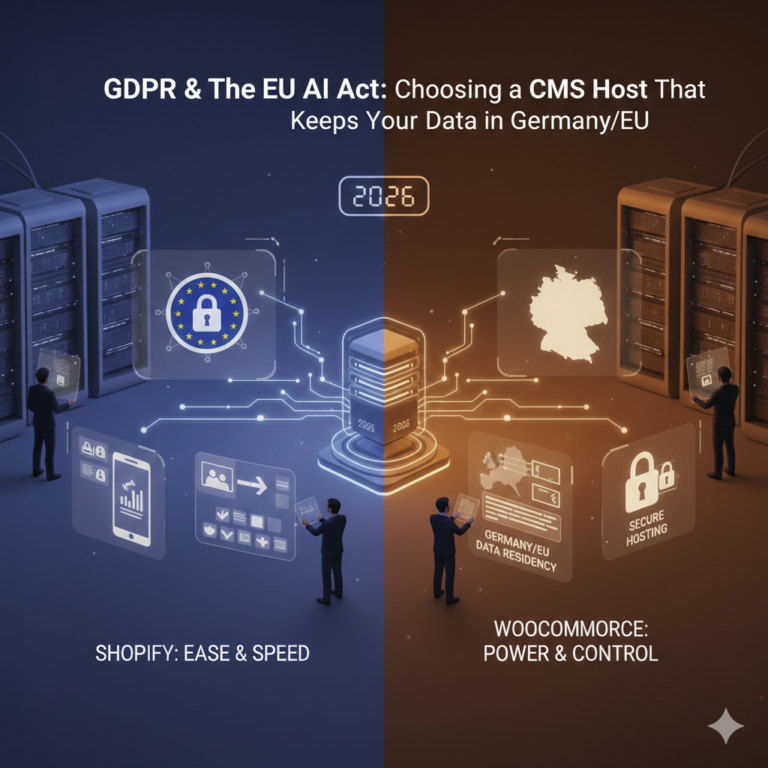

GDPR & the EU AI Act: Choosing a CMS Host That Keeps Your Data in Germany and the EU
Digital regulations in Europe are tightening. For years, the General Data Protection Regulation (GDPR) has set the global standard for data privacy, forcing businesses to rethink how they handle user information. Now, the introduction of the EU AI Act adds a new layer of complexity, specifically targeting how automated systems process data and interact with users.
For businesses operating in Europe, the physical and legal location of their Content Management System (CMS) hosting is no longer just a technical detail—it is a critical compliance decision. The intersection of these two major regulations means that simply having a “compliant privacy policy” is insufficient if your infrastructure exposes data to non-EU jurisdictions.
This guide explores why data sovereignty is becoming the central pillar of digital compliance. We will examine the specific requirements of GDPR and the EU AI Act regarding hosting, the hidden risks of using non-EU providers, and how choosing a sovereign cloud host in Germany can safeguard your business against legal pitfalls.
What GDPR Requires for CMS Hosting
The GDPR fundamentally changes the relationship between a website owner (the data controller) and their hosting provider (the data processor). When you choose a host for your CMS—whether it’s WordPress, Drupal, or a custom enterprise solution—you are entrusting a third party with the personal data of your visitors.
Strict Personal Data Handling
GDPR hosting requirements mandate that any storage of personal data must be secure and lawful. Your CMS database likely contains user emails, IP addresses, purchase histories, and contact forms. A compliant host must ensure this data is processed only according to your instructions and is not mined for their own marketing purposes or shared with unauthorized third parties.
Lawful Processing and DPAs
To achieve GDPR compliant hosting in Germany or the wider EU, you must have a Data Processing Agreement (DPA) in place with your host. This legal contract outlines exactly how the host protects data. If your host cannot provide a DPA that satisfies Article 28 of the GDPR, you are already non-compliant.
Breach Notification Protocols
Speed is essential when security fails. GDPR requires that data breaches be reported to the relevant supervisory authority within 72 hours. Your hosting provider must have the infrastructure and protocols to detect intrusions immediately and notify you without delay. If their systems are opaque or they lack rapid incident response teams, your ability to meet this 72-hour window is compromised.
What the EU AI Act Adds to Hosting Requirements
While GDPR protects personal privacy, the EU AI Act regulates the tools that process that data. As CMS platforms increasingly integrate artificial intelligence for chatbots, personalized recommendations, and content generation, the underlying hosting infrastructure faces new scrutiny.
AI System Classification
The AI Act classifies systems based on risk. If your CMS uses AI plugins for customer service or profiling, these may fall under specific transparency obligations. EU AI Act compliance hosting means your infrastructure must support the governance required for these tools. You need to know exactly where the AI model is running and where the inference data (the user’s input) is being processed.
Logging and Transparency
A key component of AI regulatory requirements in EU law is traceability. High-risk AI systems require automatic logging of events over their lifetime. Your hosting environment must offer robust, unalterable logging capabilities to prove how the AI made decisions. If your host limits access to server logs or rotates them too quickly, you may fail to meet these transparency standards.
Risk Controls and Governance
The AI Act emphasizes human oversight and technical robustness. Your hosting provider acts as the foundation for this robustness. They must guarantee high availability and security to prevent the AI system from behaving erratically due to server strain or cyberattacks.
Data Residency vs Data Sovereignty Explained
When evaluating secure CMS hosting, terms like “residency” and “sovereignty” are often used interchangeably, but they mean very different things in a legal context.
Data Residency
Data residency in the EU simply refers to the physical location of the data center. If a US-based provider rents a server farm in Frankfurt, you have German data residency. The data physically sits on a disk within German borders. However, this does not necessarily protect you from foreign laws.
Data Sovereignty
Sovereign cloud hosting goes a step further. It ensures that the data is not only physically located in the EU but is also subject only to the laws of the EU (and the specific country, like Germany). It means the hosting provider is not a subsidiary of a foreign company that could be compelled by its home government to hand over data. True sovereignty requires both physical presence and legal independence from non-EU jurisdictions.
Why Keeping Data in Germany/EU Matters
Germany has historically held some of the strictest data privacy interpretations in the world, often going above and beyond the baseline EU requirements.
The “Schrems II” Impact
The European Court of Justice’s “Schrems II” ruling invalidated the Privacy Shield agreement, which previously allowed easy data transfers between the EU and the US. The court found that US surveillance laws (like FISA 702) did not respect the privacy rights of EU citizens. Consequently, hosting data in Germany or other EU member states under a sovereign provider eliminates the headache of justifying international data transfers.
Mitigating Government Access Risks
If your data resides on a sovereign cloud, foreign intelligence agencies cannot easily demand access to it. EU data protection hosting effectively shields your business corporate espionage and foreign surveillance, providing a safe harbor for sensitive intellectual property and customer information.
Building Customer Trust
European consumers are increasingly privacy-savvy. Displaying that your site is hosted in a German data center is a trust signal. It demonstrates that you respect their digital rights and are not recklessly shipping their private information across the Atlantic.
CMS Hosting Risks with Non-EU Providers
Many businesses default to the large “hyperscaler” cloud providers based in the United States. While convenient, this introduces significant compliance friction.
Cross-Border Transfers
Even if a US provider promises that your data stays in their Dublin or Frankfurt region, their support teams might be located in the US or India. If a support engineer in Ohio accesses your server to fix a bug, that is technically a cross-border data transfer. Cross border data transfer risks are difficult to manage without strict controls that many hyperscalers lack.
Cloud Act Exposure
The US CLOUD Act allows US federal law enforcement to compel US-based technology companies to provide requested data stored on servers, regardless of whether the data is stored in the US or on foreign soil. This creates a direct conflict with GDPR. By using a US-headquartered host, you are potentially exposing your US cloud GDPR risks, regardless of where the server rack is physically bolted down.
Infrastructure Requirements for Compliant CMS Hosting
Moving to a compliant host doesn’t mean sacrificing security; in fact, it usually requires enhancing it.
Encryption Everywhere
Secure CMS hosting requires encryption both at rest (on the hard drive) and in transit (between the browser and the server). Compliant hosts should provide easy SSL management and encrypted storage volumes by default.
Granular Access Controls
To meet GDPR’s “data minimization” principle, only authorized personnel should have access to your CMS backend. A robust host provides Role-Based Access Control (RBAC), allowing you to restrict server access to specific IP addresses or team members.
Backup Locality
It is a common error to host the live site in Germany but back it up to a cheaper storage bucket in a non-EU region. GDPR hosting security dictates that backups must be treated with the same level of protection as live data. Ensure your disaster recovery copies also reside within the sovereign boundary.
Performance and Scalability Within the EU
There is a misconception that choosing a regional European host limits performance. The reality is often the opposite for businesses targeting European markets.
Latency Optimization
Hosting your website closer to your users reduces latency (the time it takes for data to travel). Fast hosting Germany ensures that a request from Berlin or Munich doesn’t have to travel to a server in Virginia and back. This improves Core Web Vitals, which is beneficial for both user experience and SEO.
Multi-Region Redundancy
Top-tier European providers offer scalable EU hosting with multi-region redundancy. You can replicate your CMS across data centers in Germany, France, and Poland. This ensures that if one data center goes offline, your site fails over to another EU location, maintaining uptime without breaking data sovereignty.
Evaluating a GDPR-Compliant CMS Host (Checklist)
When shopping for the best GDPR hosting provider, use this checklist to cut through the marketing noise.
- Location: Are the data centers physically in the EU?
- Ownership: Is the parent company headquartered in the EU?
- Certifications: Does the host hold ISO 27001 (Information Security) and C5 (Cloud Computing Compliance Controls Catalogue, specific to Germany)?
- Transparency: Do they publish a clear list of sub-processors?
- Support: Is the support team located within the EU to prevent accidental data transfers?
- Contracts: Do they offer a standard DPA without requiring negotiation?
An EU compliant hosting checklist like this helps you avoid providers who claim compliance but lack the structural independence to guarantee it.
Example: Sovereign CMS Hosting with OVHcloud
To visualize what a compliant solution looks like, consider OVHcloud Germany hosting. As a European-founded and owned company, OVHcloud operates outside the jurisdiction of the US CLOUD Act.
OVHcloud represents a sovereign cloud provider EU model. They design and build their own servers, operate their own data centers (including facilities in Limburg, Germany), and maintain a strict legal separation from non-EU laws. For a CMS owner, this means you get the scalability of a cloud giant—autoscaling, load balancers, and managed databases—without the data sovereignty risks associated with US hyperscalers.
Migrating Your CMS to a German/EU Host
Moving your site is a significant project, but the long-term risk reduction is worth the effort.
1. Data Audit
Before you move, understand what you have. Catalogue all plugins, databases, and media files. Identify which elements contain PII (Personally Identifiable Information).
2. Migration Planning
Use a CMS hosting migration guide to plan the transition. Set up the new environment and configure the server stack (PHP, SQL, caching) to match your current setup.
3. Testing and Cutover
Migrate the data to a staging environment on the new host. Test thoroughly for broken links or missing files. Once verified, update your DNS records to point to the migrate website to EU hosting destination.
Common Compliance Mistakes to Avoid
Even with a sovereign host, you can break compliance through poor configuration.
- External CDN Leakage: Using a US-based Content Delivery Network (CDN) can inadvertently route traffic through non-EU servers. Ensure your CDN has strict geo-fencing capabilities.
- Shadow Plugins: Installing CMS plugins that send data to external servers (e.g., a relentless analytics plugin) bypasses your secure hosting.
- Backup Replication: As mentioned earlier, ensure your backup scripts aren’t silently pushing zip files to a Dropbox or S3 bucket located in the US.
FAQ – GDPR & EU CMS Hosting (High-Intent SEO)
Q1: Does GDPR require website data to stay in the EU?
Strictly speaking, GDPR does not ban international transfers, but it restricts them heavily. You must ensure the destination country offers “adequate” protection. Since the US currently lacks an adequacy decision that covers all transfers without caveats, keeping data in the EU is the safest and most cost-effective way to ensure compliance.
Q2: What is EU data residency hosting?
This refers to hosting services where the physical infrastructure (servers, storage, networking) is located within the borders of the European Union, ensuring data does not physically leave the territory.
Q3: Can US hosting providers be GDPR compliant?
They can be, but it requires complex legal frameworks (Standard Contractual Clauses) and additional safeguards. Even then, the risk of US government access remains a legal grey area. Many risk-averse organizations prefer EU-owned providers to avoid this complexity entirely.
Q4: How does the EU AI Act affect CMS platforms?
If your CMS uses AI for profiling, biometric categorization, or interacting with users (chatbots), you have new transparency and risk management obligations. Your host must support the data governance and logging required to audit these AI systems.
Q5: What certifications prove GDPR hosting compliance?
Look for ISO 27001 for security management and ISO 27701 for privacy information management. In Germany, the C5 attestation (Cloud Computing Compliance Controls Catalogue) is a high standard for cloud security.
Q6: Which CMS platforms support EU data residency best?
Most open-source platforms like WordPress, Typo3, and Drupal are ideal because they are host-agnostic. You can install them on any server. SaaS CMS platforms are harder to control, as you are bound by their specific hosting choices.
Conclusion
The digital landscape in Europe is shifting toward a model of strict data sovereignty. Between the established requirements of GDPR and the emerging obligations of the EU AI Act, the risks of hosting sensitive data with non-EU providers are rising.
For business leaders, the decision is clear: choosing a hosting provider is no longer just about price and CPU cores. It is about legal safety, customer trust, and long-term viability. By selecting a sovereign cloud provider in Germany or the EU, you immunize your business against cross-border legal conflicts and position your brand as a leader in data ethics.
Don’t wait for a compliance audit to reveal your vulnerabilities. Audit your current hosting infrastructure today and take the necessary steps to bring your data home.