SEO Best Practices for Headless CMS in 2026: Improve Performance, Indexing & Rankings
By 2026, the migration toward headless architecture has shifted from a trend to an industry standard. Enterprise organizations, e-commerce giants, and agile startups alike have moved away from monolithic systems in favor of the flexibility that decoupled content offers. However, this architectural freedom comes with a significant responsibility: you must build your SEO foundation from the ground up.
Unlike traditional platforms that often come with SEO safety nets pre-installed, a headless CMS requires developers and marketers to intentionally engineer searchability. If the frontend framework cannot communicate effectively with search engine crawlers, even the highest-quality content will remain invisible.
This guide explores the essential headless CMS SEO best practices for 2026. We will cover the technical intricacies of rendering, the evolution of Core Web Vitals, and how to maintain high search visibility across global markets like the US, UK, and Germany.
What Makes Headless CMS Different for SEO
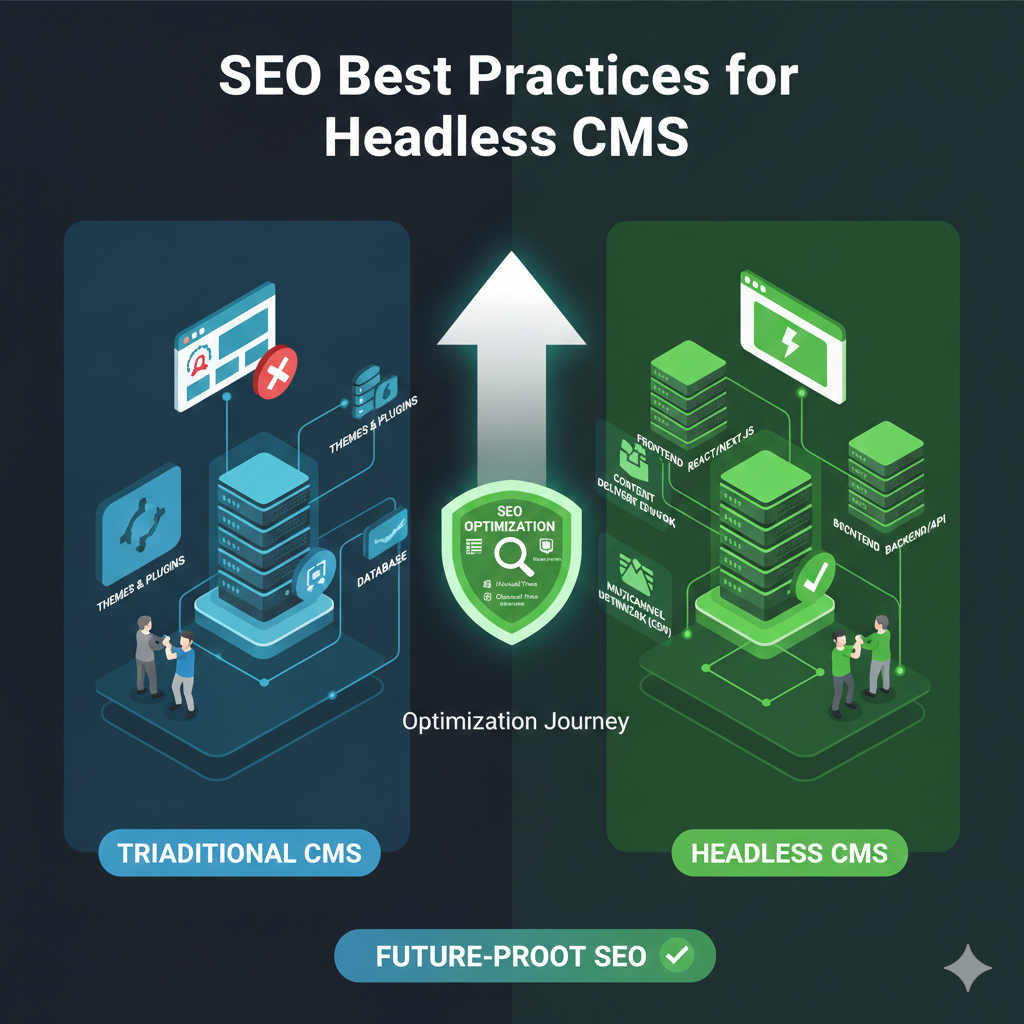
To master SEO in this environment, one must first understand the fundamental structural difference. A traditional CMS (like WordPress or Drupal of the past) couples the backend (content repository) and the frontend (presentation layer) tightly. When a user requests a page, the server builds it instantly.
A headless CMS, such as Contentful, Sanity, or Strapi, severs this link. The content lives in a repository and is delivered via APIs to any frontend destination—be it a website, a mobile app, or a smartwatch.
The SEO Disconnect
This separation is where the friction lies. Search engines like Google are excellent at crawling HTML. However, many headless setups rely heavily on JavaScript frameworks (React, Vue, Angular) to render content in the browser. If the crawler arrives and finds an empty shell waiting for JavaScript to execute, your content may not be indexed correctly.
While the flexibility of “write once, publish everywhere” is a massive benefit for omnichannel marketing, it introduces technical debt. You are no longer just managing content; you are managing how machines interpret your application code.
Rendering Strategies That Impact Indexing & Rankings
In 2026, the debate regarding rendering is no longer just about “making it work”—it is about choosing the precise method that balances user experience (UX) with crawler efficiency. Your choice of rendering strategy is the single most important technical SEO decision you will make.
Server-Side Rendering (SSR)
SSR remains a dominant strategy for dynamic content. With SSR, the HTML is generated on the server for each request. When Googlebot hits the URL, it receives a fully populated HTML page immediately.
- Pros: excellent for SEO; ensures crawlers see exactly what users see.
- Cons: Can be slower to load (Time to First Byte) if the server is under heavy load or located far from the user.
Static Site Generation (SSG)
SSG builds the pages at build time. The HTML is pre-rendered and sits on a CDN (Content Delivery Network), ready to be served instantly.
- Pros: Incredible speed and security. Core Web Vitals scores are usually very high.
- Cons: Build times can become unmanageable for sites with thousands of pages. Content is not “live” until the site is rebuilt.
Hybrid Rendering and ISR
By 2026, Hybrid Rendering and Incremental Static Regeneration (ISR) have become the gold standard for headless CMS SEO. This approach allows you to retain the speed of static generation while updating content dynamically. You can set specific pages to rebuild in the background after a certain interval, ensuring users and crawlers always get fresh content without sacrificing the performance benefits of a static site.
Recommendation: For high-ranking content, leverage Hybrid rendering. Use SSG for your core marketing pages and SSR or ISR for listing pages and news feeds that change frequently.
Core Web Vitals & Performance Optimization
Google’s Core Web Vitals have evolved. In 2026, passing these metrics is a baseline requirement for competitive rankings, particularly in the mobile-first index. Headless architectures often struggle here due to “bloat” from heavy JavaScript libraries.
Managing LCP, CLS, and INP
- Largest Contentful Paint (LCP): This measures loading performance. In a headless environment, LCP often suffers if the browser has to wait for an API call to fetch the hero image or headline.
- Fix: Implement “eager loading” for hero assets and use server-side pre-fetching so the initial view is populated before the browser executes the rest of the script.
- Cumulative Layout Shift (CLS): Visual stability is critical. A common headless issue occurs when content loads asynchronously, causing the layout to jump.
- Fix: Reserve explicit space (aspect ratios) for images and video containers in your CSS so the browser knows how much space to allocate before the API delivers the asset.
- Interaction to Next Paint (INP): Replacing FID (First Input Delay), INP measures responsiveness. Heavy JavaScript execution on the main thread can cause the site to freeze when a user clicks a button.
- Fix: Code splitting. Only load the JavaScript necessary for the current route. Do not force the user to download the code for the “Contact” page when they are reading a blog post.
CDN and Edge Caching
Performance optimization in 2026 relies heavily on edge computing. By caching your API responses and static assets on edge networks (servers located physically closer to the user), you reduce latency significantly. This is vital for maintaining green Core Web Vitals scores across diverse geographies.
Crawlability, Indexation & JavaScript SEO
While Googlebot has become significantly better at rendering JavaScript over the last decade, relying entirely on client-side rendering is still a gamble in 2026.
Googlebot Behavior
Googlebot processes JavaScript in a second wave of indexing (the “rendering queue”). This can delay the indexing of your new content by hours or even days. For news publishers or e-commerce sites running flash sales, this delay is unacceptable.
Managing Crawl Budget
Headless sites built as Single Page Applications (SPAs) often face crawl budget issues. If your internal linking structure relies on user-triggered events (like “Load More” buttons that do not change the URL), crawlers might never find your deeper content.
- Best Practice: Ensure every piece of content has a unique, resolvable URL.
- Best Practice: Use standard HTML
<a>href links for navigation, rather thanonclickJavaScript events.
Metadata, URLs & Canonicalization at Scale
In a traditional CMS, plugins handle metadata automatically. In a headless setup, you must model this data explicitly in your content schema.
Dynamic Meta Tags
You must create specific fields in your headless CMS content model for:
- Meta Titles
- Meta Descriptions
- Open Graph Tags (for social media)
- Twitter Cards
Your frontend developer must then program the application to inject these API values into the <head> of the document during the build or render process. If this is missed, search engines will likely generate their own snippets, which often results in lower click-through rates (CTR).
Pagination and Canonical URLs
Canonicalization is the primary defense against duplicate content. In headless architectures, it is easy to accidentally serve the same content on multiple routes (e.g., /products/shoe and /category/mens/shoe).
- Solution: Programmatically generate self-referencing canonical tags for every page.
- Pagination: Avoid infinite scroll for crawlers. Implement distinct paginated URLs (e.g.,
/blog/page/2) or use a “View All” page to ensure search engines can traverse your full archive.
Structured Data & Schema for Headless CMS
Structured data (Schema.org) helps search engines understand the context of your content and powers rich results (like star ratings, recipe cards, and event snippets).
JSON-LD Automation
Do not hard-code Schema. Instead, create a modular system. When a content editor selects “Recipe” as the content type in the CMS, the frontend should automatically map the ingredients, cook time, and nutrition data from the API response into a valid JSON-LD script block.
Pro Tip: Inject JSON-LD server-side. If you rely on client-side injection, there is a risk that Google will miss the markup if the rendering times out.
International SEO for Headless Architectures
For businesses targeting the US, UK, and Germany, handling localization in a headless environment requires robust architecture. It is not enough to simply translate the text; you must signal the relevance to search engines.
Hreflang Implementation
Implementing hreflang tags is notoriously difficult in headless setups because the frontend needs to know about every other localized version of the current page.
- Strategy: Your API response should include the IDs or slugs of the corresponding translations. The frontend can then iterate through these to build the correct
hreflangheaders.- Example: A user on the German site (
/de/) needs code in the header pointing to the US version (/en-us/) and the UK version (/en-gb/).
- Example: A user on the German site (
Multi-Region Hosting
If you are targeting Germany, your site should load as fast in Berlin as it does in New York. Utilize a global CDN that serves your static assets from nodes within the EU. This not only helps with speed (a ranking factor) but also aids in compliance with data residency regulations which can indirectly impact trust signals.
Security, Hosting & SEO Performance Signals
Security is a confirmed ranking signal. While headless CMSs are generally more secure because the database is not exposed to the public web, the connection between your API and frontend must be bulletproof.
HTTPS and SSL
Ensure that all endpoints—both your frontend delivery URL and your backend API calls—are served over HTTPS. Mixed content errors (loading an HTTP image on an HTTPS page) will hurt your rankings and display security warnings to users.
Edge and Cloud Hosting Impact
In 2026, hosting is synonymous with SEO performance. Platforms like Vercel, Netlify, and AWS Amplify have optimized their infrastructure specifically for headless frameworks (like Next.js and Nuxt). Migrating your frontend to these platforms often results in an immediate boost in Time to First Byte (TTFB), a metric Google watches closely.
SEO Tooling & Monitoring for Headless CMS
You cannot optimize what you cannot measure. Standard tools often fail to capture the nuances of JavaScript-heavy headless sites.
Automated Audits
Integrate SEO testing into your CI/CD (Continuous Integration/Continuous Deployment) pipeline. Tools like Lighthouse CI can block a deployment if the code changes cause the SEO score to drop below a certain threshold. This prevents developers from accidentally pushing code that kills your rankings.
Indexing and Performance Tracking
- Google Search Console: Monitor the “Crawl Stats” report to see if Google is spending too much time downloading JSON resources.
- Screaming Frog: Use the “JavaScript Rendering” mode to compare the HTML source code against the rendered HTML. If there are discrepancies in links or metadata, you have a rendering issue.
Future Trends: Headless CMS SEO Beyond 2026
As we look further ahead, the convergence of AI and search will redefine headless SEO.
AI-Driven SEO Workflows
By late 2026, we expect AI agents to manage large portions of technical SEO. Headless CMS platforms will likely integrate “SEO Copilots” that analyze your content models and suggest structural changes to better align with semantic search and AI Overviews (formerly SGE).
Search + UX Convergence
The line between “good SEO” and “good UX” will vanish completely. Search engines will prioritize sites that offer seamless, app-like transitions (which headless excels at) over simple keyword optimization. The focus will shift entirely to entity optimization—ensuring your CMS feeds search engines structured facts about your business, products, and authors.
Designing Headless CMS for SEO Success
Building a headless website in 2026 offers unparalleled freedom, but it requires a “security by design” approach to SEO. You cannot treat search visibility as an afterthought or a plugin to be installed later.
To succeed, the relationship between the marketing team (who needs the traffic) and the development team (who builds the structure) must be symbiotic. Marketers need to define the SEO requirements—metadata fields, URL structures, schema needs—before a single line of code is written.
By prioritizing server-side or hybrid rendering, obsessed over Core Web Vitals, and ensuring robust international architecture, you can turn your headless CMS into a powerful engine for organic growth. The future of the web is decoupled; ensure your SEO strategy is connected.
FAQ Section
Is a headless CMS good for SEO in 2026?
Yes, a headless CMS can be excellent for SEO, but it is not automatic. It offers cleaner code and faster load times (vital for Core Web Vitals), but it requires developers to manually configure technical elements like metadata, sitemaps, and rendering strategies that traditional CMS platforms might handle out of the box.
How do you improve indexing on a headless CMS site?
To improve indexing, ensure you are using Server-Side Rendering (SSR) or Static Site Generation (SSG) rather than client-side rendering. This ensures Googlebot receives fully rendered HTML immediately. Additionally, submit an XML sitemap to Google Search Console and ensure all internal links use standard HTML anchor tags (<a href="...">) rather than JavaScript events.
What rendering method is best for headless CMS SEO?
For most large-scale websites in 2026, Hybrid Rendering or Incremental Static Regeneration (ISR) is best. This allows you to serve static, fast-loading pages for high-traffic content while updating them dynamically in the background, ensuring content freshness without sacrificing the speed benefits of static generation.
How do Core Web Vitals affect headless CMS rankings?
Core Web Vitals are a significant ranking factor. Headless sites often struggle with LCP (due to slow API calls) and CLS (due to layout shifts as content loads). optimizing these metrics by pre-loading critical assets and reserving space for media is essential for maintaining rankings.
Can headless CMS support international SEO?
Absolutely. Headless is ideal for international SEO because a single content repository can feed multiple regional frontends. However, you must correctly implement hreflang tags programmatically to tell search engines which version of a page to serve to users in the US, UK, or Germany.
What are common SEO mistakes in headless CMS setups?
The most common mistakes include:
- Relying solely on client-side rendering (making content invisible to some crawlers).
- Forgetting to programmatically inject metadata (titles and descriptions).
- Creating “orphan pages” due to poor internal linking structures.
- Mishandling canonical tags, leading to duplicate content issues.