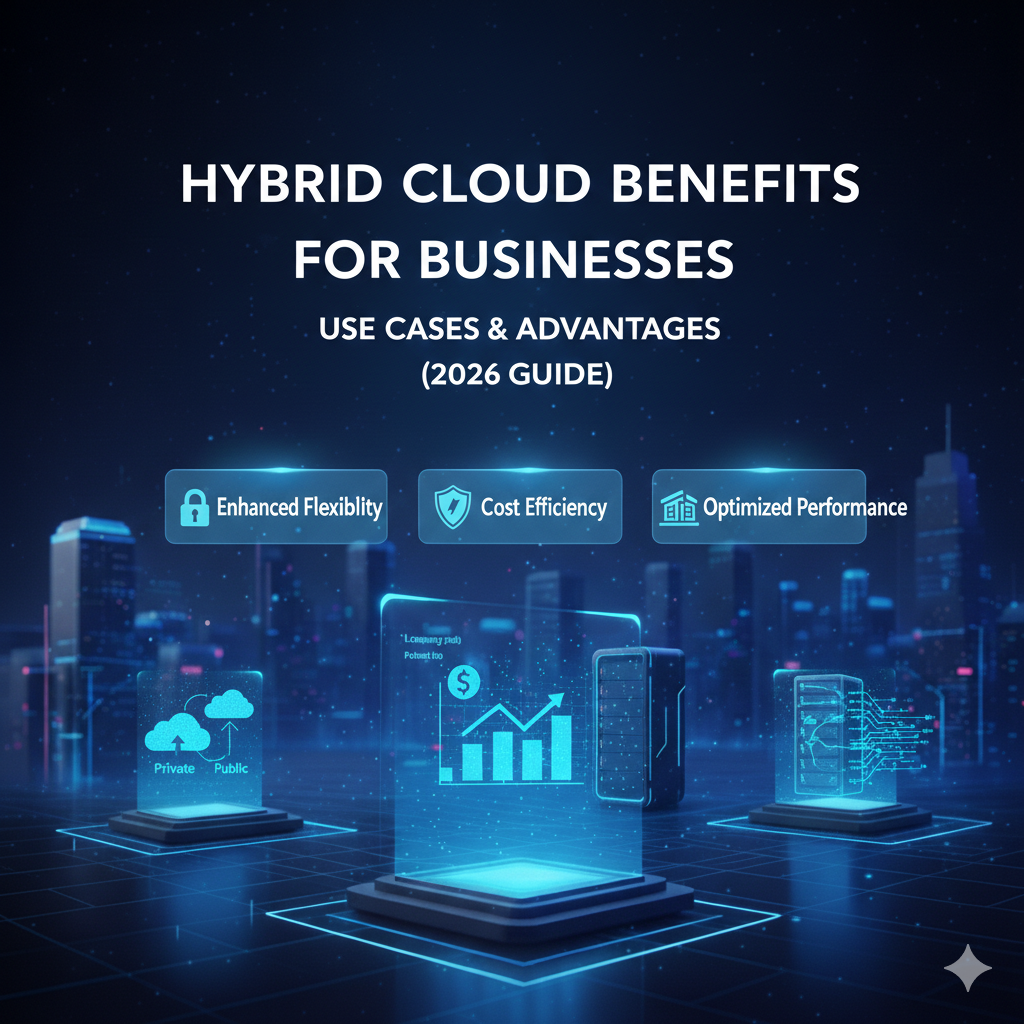
Hybrid Cloud Benefits for Businesses: Use Cases & Advantages
For years, the technology conversation was binary: you either kept your servers on-premises to maintain control, or you moved everything to the public cloud to gain speed and agility. Business leaders were often forced to choose between the security of their own data centers and the boundless innovation offered by providers like AWS, Microsoft Azure, or Google Cloud.
But as digital transformation strategies mature, that binary choice has largely vanished. The modern enterprise doesn’t have to pick a side. Instead, they are increasingly adopting a “best of both worlds” approach known as the hybrid cloud.
Hybrid cloud architecture has emerged as the dominant strategy for businesses that need to balance strict compliance requirements with the need for rapid scaling. It allows organizations to keep sensitive workloads close to home while leveraging the vast computational power of the public cloud for everything else. This guide explores exactly why this model is winning over IT decision-makers, how it functions in the real world, and whether it is the right infrastructure strategy for your organization.
What Is Hybrid Cloud?
At its core, a hybrid cloud is a computing environment that combines an on-premises data center (also called a private cloud) with a public cloud, allowing data and applications to share between them.
This isn’t just about having two different servers; it’s about connectivity. A true hybrid environment uses technology to orchestrate workloads between the two spheres. This orchestration allows you to move data seamlessly as computing needs and costs change. It gives your business greater flexibility and more deployment options than a standard public cloud or private cloud alone.
Think of it like owning a car versus using a ride-sharing service. Your private cloud is the car you own in your garage—it’s yours, you control it, and you use it for your daily, predictable commute. The public cloud is the ride-share—it’s there when you need extra capacity, like when you’re travelling or need to transport a large group of people, and you only pay for what you use. Hybrid cloud computing effectively lets you manage both fleets from a single dashboard.
Why Businesses Choose Hybrid Cloud
The shift toward hybrid infrastructure is rarely accidental. It is usually a deliberate strategic move driven by two main factors: the need for control and the desire for agility.
Balancing Control and Scalability
Many industries, particularly finance, healthcare, and government, are bound by strict regulations regarding where data can reside. They often cannot legally store sensitive customer information on shared public servers. However, these same organizations still need to run high-performance applications that might require massive processing power during peak times.
A hybrid model solves this by allowing them to keep the sensitive “gold” data in their private, on-premises fortress while running the application interface or processing algorithms in the public cloud. This separation ensures compliance without sacrificing the user experience.
Avoiding Full Cloud Lock-in
“Vendor lock-in” is a significant concern for modern CIOs. If you move 100% of your assets to a single public cloud provider, moving away later can be technically difficult and prohibitively expensive.
Adopting a hybrid strategy inherently diversifies your risk. By maintaining a private infrastructure alongside your public cloud resources, you retain the ability to migrate workloads back on-premise if a vendor changes their pricing model or service terms. It keeps the bargaining power in your hands, rather than ceding it entirely to a third-party provider.
Key Benefits of Hybrid Cloud for Businesses
Implementing a hybrid architecture offers tangible operational advantages that go beyond simple data storage. Here is how this model drives business value.
Cost Optimization
One of the most compelling arguments for hybrid adoption is the potential for significant cost savings. Public cloud services are often billed on a variable OpEx (Operating Expense) model—you pay for what you use. While this is great for short-term projects, it can become incredibly expensive for “always-on” workloads that run 24/7.
Conversely, on-premises infrastructure is a CapEx (Capital Expense) investment. Once you buy the hardware, running predictable workloads on it is often cheaper than renting that same capacity from a cloud provider. A hybrid approach allows you to perform “cost arbitrage.” You can run your steady, predictable core business processes on your private infrastructure (the cheaper option) and only tap into the public cloud for temporary spikes or testing environments. This prevents the “sticker shock” often associated with monthly cloud bills.
Scalability & Flexibility
Business demand is rarely a flat line. Retailers see spikes during holidays; tax firms see spikes in April; media companies see spikes when breaking news hits.
If you rely solely on physical servers, you have to buy enough hardware to handle the busiest day of the year, meaning that hardware sits idle for the other 364 days. If you rely solely on the public cloud, you might face latency issues or unexpected costs during those peaks.
Hybrid cloud enables a technique called “cloud bursting.” This is when an application runs in a private cloud or data center and bursts into a public cloud when the demand for computing capacity spikes. This gives you unlimited scalability for traffic surges without requiring you to permanently upgrade your physical infrastructure.
Improved Security & Compliance
Security is often the primary driver for hybrid adoption. While public cloud providers invest billions in security, the “shared responsibility” model can still leave businesses uneasy about hosting their most proprietary secrets on shared hardware.
With a hybrid environment, you don’t have to trust a third party with everything. You can segregate your data based on sensitivity.
- Private Cloud: Holds customer records, intellectual property, and regulated data (GDPR, HIPAA, etc.).
- Public Cloud: Hosts anonymous data, public-facing web applications, and encrypted archives.
This segmentation minimizes the “attack surface” for your most critical assets while still allowing you to innovate.
Business Continuity & Reliability
Disaster recovery is a critical component of IT strategy. If your on-premises data center is hit by a flood, fire, or ransomware attack, you need a backup.
A hybrid cloud provides an immediate, cost-effective failover solution. You can back up your critical data to the public cloud regularly. If your primary site goes down, you can spin up your systems in the public cloud to keep the business running with minimal downtime. Once the crisis is resolved, you can migrate back. This is often far cheaper than maintaining a secondary physical data center that sits empty just in case of an emergency.
Better Performance
Latency—the delay before a transfer of data begins following an instruction—can be a dealbreaker for certain applications. If you are running high-frequency trading algorithms or controlling robotic manufacturing arms, you cannot afford the split-second delay it takes for data to travel to a public cloud data center and back.
Hybrid cloud allows you to keep latency-sensitive processing right on the “edge”—on your local servers—while offloading heavier, non-urgent data processing to the cloud. Furthermore, if you have a global customer base, you can use the public cloud’s global network of data centers (CDNs) to serve content to users from a location physically closer to them, speeding up your website or application for international audiences.
Hybrid Cloud vs Public Cloud vs Private Cloud
Understanding the nuances between these three models helps clarify why hybrid is often the middle-ground winner.
Public Cloud:
- What it is: Infrastructure owned by a third party (AWS, Google, Azure) and shared by multiple organizations.
- Pros: Zero maintenance, infinite scalability, pay-as-you-go.
- Cons: Less control over data, potential security concerns for sensitive industries, unpredictable costs.
Private Cloud:
- What it is: Infrastructure dedicated solely to your organization, either on-premises or hosted by a third party.
- Pros: Maximum security, total control, predictable performance.
- Cons: High initial cost (hardware), expensive to maintain (staffing/power), difficult to scale quickly.
Hybrid Cloud:
- What it is: A connected mix of both.
- Pros: Offers the scalability of public with the security of private. Optimizes costs by placing workloads where they are cheapest to run.
- Cons: More complex to manage and set up. Requires software to “glue” the environments together.
Common Hybrid Cloud Use Cases
So, what does this look like in practice? Here are four scenarios where hybrid cloud shines.
1. Enterprise Applications
Large corporations often have massive ERP (Enterprise Resource Planning) systems. They might use a hybrid model to run the core database on secure, private servers, while running the web interface (where employees log in) on the public cloud to ensure fast access from branch offices worldwide.
2. E-commerce Platforms
During sales events like Black Friday, traffic can jump by 500%. An e-commerce business can host its catalog and transaction engine on the private cloud for security but use the public cloud to host static images and handle the surge in web traffic, preventing the site from crashing.
3. Data Backup and Disaster Recovery
Many organizations replicate their on-premise servers to a public cloud environment. This is “cold storage”—it costs very little to keep the data there until it is needed. If a server fails in the office, the cloud backup is activated instantly.
4. Legacy System Modernization
Many established companies rely on mainframe computers or old software that simply cannot be moved to the cloud. A hybrid approach allows them to keep that “legacy” hardware running on-premise but build modern, consumer-facing apps in the public cloud that connect back to the old system via APIs. This bridges the gap between old and new tech without a total rebuild.
Challenges of Hybrid Cloud
While the benefits are substantial, hybrid cloud is not a magic wand. It introduces layers of complexity that IT leaders must acknowledge.
Management Complexity
Managing two different environments requires a sophisticated set of tools and skills. Your IT team needs to know how to manage physical hardware and how to configure cloud instances. This creates a “skills gap” that can be hard to fill.
Integration and Networking Issues
The “hybrid” part only works if the two sides talk to each other efficiently. Setting up the networking tunnels, VPNs, or direct connections between your office and the cloud provider can be technically challenging. If this link is slow or unstable, the whole benefits of the architecture crumble.
Cost Monitoring Difficulties
While hybrid can save money, it can also hide waste. It is easy to lose track of resources when they are spread across different environments. Without a centralized view of your spending (FinOps), you might end up paying for duplicate services or leaving cloud instances running when they should have been shut down.
Is Hybrid Cloud Right for Your Business?
Deciding to move to a hybrid model is a significant architectural decision. Consider these three factors before making the leap.
Business Size Considerations
Small businesses often benefit more from a pure public cloud approach because they lack the IT staff to manage physical servers. Hybrid is typically better suited for mid-sized to large enterprises that already have some on-premise infrastructure they want to leverage.
Technical Requirements
Does your business rely on low-latency applications or handle highly sensitive data? If yes, hybrid is likely the correct choice. If your applications are standard web-based tools (like CRM or email), a full public cloud deployment might be simpler.
Budget and Skill Assessment
Do you have the capital to invest in (or upgrade) your own servers? Do you have a team capable of managing complex network integrations? If your budget is strictly OpEx and your team is small, look carefully at the management overhead hybrid requires.
FAQs – Hybrid Cloud Benefits
What is the main benefit of hybrid cloud?
The primary benefit is agility. It gives businesses the flexibility to move workloads between secure private environments and scalable public environments based on current needs, costs, and regulatory demands.
Is hybrid cloud more secure?
Potentially, yes. It allows you to keep your most sensitive data behind your own firewalls (private cloud) while still using the public cloud for less critical tasks. However, security depends heavily on how well the connection between the two clouds is managed.
Does hybrid cloud reduce costs?
It can reduce costs if managed correctly. By running predictable, always-on workloads on private servers (which is often cheaper than cloud rental) and only using the public cloud for temporary spikes, you optimize your IT spend.
Can small businesses use hybrid cloud?
Yes, but it is often more complex than necessary for very small firms. Small businesses might use a “light” version of hybrid cloud, such as keeping files on a local office server but backing them up to Google Drive or AWS.
How does hybrid cloud improve scalability?
It utilizes “cloud bursting.” When your private servers reach maximum capacity, traffic is automatically overflowed to the public cloud. This ensures your services never go offline due to high demand.
Taking the Next Step in Your Cloud Journey
The cloud is no longer a destination; it is an operating model. For many businesses, the hybrid cloud represents the most mature, pragmatic version of that model. It acknowledges the reality that not everything belongs in the public cloud, nor should everything stay locked in a basement server room.
If your organization is looking to modernize without losing control, or scale without breaking the bank, a hybrid architecture is likely your strongest path forward. Start by auditing your current workloads: identify what needs to stay, what should go, and how connecting the two could unlock new efficiency for your team.