Secure, Sustainable, and Scalable: Why OVHcloud Is Powering the Future of Ethical Computing
In 2026, the question is no longer just “Does it work?” but rather “Is it right?” As businesses continue to digitize every aspect of their operations, the infrastructure underpinning these technologies has come under scrutiny. We are entering an era where technology choices are not merely operational decisions; they are moral ones.
For decades, the primary metrics for cloud computing were speed, storage, and cost. While these remain critical, a new dimension has emerged: ethical computing. This concept encompasses everything from how data is secured and where it is stored to the environmental footprint of the data centers powering our digital lives.
Business leaders are waking up to the reality that their digital supply chain—specifically their choice of cloud provider—directly impacts their ESG (Environmental, Social, and Governance) goals. A company cannot claim to be sustainable if its workloads are running on inefficient, coal-powered servers. Nor can it claim to value user privacy if it stores customer data in jurisdictions with invasive surveillance laws.
This article explores why ethical computing is the inevitable future of IT strategy. We will examine the pillars of responsible technology—security, sustainability, and transparency—and demonstrate how providers like OVHcloud are leading the charge in building a cloud that is not just powerful, but principled.
What Is Ethical Computing?
At its core, ethical computing explained is the practice of designing, deploying, and maintaining technology in a way that respects human rights, environmental boundaries, and societal well-being. It moves beyond simple compliance to address the broader impact of technology on the world.
Responsible technology principles dictate that digital infrastructure should not be a “black box.” Instead, it requires:
- Integrity: Ensuring data is handled with strict adherence to privacy laws and moral standards.
- Accountability: Taking ownership of the environmental impact of computing resources.
- Fairness: Avoiding exploitative pricing models and ensuring accessibility.
Ethical computing is not a niche trend; it is the new baseline for modern digital infrastructure.
Why Businesses Are Prioritizing Ethical Infrastructure
The shift toward ethical cloud computing is driven by a convergence of market forces. First and foremost is customer trust. In an age of frequent data breaches and misuse, consumers are increasingly wary of how their information is handled. They prefer brands that demonstrate a genuine commitment to privacy and security.
Secondly, regulatory landscapes are tightening. From GDPR in Europe to various state-level privacy acts in the US, compliance is no longer optional. An ethical IT strategy ensures that businesses stay ahead of these regulations rather than scrambling to catch up.
Finally, corporate ESG commitments are moving from marketing slides to board-level mandates. Investors and stakeholders are demanding concrete evidence of sustainability. Migrating to an ethical cloud provider is one of the most effective ways to reduce Scope 3 emissions (indirect emissions from the value chain) and demonstrate a commitment to a greener future.
Security as a Foundation of Ethical Computing
There is no ethics without safety. If a platform cannot protect the data entrusted to it, it fails the most basic test of responsibility. This makes secure cloud infrastructure the bedrock of ethical computing.
Ethical providers move beyond standard firewalls to implement rigorous data privacy cloud hosting standards. This often involves adopting “Zero Trust” models, where no user or device is trusted by default, regardless of their location within the network.
Furthermore, ethical security involves data sovereignty—knowing exactly where your data resides and under whose laws it falls. For global enterprises, this is crucial. Using a provider that guarantees data remains within specific legal borders protects against extraterritorial data access and ensures compliance with local privacy regulations.
Sustainability and Environmental Responsibility
The cloud is physical. Every email sent, every database queried, and every AI model trained generates heat and consumes electricity. The environmental impact of the digital sector is significant, rivaling the aviation industry in terms of carbon emissions.
Green cloud hosting addresses this by rethinking data center design. Traditional data centers rely heavily on energy-intensive air conditioning units to keep servers cool. In contrast, sustainable data centers utilize innovative technologies like water cooling.
OVHcloud, for example, pioneered industrial-scale water cooling for servers in 2003. This technology eliminates the need for air conditioning in server rooms, significantly reducing energy consumption. By prioritizing green cloud hosting, businesses can drastically lower their carbon footprint without sacrificing performance.
Scalability Without Resource Waste
One of the often-overlooked aspects of ethical computing is efficiency. Waste—whether it is wasted energy, wasted hardware, or wasted budget—is inherently unethical in a resource-constrained world.
Scalable cloud infrastructure must be designed to match resource usage with actual demand. This prevents the common problem of “zombie servers”—instances that are running and consuming power but doing no useful work.
Cloud resource optimization ensures that businesses only use (and pay for) what they need. True scalability allows for predictable growth, enabling companies to ramp up computing power during peak times and scale down during lulls. This elasticity is not just good for the bottom line; it is a key component of a sustainable, responsible IT strategy.
Transparency and Vendor Independence
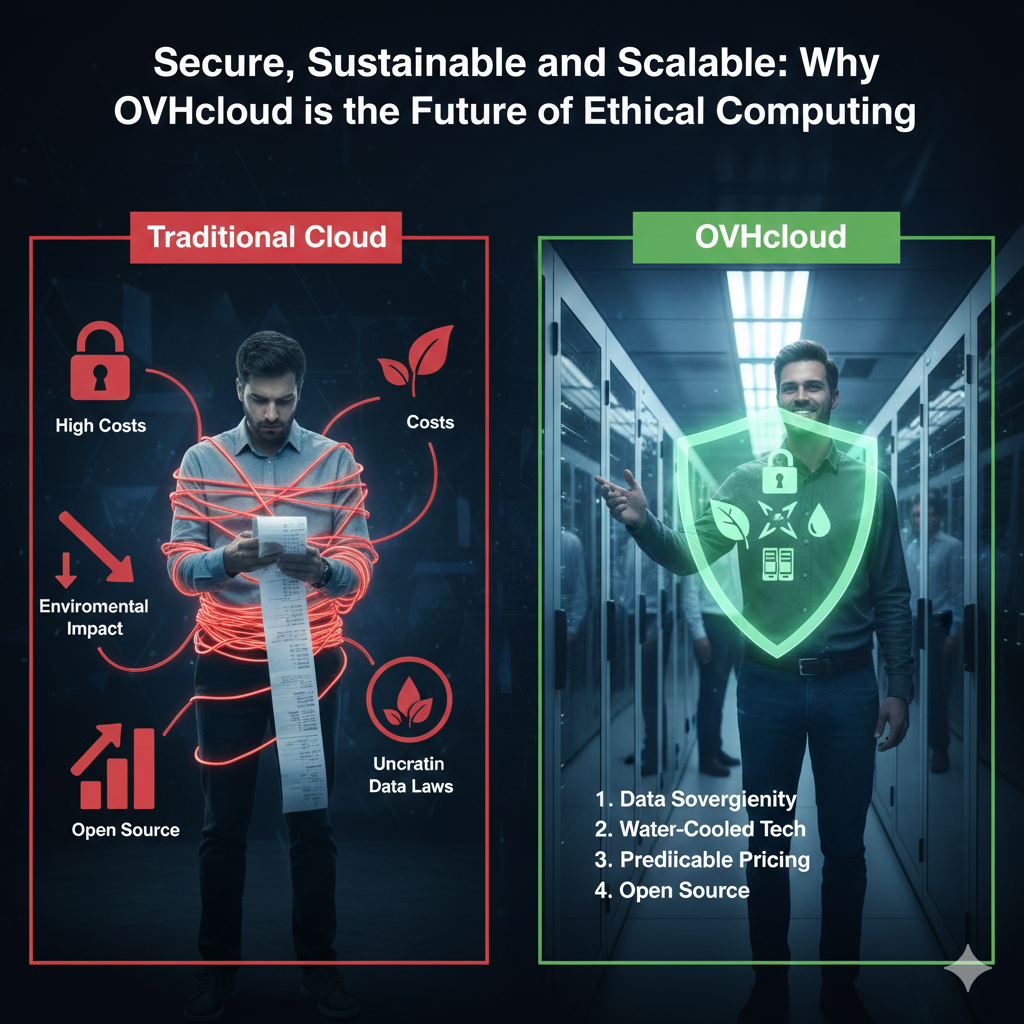
The “lock-in” effect is a significant issue in the cloud market. Many hyperscalers make it easy to put data in but prohibitively expensive or technically difficult to get it out. Ethical computing demands transparent cloud pricing and freedom of movement.
Sovereign cloud hosting champions the idea that you should retain full control over your data and your technology stack. This includes:
- Pricing Clarity: No hidden fees for data egress or API calls. You should know what your bill will look like before you receive it.
- Open Standards: Building on open-source technologies that allow you to migrate workloads between providers if necessary.
- Data Sovereignty: Ensuring that your data is not subject to the CLOUD Act or other regulations that allow foreign governments to access it without your consent.
Reducing vendor lock-in fosters a healthy, competitive market and puts the power back in the hands of the customer.
How OVHcloud Aligns with Ethical Computing Principles
OVHcloud stands out as a prime example of an ethical cloud provider. Their unique model of vertical integration—designing their own servers, building their own data centers, and managing their own fiber-optic network—gives them unparalleled control over their supply chain.
This approach allows for rigorous OVHcloud sustainability measures. By manufacturing their own servers, they can optimize for energy efficiency and extend hardware lifecycles through refurbishment and recycling. Their proprietary water-cooling technology allows them to achieve industry-leading PUE (Power Usage Effectiveness) ratings.
Moreover, OVHcloud operates with a “privacy-first” mindset. As a European provider, they are deeply rooted in GDPR compliance and data sovereignty, offering a secure alternative to US-based hyperscalers. Their commitment to open standards ensures that customers are never trapped, aligning perfectly with the principles of transparency and fairness.
Real-World Ethical Computing Use Cases
The transition to responsible cloud hosting is already underway across various sectors:
- SaaS Providers: Software companies are using ethical cloud infrastructure to assure their own clients that their data is safe and that the software supply chain is sustainable.
- Healthcare: Hospitals and medical startups require strict data privacy. Ethical cloud use cases in healthcare rely on sovereign clouds to protect patient records while leveraging high-performance computing for research.
- AI Startups: Training AI models requires immense computational power. By choosing a green cloud provider, AI companies can mitigate the environmental impact of their heavy workloads.
Ethical Cloud vs. Hyperscaler Cloud
When choosing a provider, the distinction between an ethical cloud vs. hyperscaler becomes clear in three key areas:
| Feature | Ethical Cloud (e.g., OVHcloud) | Traditional Hyperscaler |
|---|---|---|
| Data Control | High sovereignty; strict adherence to local privacy laws (e.g., GDPR). | Often subject to extraterritorial laws (e.g., US CLOUD Act). |
| Environmental Impact | Optimized PUE; often uses water cooling and circular economy principles. | varied; often relies on offsetting rather than direct reduction. |
| Cost Transparency | Predictable, transparent pricing; often zero ingress/egress fees. | Complex pricing structures; high egress fees that create lock-in. |
While hyperscalers offer massive scale, AWS alternatives cloud providers like OVHcloud offer a compelling balance of performance, price, and principle.
How to Evaluate an Ethical Cloud Provider
To ensure you are choosing a partner that aligns with your values, use this ethical cloud checklist:
- Sustainability Metrics: Do they publish their PUE and WUE (Water Usage Effectiveness) scores? Are they transparent about their carbon footprint?
- Security Certifications: Look for ISO 27001, SOC 2, and relevant regional compliance certifications (like SecNumCloud in France).
- Governance Policies: Review their data sovereignty guarantees. Do they offer an “open cloud” based on interoperable standards?
- Hardware Lifecycle: Do they refurbish servers? What happens to the hardware at the end of its life?
Using these criteria will help you choose a sustainable cloud provider that supports your long-term business and ethical goals.
Business ROI of Ethical Computing
Adopting ethical computing is not just an act of corporate benevolence; it drives tangible business value.
- Brand Value: Consumers and B2B partners increasingly prefer sustainable, privacy-focused brands. Ethical infrastructure becomes a marketable asset.
- Regulatory Readiness: Being proactive about data sovereignty and sustainability protects the business from future fines and regulatory crackdowns.
- Long-Term Cost Stability: Transparent pricing and energy-efficient infrastructure insulate the business from volatile energy costs and surprise cloud bills.
FAQ – Ethical Computing & OVHcloud
Q1: What is ethical computing?
Ethical computing refers to the development and use of technology in ways that align with moral principles, prioritizing data privacy, environmental sustainability, and social responsibility. It ensures technology serves humanity without exploiting users or the planet.
Q2: Why does sustainability matter in cloud computing?
Data centers consume massive amounts of electricity and water. Prioritizing sustainability reduces the global carbon footprint and helps combat climate change. For businesses, it is also essential for meeting ESG goals and reducing operational costs associated with energy inefficiency.
Q3: Is OVHcloud considered a green cloud provider?
Yes, OVHcloud is a leader in green cloud hosting. They utilize proprietary water-cooling technology to eliminate the need for air conditioning in servers, achieve low PUE scores, and manufacture their own servers to optimize the hardware lifecycle through recycling and refurbishment.
Q4: How does ethical computing improve data security?
Ethical computing emphasizes “privacy by design” and data sovereignty. It ensures that data is stored in secure jurisdictions, protected by robust encryption, and managed transparently, reducing the risk of unauthorized access and government surveillance.
Q5: What industries benefit most from ethical cloud infrastructure?
While all industries benefit, highly regulated sectors like healthcare, finance, and government see the most immediate value due to strict data privacy requirements. Additionally, AI and SaaS companies benefit significantly from the cost efficiency and sustainability credentials.
Q6: How can companies transition to ethical computing?
Companies can start by auditing their current cloud usage and carbon footprint. The next step is to evaluate providers based on the ethical cloud checklist (sustainability, sovereignty, transparency) and migrate workloads to a provider like OVHcloud that aligns with these values.
Building a Future-Proof Strategy
The future of technology is not just about computing power; it is about computing power with a conscience. As we look toward 2026 and beyond, the businesses that will thrive are those that recognize technology as a pillar of their corporate identity and responsibility.
Ethical computing offers a pathway to a more secure, sustainable, and scalable future. It turns IT infrastructure from a commodity into a competitive advantage. By partnering with providers like OVHcloud, organizations can ensure that their digital growth does not come at the expense of their values.
Now is the time to evaluate your cloud strategy. Is your infrastructure working for the future, or against it? Make the switch to a cloud that respects your data, your budget, and the planet.