
Domain vs Hosting: What’s the Difference Explained
Building a website requires two fundamental components: a domain name and web hosting. While these terms are often mentioned together, they serve entirely different purposes. Understanding the distinction between them is essential for anyone looking to establish an online presence.
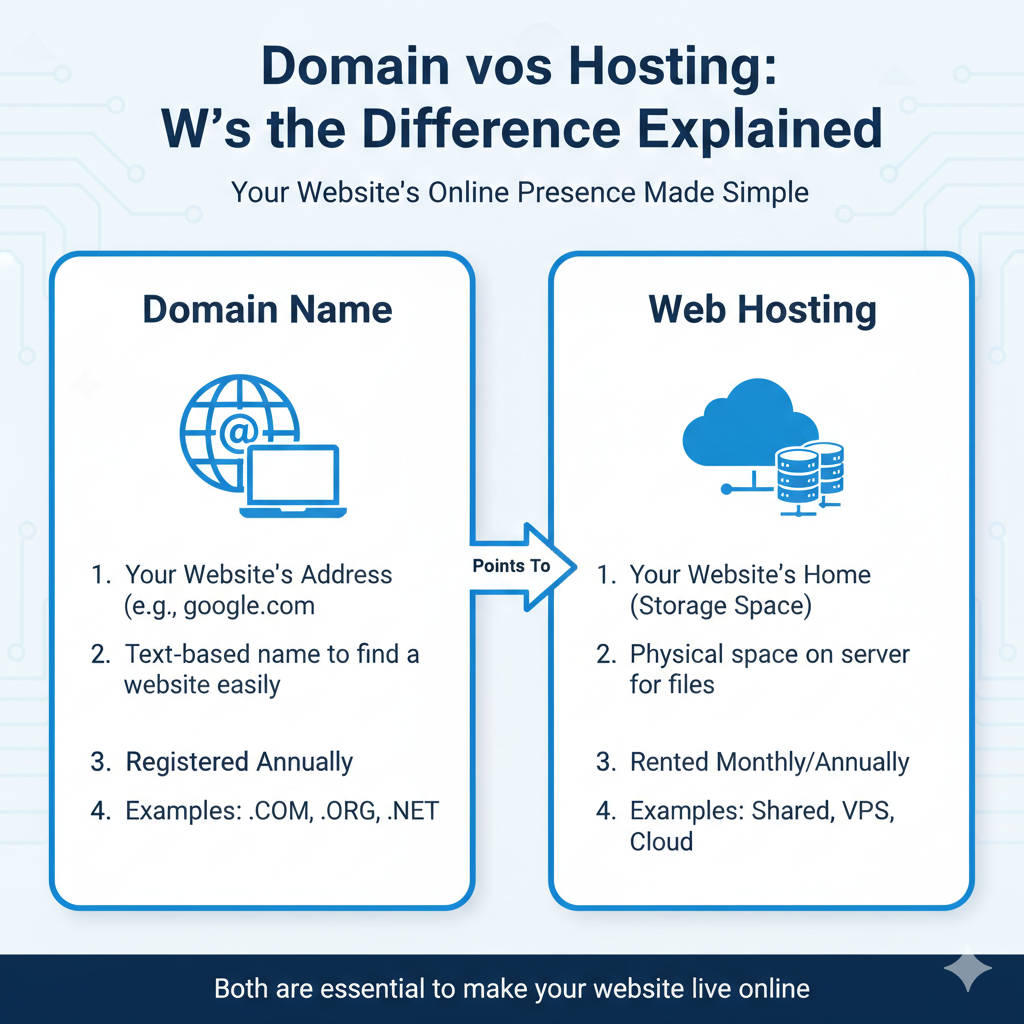
A domain name is your website’s address on the internet—the URL visitors type into their browser to find you. Web hosting, on the other hand, is the service that stores your website’s files and makes them accessible online. Think of it this way: if your website were a house, the domain would be its street address, and hosting would be the physical structure itself.
Many people confuse these two services or assume they’re bundled together automatically. In reality, you can purchase them separately from different providers, though many companies offer both for convenience. This guide will break down exactly what domains and hosting are, how they work together, and what you need to know before launching your website.
What Is a Domain Name?
A domain name is the unique address that identifies your website on the internet. It’s what users type into their browser’s address bar to visit your site. For example, if your business is called “Stellar Designs,” your domain might be stellardesigns.com.
Domain names consist of two main parts: the name itself (like “stellardesigns”) and the extension (like “.com,” “.org,” or “.net”). Together, they create a memorable way for people to find your website without needing to remember a string of numbers.
You don’t technically own a domain name—you lease it from a domain registrar for a specified period, typically one year at a time. These registrars are organizations accredited to sell domain names. Popular registrars include GoDaddy, Namecheap, and Google Domains. When you register a domain, you’re essentially reserving that web address for your exclusive use during the registration period.
Domain names must be unique. Once someone registers a particular domain, no one else can use it until it expires and becomes available again. This is why choosing and securing your domain early is important, especially if you have a specific brand name in mind.
To learn more about how domains connect to your website’s infrastructure, check out our guide on web hosting basics.
What Is Web Hosting?
Web hosting is a service that provides the server space where your website’s files are stored. Every website consists of files—HTML documents, images, videos, stylesheets, and scripts. These files need to live somewhere accessible to the internet 24/7, and that’s what a hosting provider offers.
When you sign up for web hosting, you’re essentially renting space on a physical server owned by the hosting company. This server is a powerful computer that stays connected to the internet constantly, ensuring your website remains accessible to visitors around the clock.
Hosting services vary in what they offer. At a minimum, they provide storage space for your files and bandwidth to handle visitor traffic. More comprehensive plans include features like email accounts, security certificates, automatic backups, and technical support.
Different types of hosting cater to different needs. Shared hosting places multiple websites on one server, making it affordable but potentially slower during traffic spikes. VPS (Virtual Private Server) hosting offers more dedicated resources and better performance. Dedicated hosting gives you an entire server to yourself, ideal for high-traffic sites. Cloud hosting distributes your website across multiple servers for enhanced reliability.
Understanding what web hosting means for your specific website needs will help you choose the right plan and provider.
Key Differences Between Domain and Hosting
While domains and hosting work together to make your website accessible, they serve distinct functions. Here’s a breakdown of their key differences:
| Feature | Domain | Hosting |
|---|---|---|
| Purpose | Serves as your website’s address | Provides server storage for website files |
| Managed by | Domain registrar | Hosting provider |
| Cost structure | Annual registration fee | Monthly or annual subscription |
| Required? | Yes, to have a web address | Yes, to store and display content |
| Can be changed? | Can be transferred between registrars | Can be migrated between providers |
| Examples | GoDaddy, Namecheap, Google Domains | Bluehost, SiteGround, HostGator |
The domain is what people see and remember—it’s your brand’s online identity. Hosting is the behind-the-scenes infrastructure that makes your website function. You need both to have a working website, but they’re purchased and managed separately, even when bought from the same company.
One way to understand this relationship: your domain name points visitors to your hosting server, where your website’s content is stored and delivered to their browsers.
How Domain and Hosting Work Together
When someone types your domain name into their browser, a complex but nearly instantaneous process begins. Understanding this process helps clarify why you need both a domain and hosting.
First, when a user enters your domain (like yourwebsite.com), their browser sends a request to find out where that website is located. This request goes to the Domain Name System (DNS), which acts like the internet’s phonebook. The DNS contains records that connect domain names to their corresponding IP addresses.
An IP address is a unique numerical identifier (like 192.168.1.1) assigned to every server on the internet. While humans prefer memorable names like “yourwebsite.com,” computers communicate using these numerical addresses. To understand more about how DNS works, think of it as a translation service between human-friendly domain names and computer-friendly IP addresses.
Once the DNS identifies what an IP address is for your domain, it directs the browser to your hosting server. The server then retrieves your website’s files and sends them back to the visitor’s browser, which assembles and displays your web page.
This entire process—from typing the domain to seeing the website—takes just milliseconds. Your domain acts as the signpost that guides visitors, while your hosting provides the destination where your website actually lives.
The connection between your domain and hosting is established through nameservers. These are special DNS servers provided by your hosting company. When you purchase a domain and hosting separately, you’ll need to update your domain’s nameserver settings to point to your hosting provider’s servers. Most hosting companies provide clear instructions for this process.
Do You Need Both Domain and Hosting?
Yes, you need both a domain name and web hosting to have a fully functional website accessible to the public. However, the type of hosting you need depends on what kind of website you’re building.
For a static website (one with fixed content that doesn’t change frequently), you’ll need both a domain and basic hosting. Static sites typically consist of HTML, CSS, and JavaScript files. They don’t require databases or server-side processing, so shared hosting is usually sufficient and affordable.
For a WordPress site, you need both a domain and hosting that supports WordPress. Many hosting providers offer WordPress-specific plans that come pre-configured with the WordPress software. These plans typically include features like one-click WordPress installation, automatic updates, and WordPress-optimized server settings. A shared hosting solution works well for small to medium-sized WordPress sites.
For an ecommerce site, you’ll need a domain and more robust hosting. Online stores require additional resources to handle product databases, payment processing, and customer accounts. They also need enhanced security features like SSL certificates to protect sensitive information. Depending on your expected traffic and the size of your product catalog, you might need a VPS hosting option or even dedicated hosting to ensure fast loading times and reliable performance.
Some website builders like Wix or Squarespace include both domain registration and hosting in their packages, simplifying the process for beginners. However, this convenience comes with less flexibility and control compared to purchasing these services separately.
If you’re building an email-only presence without a website, you technically only need a domain. Many domain registrars offer email hosting services that let you create professional email addresses (like name@yourdomain.com) without requiring web hosting.
Can You Buy Domain and Hosting From Different Companies?
Absolutely. You can purchase your domain from one company and your hosting from another. Many website owners do this to take advantage of better pricing, features, or customer service from different providers.
When you buy from different companies, you’ll need to connect them using nameservers. Nameservers are provided by your hosting company and tell the internet where to find your website’s files. You’ll log into your domain registrar’s control panel and update the nameserver settings to point to your hosting provider’s nameservers.
This process is straightforward but does require a basic understanding of how DNS works. Most hosting companies provide step-by-step instructions, and the changes typically take effect within 24-48 hours (though often much faster).
Advantages of separating domain and hosting:
- Better pricing: Domain registrars often offer competitive renewal rates, while hosting companies might inflate domain prices.
- Flexibility: You can switch hosting providers without transferring your domain, or vice versa.
- Specialization: Some companies excel at domain services while others focus on hosting quality.
- Risk management: If one provider has issues, your domain or hosting isn’t held hostage.
Disadvantages of separating domain and hosting:
- Extra setup: You’ll need to configure nameservers manually.
- Multiple accounts: Managing services through different control panels can be less convenient.
- Support complexity: If something goes wrong, you might need to contact two different support teams.
For beginners, buying both from the same company can simplify setup and management. Many hosting providers offer a free domain for the first year when you purchase a hosting plan, making it an economical starting point. As you become more comfortable with website management, you can always transfer your domain or hosting to different providers if needed.
FAQs About Domain vs Hosting
Is a domain free with hosting?
Many hosting providers offer a free domain for the first year when you purchase an annual hosting plan. After the first year, you’ll need to pay the standard renewal fee, which typically ranges from $10-$20 annually depending on the domain extension. Some premium or specialized hosting plans include a free domain indefinitely, but this is less common. Always check the terms to understand when domain renewal charges will begin.
Can I transfer my domain to another hosting provider?
Yes, you can transfer your domain to a different registrar, and you can also move your hosting to a different provider. These are separate processes. If you’re just changing hosting providers but keeping your domain registrar the same, you don’t need to transfer the domain—you simply update the nameserver settings to point to your new host. If you want to transfer domain registration to a new registrar, you’ll need to unlock the domain, obtain an authorization code, and initiate the transfer through the new registrar. Most domain transfers take 5-7 days to complete.
What happens if my hosting expires?
If your hosting subscription expires and isn’t renewed, your website will go offline. Visitors who try to access your domain will see an error message. Your files may remain on the server for a grace period (typically 30-90 days), during which you can renew your hosting and restore your site. After this grace period, the hosting company will likely delete your files permanently. Your domain registration isn’t affected by hosting expiration—it will continue to be registered to you until its own renewal date.
What happens if my domain expires?
When a domain registration expires, it goes through several stages. First, there’s a grace period (usually 30 days) where you can renew it at the regular price. Next comes a redemption period (typically 30-90 days) where renewal is possible but at a significantly higher fee. Finally, if still not renewed, the domain becomes available for anyone to register. During expiration, your website will stop working even if your hosting is active, because the domain no longer points to your server. Email services associated with the domain will also stop functioning.
Which should I buy first—domain or hosting?
It doesn’t matter which you purchase first, but securing your desired domain early is wise. Domain names can be registered and “parked” (held without active hosting) until you’re ready to build your site. This prevents someone else from taking your preferred name. Many people register their domain first to secure their brand, then shop for hosting when they’re ready to build. Alternatively, purchasing both together from the same provider during a promotional period can save money and simplify setup. The key is to secure your domain name as soon as you’ve decided on it, since good domain names become unavailable quickly.
Getting Started With Your Website
Understanding the difference between a domain and hosting is the first step toward building your online presence. A domain gives your website its identity and makes it memorable to visitors, while hosting provides the infrastructure that makes your website accessible around the clock.
Both components are essential, but they serve different roles in your website’s ecosystem. Whether you choose to purchase them from the same provider for convenience or from different companies to optimize cost and features, knowing how they work together empowers you to make informed decisions.
Before launching your website, take time to research both domain registrars and hosting providers. Compare pricing, renewal rates, customer support quality, and included features. Consider your website’s specific needs—a personal blog requires far less robust hosting than an ecommerce store with hundreds of products.
Remember that both domain registration and hosting are ongoing expenses. Factor renewal costs into your budget to avoid unexpected service interruptions. Most importantly, set calendar reminders for renewal dates so you never lose access to your domain or hosting due to accidental expiration.
Ready to take the next step? Secure your domain name today and explore hosting options that align with your website’s goals and growth plans.
See also:
| Step By Step Guide To Buying Domain Hosting Together |
| How To Choose A Uk Web Host With Co Uk Domain Registration 2026 Guide |
| How To Register A Ae Domain Step By Step Guide For Uae Residents 2026 |