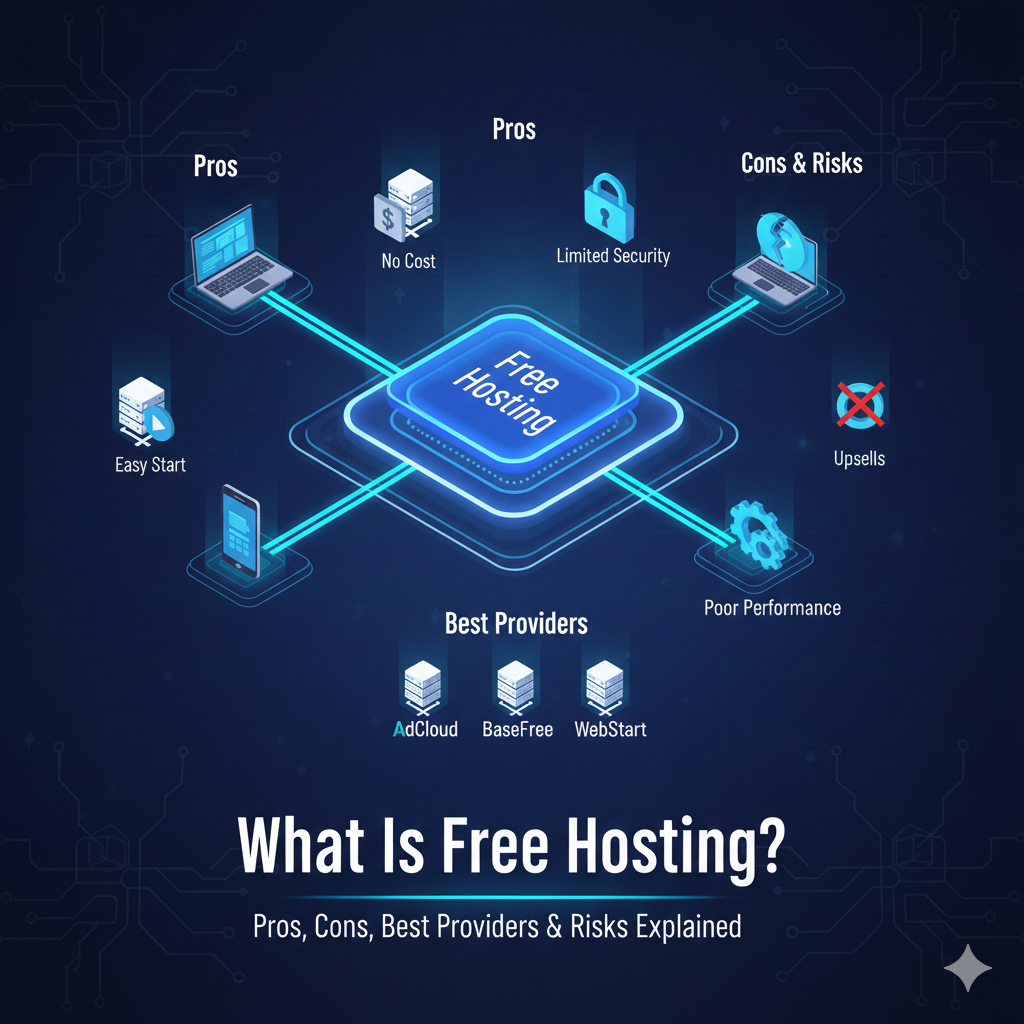
What Is Free Hosting? Pros, Cons, Best Providers & Risks Explained
Launching a website is an exciting venture, but it often comes with a daunting list of expenses. You need a domain name, potentially a designer or developer, and a place for your website to live on the internet—otherwise known as web hosting. When you start researching options, you will almost certainly stumble upon a term that sounds too good to be true: free hosting.
For students, hobbyists, or anyone testing the waters of web development, the appeal is obvious. Why pay monthly fees when you can get your site online for zero dollars?
However, the reality of free website hosting is rarely as simple as it seems. While legitimate options exist, they often come with significant strings attached—from restrictive limits on storage to intrusive advertisements placed on your content. Understanding what is free hosting and how it functions is crucial before you entrust your data to a provider who isn’t charging you a dime.
In this comprehensive guide, we will break down the free web hosting meaning, explore the different types available, and offer an honest look at the pros, cons, and safety risks involved. By the end, you will know exactly whether a free plan is the right launchpad for your project or if a low-cost paid alternative is the smarter investment.
What Is Free Hosting? (Definition)
At its core, the free hosting definition is straightforward: it is a service that allows you to publish a website on the internet without paying a subscription fee. A web hosting company provides you with server space, bandwidth, and maintenance, covering the costs that would usually be passed on to the customer.
But server farms, electricity, and technical support staff cost money. So, how free hosting works usually involves a trade-off. To offer these services for free, providers must monetize their platform in other ways or drastically limit the resources you can use.
Most free hosting providers operate on one of two models:
- Ad-Supported: The host places banner ads or pop-ups on your website. You provide the content; they collect the ad revenue.
- Freemium Model: This is the most common modern approach. The provider offers a basic, limited version of their service for free, hoping you will eventually outgrow the limitations and upgrade to a paid “Premium” plan.
Types of Free Hosting
Not all zero-cost hosting is created equal. Depending on your goals, you might encounter different variations of free hosting types.
Ad-Supported Free Hosting
This was the standard in the early days of the internet (think Geocities). Today, it is less common but still exists. The provider injects code into your website that displays advertisements. You usually have no control over what ads are shown, which can look unprofessional and sometimes even display competitors’ products.
Freemium Hosting
This is the best free hosting platform model for most users. Companies like Wix, Weebly, or specialized WordPress hosts offer a free tier. They won’t force ads on your site (though they might include a “Powered by…” footer), but they will cap your storage, bandwidth, and features to encourage an upgrade.
Free Trials
While not permanently free, many premium hosts offer extended free trials (ranging from 14 days to a few months). This is strictly for testing purposes. If you don’t pay when the trial ends, your site is taken offline.
Student / Community Hosting
Some organizations, universities, or developer communities offer free hosting to students or open-source contributors. These are generally high-quality but come with strict eligibility requirements.
What Do You Get With Free Hosting?
When you sign up for a free website hosting plan, it is important to manage your expectations. You are essentially getting a “lite” version of a real hosting environment. Here is a breakdown of the typical free hosting features and limitations.
Storage and Bandwidth Limits
Paid hosting might offer 50GB of storage or unmetered bandwidth. Free hosting usually caps storage at 300MB to 1GB and strictly limits bandwidth. If your site gets a sudden spike in traffic (viral popularity), a free host will often suspend your site immediately to preserve server resources for other users.
Subdomain Usage
With paid hosting, you use a custom domain (e.g., www.yourbusiness.com). With free hosting, you are often forced to use a subdomain (e.g., www.yourbusiness.wixsite.com or yourname.wordpress.com). This is one of the biggest free hosting limitations for branding.
Limited Support
Customer support is expensive. Therefore, free users rarely get access to 24/7 live chat or phone support. You will likely be reliant on community forums or knowledge base articles to solve technical issues.
Performance Throttling
Free accounts are often packed onto shared servers with thousands of other users. To ensure stability, the host may throttle CPU and RAM usage, leading to slower page load times compared to paid plans.
Pros and Cons of Free Hosting
Before making a decision, it helps to see the free hosting pros and cons laid out clearly.
Advantages
- Zero Cost: The most obvious benefit. It is perfect for those with literally no budget.
- Risk-Free Testing: You can learn how to build a website, test code, or try out a CMS like WordPress without financial commitment.
- Good for Simple Projects: If you just need a one-page resume or a temporary event page, free hosting is often sufficient.
Disadvantages
- Unprofessional Appearance: Subdomains and potential ads make your site look amateurish.
- Poor Performance: Slower load times can frustrate visitors and hurt SEO.
- Unreliable Uptime: Free hosts have fewer guarantees regarding keeping your site online.
- Strict Limits: You can hit storage or bandwidth caps very quickly.
- Lack of Ownership: Terms of service for free hosts are often stricter, allowing them to delete your site without notice if you violate vague rules or if the service shuts down.
Is Free Hosting Safe and Reliable?
This is the most critical question: is free hosting safe? The honest answer is “less safe than paid hosting.”
Security Risks
Free hosts generally invest less in security infrastructure. They may not offer automated backups, malware scanning, or free SSL certificates (the padlock icon in the browser). Furthermore, because free platforms are often used by spammers and hackers to launch attacks, the server IP address might be blacklisted, which can impact your email deliverability.
Downtime Risks
Paid hosts offer an uptime guarantee (usually 99.9%). Free hosts rarely offer this. If their server goes down, your site goes down, and you are not a priority for getting back online. Free hosting security risks also include the platform simply ceasing operations. Over the years, many free hosts have shut down overnight, leaving users scrambling to save their data.
Data Ownership
Always read the fine print. Some unscrupulous free hosts claim ownership of the content you upload to their servers or reserve the right to sell your data to third-party advertisers.
Best Free Hosting Providers (2026 Updated)
If you have weighed the risks and still want to proceed, you should stick to reputable companies. Here is a quick overview of some of the best free hosting providers and free web hosting sites currently available.
| Provider | Best For | Key Features | Limitations |
|---|---|---|---|
| InfinityFree | General Use | No time limits, decent storage | Limited server power, no email accounts |
| Wix (Free Tier) | Drag-and-Drop | Incredible ease of use, beautiful templates | Wix branding on site, subdomain only |
| WordPress.com | Blogging | High security, great for writers | Cannot install custom plugins/themes on free plan |
| GitHub Pages | Developers | Perfect for static sites (HTML/CSS), secure | Requires technical knowledge (Git) |
| Oracle Cloud | Tech-Savvy | “Always Free” tier is powerful (VPS) | Very difficult setup for beginners |
Note: While these providers are reputable, the limitations listed still apply.
Free Hosting vs Paid Hosting
When comparing free hosting vs paid hosting, the differences usually come down to four pillars: performance, control, scalability, and cost.
Performance
Paid hosting uses better hardware (SSDs), content delivery networks (CDNs), and caching technologies to make your site load instantly. Free hosting usually runs on older infrastructure.
Control
With paid hosting, particularly “self-hosted” options, you have full root access or control panel access (cPanel). You can install any software, scripts, or plugins you want. Free hosting (like WordPress.com free tier) often locks you out of installing custom plugins.
Scalability
What happens if your blog goes viral? On paid hosting, you can upgrade your plan instantly to handle the traffic. On free hosting, your site will likely be suspended for exceeding bandwidth limits.
Cost
This is where cheap web hosting alternatives come into play. Paid hosting doesn’t have to be expensive. Providers like Bluehost, Hostinger, or DreamHost often have introductory rates as low as $2.99/month. For the price of a coffee, you eliminate almost all the downsides of free hosting.
When Should You Use Free Hosting?
Despite the drawbacks, there are specific scenarios where learning when to use free hosting makes perfect sense:
- Learning Projects: You are a student learning HTML, CSS, or PHP and need a live environment to test your code.
- Personal Blogs (Hobby): You are writing a travel diary for family and friends, and you don’t care about custom domains or SEO.
- Testing Environments: You need a sandbox to test a website design before moving it to your main paid server.
- Temporary Sites: You need a page for a one-time event (like a potluck dinner) that will be deleted in a week.
When Should You Avoid Free Hosting?
There are other scenarios where choosing free hosting can be disastrous. Here is why free hosting is bad for business:
- Business Websites: If you are selling a service or product, a free subdomain (business.wix.com) looks unprofessional and erodes trust.
- eCommerce: Never run an online store on free hosting. The lack of security features puts customer credit card data at risk, and PCI compliance is rarely supported.
- SEO Projects: If you want to rank on Google, avoid free hosting. Slow speeds, downtime, and bad neighbors on shared servers can tank your search engine rankings.
- Portfolio Sites: If you are a designer or freelancer, your portfolio is your sales pitch. Hosting it on a slow, ad-filled free platform sends the wrong message to clients.
How to Move from Free Hosting to Paid Hosting
If you started on a free plan and realized it’s holding you back, you aren’t stuck. You can upgrade from free hosting to a paid provider.
1. Choose a Paid Host
Select a provider that offers migration services. Many reputable hosts will migrate your site for free when you buy a subscription.
2. Back Up Your Data
Before doing anything, download all your website files and export your database. This is your safety net.
3. Domain Setup
Purchase a custom domain name (e.g., yourname.com). Connect it to your new paid hosting account.
4. Move Website from Free Hosting
If your new host doesn’t offer free migration, you may need to use an FTP client (like FileZilla) to upload your files to the new server. For WordPress users, migration plugins like Duplicator can automate this process.
FAQs – Free Hosting
Is free hosting really free?
Yes, in terms of monetary cost, it is free. However, you “pay” with your data, by viewing ads, or by accepting severe limitations on performance and features.
Which free hosting is best for beginners?
Wix or WordPress.com are the best for absolute beginners because they handle the technical setup for you. If you want to learn actual file management, InfinityFree is a popular choice.
Can I use free hosting for business websites?
Technically yes, but it is highly discouraged. It looks unprofessional, lacks reliability, and can pose security risks to your customers.
Does free hosting allow custom domains?
Most free hosting plans do not allow custom domains (you must use their subdomain). Some may allow it, but you will still have to purchase the domain name from a registrar (domains are rarely free).
Is free hosting good for SEO?
No. Google prefers fast, secure, and reliable websites. Free hosts often suffer from slow speeds and downtime, which are negative ranking signals.
What are the risks of free hosting?
The main risks are sudden account suspension, lack of backups (data loss), security vulnerabilities (hacking), and lack of customer support.
How long can I use free hosting?
Depending on the provider, you can use it indefinitely as long as you adhere to their terms of service. However, free trial accounts will expire after a set period.
Meta data
Meta title
What Is Free Hosting? Definition, Risks & Best Providers (2026)
Meta description
What is free hosting and is it safe? We explain the pros, cons, and hidden risks of free web hosting, plus the best providers for beginners.
Summary and Recommendation
Free hosting serves a valuable purpose in the web ecosystem: it lowers the barrier to entry for students, developers, and hobbyists. If you are just experimenting with code or starting a personal blog with zero budget, the best free hosting providers offer a great sandbox to play in.
However, for anyone serious about building an online presence, business, or brand, the limitations of free hosting—from poor security to lack of professional branding—often outweigh the savings.
If you are ready to build a site that is fast, secure, and truly yours, we recommend skipping the free tier and looking at affordable shared hosting options. For less than the price of a sandwich each month, you can secure your data, boost your SEO, and present a professional image to the world.
[View Cheap Hosting Options] | [Compare Hosting Plans]
Disclaimer: Some of the links in this post may be affiliate links. If you purchase through them, we may earn a commission at no extra cost to you.