
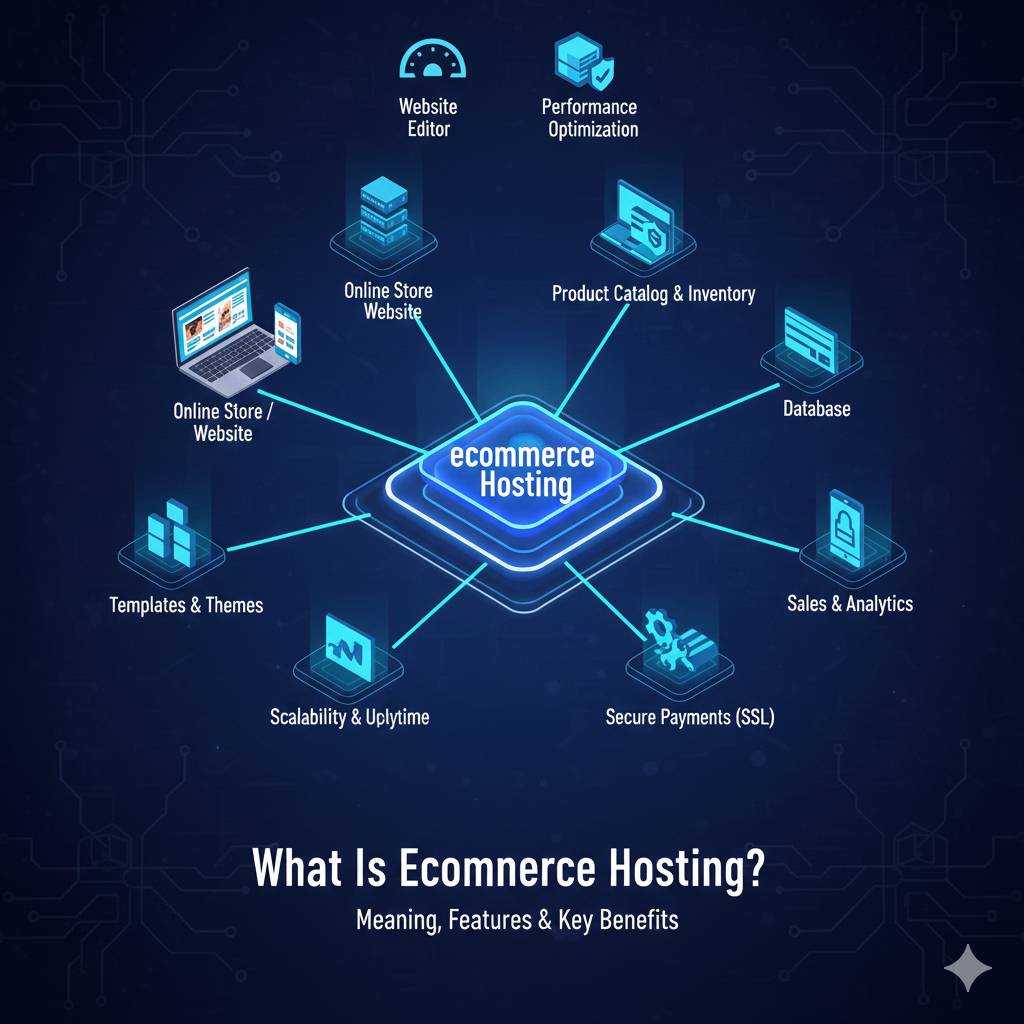
What Is eCommerce Hosting? Meaning, Features & How It Works
Starting an online store is an exciting venture. You have your products ready, your brand name picked out, and a vision for your digital storefront. But there’s a critical technical foundation you need to lay before you can welcome your first customer: hosting.
Not just any hosting will do, however. If you are accepting payments, managing inventory, and handling sensitive customer data, you need a solution built specifically for the job.
This is where eCommerce hosting comes in. Unlike a standard personal blog or a simple portfolio site, an online store has unique demands. It requires robust security to protect credit card numbers, high speed to prevent cart abandonment, and the ability to scale up when your marketing campaigns go viral.
In this guide, we will break down exactly what eCommerce hosting is, how it differs from regular web hosting, and how to choose the right provider to set your business up for success. Whether you are launching a small boutique or scaling a high-traffic enterprise, understanding these fundamentals is the first step toward building a profitable online presence.
See also: The Evolution of Web Hosting: From Shared Servers to Cloud Infrastructure
What Is eCommerce Hosting? (Definition)
Simply put, eCommerce hosting is a web hosting service that offers a platform specifically designed to build and manage online stores. It provides the server space, features, and functionalities necessary to sell products and services online.
While generic web hosting provides a home for your website’s files, eCommerce hosting includes specialized tools optimized for electronic commerce. This often includes:
- SSL certificates for encrypted connections.
- Payment gateway integration support.
- Shopping cart software compatibility (like WooCommerce or Magento).
- High-level security measures to meet Payment Card Industry (PCI) standards.
If you are asking, “what does eCommerce hosting mean for my business?”, think of it as renting specialized commercial retail space rather than a residential apartment. A retail space comes with loading docks, security systems for merchandise, and customer parking. Similarly, eCommerce hosting comes with the digital infrastructure required to handle transactions securely and efficiently.
How Does eCommerce Hosting Work?
Understanding how eCommerce hosting works requires looking under the hood of a server. When a customer visits your online store, their browser sends a request to your host’s server. The server then retrieves your site’s files—images, product descriptions, pricing—and displays them to the shopper.
However, the process gets more complex during a transaction. Here is what happens in an optimized eCommerce environment:
Server Optimization
eCommerce sites are database-heavy. Every time a user filters by size, searches for a product, or adds an item to their cart, the server queries a database. eCommerce hosting optimizes these database interactions to ensure they happen instantly. If the server lags, the customer leaves.
Payment Processing Integration
Secure online store hosting features include the ability to hand off sensitive data to payment processors (like Stripe or PayPal) securely. The hosting environment must support the specific scripts and security protocols required to facilitate this handshake without exposing data to hackers.
Security Protocols
Behind the scenes, the host runs firewalls and malware scanners specifically tuned to detect threats common to online retail, such as credit card skimming bots or DDoS attacks designed to take your store offline during a sale.
Types of eCommerce Hosting
Not all hosting is created equal. Depending on your budget and technical expertise, you will likely choose from one of the following types of eCommerce hosting.
Shared eCommerce Hosting
This is the entry-level option where your store shares a server with hundreds of other websites.
- Pros: Very affordable; often comes with one-click installers for platforms like WooCommerce.
- Cons: Performance can suffer if other sites on the server get high traffic; security risks are slightly higher due to the shared environment.
- Best for: Brand new stores with low traffic and limited budgets.
Managed eCommerce Hosting
Managed hosting is a step up where the provider handles the technical side of things—updates, security patches, and backups—so you can focus on selling.
- Pros: High performance; excellent support; hassle-free maintenance.
- Cons: More expensive than shared hosting.
- Best for: Growing businesses that want expert support without hiring an IT team.
Cloud eCommerce Hosting
Instead of relying on one physical server, your store is hosted on a network of virtual servers. If one server fails, another takes over instantly.
- Pros: Incredible reliability; easily scalable (you can add more resources during Black Friday and scale down afterward).
- Cons: Pricing can be unpredictable if traffic spikes unexpectedly.
- Best for: Businesses with fluctuating traffic or rapid growth.
VPS eCommerce Hosting (Virtual Private Server)
You still share a physical server, but you have a dedicated slice of resources that no one else can touch.
- Pros: Better performance and stability than shared hosting; more control over server settings.
- Cons: Requires more technical knowledge to manage effectively.
- Best for: Mid-sized stores that have outgrown shared hosting.
Dedicated eCommerce Hosting
You rent an entire physical server exclusively for your store.
- Pros: Maximum performance, security, and control.
- Cons: Most expensive option; requires significant technical management.
- Best for: Large enterprise retailers with massive traffic and complex inventory systems.
Key Features of eCommerce Hosting
When evaluating providers, you need to look for specific features that guarantee a secure and smooth shopping experience. Here are the non-negotiables for secure eCommerce hosting.
SSL Certificates
An SSL (Secure Sockets Layer) certificate encrypts data transmitted between the user’s browser and your website. It turns “http” into “https” and displays the padlock icon in the browser bar. Without this, customers will see a “Not Secure” warning, killing trust immediately. Most decent hosts include this for free.
PCI Compliance
The Payment Card Industry Data Security Standard (PCI DSS) is a set of requirements intended to ensure that all companies that process, store, or transmit credit card information maintain a secure environment. A good host helps you meet these standards, protecting you from lawsuits and fines.
Fast Page Loading
Speed is money. Amazon found that every 100ms of latency cost them 1% in sales. Look for hosts that offer SSD storage, PHP 7+ (or the latest version), and optimized caching mechanisms.
Daily Backups
Imagine a software update crashes your site or a hacker deletes your product database. Daily backups ensure you can restore your store to its previous state quickly, minimizing downtime and lost revenue.
CDN Integration
A Content Delivery Network (CDN) stores copies of your site’s images and files on servers around the world. If a customer visits from London, the CDN serves files from a UK server rather than your main server in New York. This drastically improves loading speeds for international customers.
eCommerce Hosting vs Regular Web Hosting
It is a common question: “Why pay more when I can get regular web hosting for $3 a month?” Here is a comparison of eCommerce hosting vs regular hosting to illustrate the difference.
| Feature | Regular Web Hosting | eCommerce Hosting |
|---|---|---|
| Primary Focus | General purpose (blogs, portfolios) | Online sales and transactions |
| Security | Basic firewalls; SSL often extra | Advanced; PCI compliance ready; SSL included |
| Performance | Standard resource allocation | Optimized for high database queries |
| Scalability | Limited; manual upgrades often needed | Auto-scaling options for traffic spikes |
| Support | General technical support | Specialized support for store platforms |
| Payment Gateways | Manual integration required | Pre-configured or easy integration |
While regular hosting is fine for a hobby blog, using it for a store is risky. If you get a sudden influx of traffic, a regular server might crash. If you are targeted by a cyberattack, standard security protocols may not handle it. Best hosting for online stores always prioritizes specialized infrastructure.
How Much Does eCommerce Hosting Cost?
The cost of hosting varies wildly based on the type of hosting and the features included.
Entry-Level Pricing
For shared hosting options suitable for startups, prices typically range from $5 to $20 USD per month. This usually gets you a basic SSL, limited storage, and support for one domain.
Growth Pricing
Managed WordPress or WooCommerce hosting, as well as VPS options, usually fall in the $25 to $100 USD per month range. These plans offer better speed, automated backups, and higher storage limits.
Enterprise Pricing
For dedicated servers or advanced cloud solutions, expect to pay $150 to $500+ USD per month. This is for businesses generating significant revenue where uptime is critical.
Watch Out for Hidden Fees
When calculating eCommerce hosting cost, be aware of:
- Renewal Rates: Many hosts offer a low introductory rate (e.g., $2.99/mo) that jumps to the regular rate (e.g., $14.99/mo) upon renewal.
- Transaction Fees: Some hosted platforms charge a percentage of every sale you make.
- Plugin Costs: While the hosting is cheap, premium security or backup features might be sold as add-ons.
Note: All prices are estimates in USD. Conversion rates will apply for international users.
Best eCommerce Hosting Platforms (2026 Preview)
The hosting landscape is competitive. Here are some of the top contenders you will likely see dominating the market.
Shopify Hosting
Shopify is a fully hosted solution. You don’t rent server space separately; the hosting is included in your monthly subscription.
- Best for: Beginners who want an all-in-one solution.
- Key Feature: Zero technical maintenance required.
WooCommerce Hosting (via providers like Bluehost or SiteGround)
WooCommerce is a plugin for WordPress. You need to buy hosting separately.
- Best for: Users who want full control and ownership of their site.
- Key Feature: Infinite customization and thousands of plugins.
BigCommerce Hosting
Similar to Shopify, BigCommerce is a SaaS (Software as a Service) platform with built-in hosting.
- Best for: Scaling businesses that need advanced built-in features without relying on apps.
- Key Feature: Multi-channel selling (Facebook, Instagram, Amazon) baked in.
Magento Hosting (Adobe Commerce)
Magento requires powerful, specialized hosting (often VPS or Dedicated).
- Best for: Large enterprises with dedicated development teams.
- Key Feature: Unmatched flexibility and power for complex catalogs.
Who Should Use eCommerce Hosting?
Ideally, anyone selling anything online should use hosting optimized for that purpose. However, different stages of business require different tiers.
Small Online Stores
If you are selling a few handmade items or digital downloads, entry-level specialized hosting ensures your customer’s data is safe without breaking the bank. Look for best hosting for small eCommerce that offers scalability.
Growing Businesses
If you are running paid ads or influencer campaigns, you cannot afford downtime. You need managed hosting that can handle sudden traffic surges without crashing.
High-Traffic Shops
If you have thousands of SKUs and concurrent shoppers, you need dedicated or cloud resources. Slow loading times here translate directly to thousands of dollars in lost revenue.
How to Choose the Best eCommerce Hosting Provider
With hundreds of options available, selecting the right partner can be overwhelming. Here is a checklist to help you compare.
- Speed Benchmarks: Look for independent tests of the host’s “Time to First Byte” (TTFB). It should be under 200ms.
- Security Compliance: Confirm they offer free SSL, automated backups, and WAF (Web Application Firewall).
- Support Quality: Test their live chat before you buy. Do they answer in minutes? Do they understand eCommerce-specific issues?
- Scalability: Can you upgrade your RAM or CPU with a single click during a sale?
- Uptime Guarantee: Look for a 99.9% uptime guarantee or higher.
When doing an eCommerce hosting comparison, prioritize support and uptime over rock-bottom pricing. A cheap host that is offline during a sale is infinitely more expensive than a premium host that stays online.
Pros and Cons of eCommerce Hosting
To summarize, here is a quick look at the benefits and limitations.
Benefits (Pros)
- Enhanced Security: Protects customer data and builds trust.
- Optimized Performance: Faster load times lead to higher conversion rates.
- Specialized Support: Get help from agents who understand online selling.
- Reliability: High uptime guarantees ensure your “doors” are always open.
Limitations (Cons)
- Cost: Generally more expensive than standard shared hosting.
- Complexity: Some advanced options (like VPS) require technical know-how.
- Restrictions: Some managed hosts may ban certain plugins that are resource-intensive.
FAQs – What Is eCommerce Hosting?
Do I really need eCommerce hosting for my online store?
Technically, you can run a store on regular hosting, but it is not recommended. eCommerce hosting provides the necessary security (SSL, PCI compliance) and performance optimizations to handle transactions safely and prevent site crashes during traffic spikes.
Is eCommerce hosting more expensive than regular hosting?
Yes, typically. Because it requires more server resources, robust security measures, and specialized support, the cost is higher. However, the return on investment comes from better reliability and customer trust, which drives sales.
Which hosting is best for WooCommerce?
There isn’t one single “best” provider, but managed WordPress hosts like SiteGround, WP Engine, and Bluehost are highly rated. They offer servers specifically configured for WooCommerce, which improves speed and security significantly compared to generic hosts.
Is cloud hosting better for eCommerce?
For growing or medium-to-large stores, yes. Cloud hosting offers superior scalability. If your store goes viral, cloud hosting can instantly allocate more resources to keep your site online, whereas a physical single server might crash under the load.
How much traffic can eCommerce hosting handle?
This depends entirely on the plan. Shared hosting might struggle with more than 10,000 monthly visits. VPS and Cloud hosting can handle hundreds of thousands of visits. Dedicated servers can handle millions. Always check the bandwidth limits of your specific plan.
Is eCommerce hosting secure for payments?
Reputable eCommerce hosting is designed to be secure. However, you must ensure your plan supports SSL certificates and that you configure your payment gateways correctly. While the host secures the server, you are often responsible for securing the application (like keeping your WordPress plugins updated).
Can I upgrade my hosting as my store grows?
Most reputable providers allow seamless upgrades. You can usually start on a shared plan and move to a VPS or Cloud plan as your traffic increases. Check with your provider beforehand to ensure they offer free migration or easy scaling options.
Conclusion
Choosing the right hosting is one of the most important business decisions you will make for your online store. It is the foundation that dictates how fast your site loads, how secure your customer data remains, and whether your store stays online during your biggest sales of the year.
While the technical jargon can be intimidating, remember that eCommerce hosting is simply about providing a safe, fast, and reliable environment for your customers to shop. Don’t cut corners on your infrastructure. Invest in a solution that provides the speed, security, and support your business deserves.
Ready to take the next step? Don’t leave your success to chance.
Related articles: