UK vs US Hosting for British Audiences: Which Is Better in 2026?
For businesses targeting the UK market, the physical location of your web server remains a critical—yet often debated—decision. While the internet feels borderless, the infrastructure powering it is very much grounded in physical geography. The question of UK vs US hosting isn’t just about patriotism or currency; it’s a technical decision that impacts latency, user experience, legal compliance, and search engine optimization (SEO).
In 2026, advances in fiber optics, 5G, and Content Delivery Networks (CDNs) have narrowed the performance gap between transatlantic data centers. However, physics hasn’t changed. Data still has to travel through cables, and distance equals time. For a user in London accessing a server in New York, that data must traverse the Atlantic Ocean, adding milliseconds to every interaction.
Is this delay negligible in the modern era, or does it still make or break conversion rates? Beyond speed, how does hosting location interact with increasingly strict data privacy laws like GDPR? This guide provides a comprehensive, data-driven comparison to help you decide whether to host your site on British soil or rely on US infrastructure.
How Server Location Affects Website Speed
At its core, the performance difference between UK and US hosting for a British user comes down to latency. Latency is the time it takes for a data packet to travel from the user’s device to the server and back again.
Latency Differences: The Physics of Distance
When a user in Manchester visits a website hosted in London, the data travels a few hundred miles. The round-trip time (RTT) might be anywhere from 5 to 15 milliseconds (ms). If that same user accesses a server in Virginia (US East), the data must travel thousands of miles through undersea cables.
Even moving at near the speed of light, this distance introduces a physical delay. In 2026, a typical optimized connection from the UK to US East Coast data centers generally sees latency between 70ms and 100ms. To the West Coast (e.g., California), this can jump to 150ms or more.
While 80ms sounds instantaneous to a human, modern websites require dozens, sometimes hundreds, of requests to load images, scripts, and stylesheets. If your site isn’t optimized with HTTP/3 or persistent connections, that 80ms delay compounds with every request, potentially adding seconds to the total load time.
Real-World Loading Impact
Latency manifests as “Time to First Byte” (TTFB). This is the pause a user experiences between clicking a link and seeing the browser start to render the page.
- UK Server: TTFB is often under 200ms for UK users. The page feels snappy and responsive immediately.
- US Server: TTFB can easily creep up to 300-400ms or higher for UK users, even on high-performance infrastructure.
For eCommerce stores or dynamic SaaS platforms where users are constantly interacting with the database (loading carts, filtering products), this lag becomes noticeable. It can make the interface feel “sticky” or slow, which correlates directly with higher bounce rates.
SEO Impact – Does Hosting Location Affect Rankings?
Search engines like Google have evolved significantly, but their primary goal remains the same: delivering the best result to the user. Speed and relevance are key components of that goal.
Geo-Relevance Signals
Historically, server IP location was a strong signal for geo-targeting. If your server IP was in London, Google assumed your content was relevant to the UK. In 2026, this signal is less dominant than ccTLDs (like .co.uk) or Search Console settings, but it hasn’t vanished entirely.
Google tries to serve the most relevant local results. If two websites have identical content and authority, but one loads faster for UK users because it’s locally hosted, the faster site often gains the edge. The server location acts as a tie-breaker signal for local relevance.
Crawl Efficiency
Googlebot crawls from IP addresses located primarily in the US, but it also crawls from international IPs to test local performance. If your server is in the UK, Googlebot needs to connect internationally to crawl it from its US base.
However, for a site targeting the UK, what matters most is how Google perceives the user experience for a UK user. If Google’s field data (Core Web Vitals gathered from real Chrome users) shows that your UK visitors are experiencing slow loads due to US hosting, your rankings in google.co.uk may suffer.
Core Web Vitals
Core Web Vitals (CWV) are a direct ranking factor. The metric most impacted by server location is Largest Contentful Paint (LCP). Since LCP measures how quickly the main content loads, high latency from a US server can push your LCP into the “Needs Improvement” or “Poor” category for British visitors.
- Optimization Tip: If you choose US hosting for a UK audience, you must work harder on image optimization and caching to offset the latency penalty and maintain green Core Web Vitals scores.
Compliance, Data Privacy & Legal Considerations
Technical performance is important, but legal compliance can be a business-critical risk factor. The divergence between UK/EU data laws and US regulations is a major consideration for enterprise businesses.
GDPR Considerations
Even post-Brexit, the UK maintains strict data protection standards (UK-GDPR) that align closely with the EU’s GDPR. These regulations require businesses to protect personal data and restrict how it is transferred internationally.
The US has historically had a different approach to data privacy (e.g., the CLOUD Act), allowing surveillance agencies easier access to data stored on US soil. This conflict led to the invalidation of previous frameworks like Privacy Shield.
While data transfer frameworks exist (like the UK-US Data Bridge), hosting data directly within the UK simplifies compliance. It removes the ambiguity of international data transfers. If your database of UK customer info sits physically in London, you have a cleaner compliance narrative than if that data resides in Texas.
Data Residency
For industries like finance, healthcare, and government contracting, “Data Residency” is often a strict requirement. Contracts may explicitly state that customer data must not leave the UK jurisdiction.
- The US Advantage: US hosting providers are often faster to achieve certifications like SOC2 or HIPAA compliance, which appeals to US-centric global firms.
- The UK Advantage: For purely British entities, keeping data in UK data centers (e.g., London or Newport) ensures sovereignty and avoids potential legal headaches regarding US government access to data.
Cost Comparison – UK Hosting vs US Hosting
Budget often dictates infrastructure decisions. Historically, the US has benefitted from massive economies of scale, leading to cheaper hosting.
Infrastructure Pricing Differences
The US is home to the world’s largest data center markets (Northern Virginia, Oregon, Texas). The sheer density of fiber and competition drives costs down.
- US Hosting: You can often find high-resource VPS or dedicated servers in the US for 20-30% less than comparable specs in Europe. Bandwidth in the US is extremely cheap due to the massive internet exchange points.
- UK Hosting: Real estate and electricity in the UK (particularly London) are expensive. These overheads are passed on to the consumer. While the gap has narrowed, a premium UK dedicated server will typically cost more than an equivalent box in Dallas.
Bandwidth Cost
If your site consumes massive amounts of bandwidth (e.g., video streaming or heavy file downloads), US hosting can offer significant savings. US providers often bundle generous “unmetered” bandwidth packages that are harder to find with UK providers, who may have stricter caps or higher overage fees.
Verdict: If budget is the primary driver and your audience is not strictly local, US hosting usually offers more “bang for your buck” in terms of raw hardware specs.
[Check Global Hosting Deals]
CDN & Hybrid Hosting – Can You Mix UK & US Hosting?
The binary choice of “UK vs US” is becoming outdated for advanced setups. Content Delivery Networks (CDNs) allow you to have the best of both worlds.
Edge Delivery
A CDN like Cloudflare, Fastly, or AWS CloudFront caches your static content (images, CSS, JS) on servers located all over the world.
- Scenario: Your origin server is in New York (cheaper hosting).
- User Action: A user in Birmingham visits your site.
- Result: The CDN serves the images and scripts from a node in Manchester or London. The user only connects to New York for the initial HTML document or dynamic API calls.
This drastically reduces the impact of latency. For content-heavy sites (blogs, portfolios, brochures), a CDN makes the origin server location almost irrelevant for 90% of the page load.
Multi-Region Deployments
For larger applications, you don’t have to choose one location. You can deploy a database replica and application server in London for UK users, while keeping your main infrastructure in the US for global traffic. This is known as “Geo-DNS” routing.
However, this increases complexity and cost. You now have two environments to manage, deploy to, and secure.
When UK Hosting Is the Better Choice
Despite the power of CDNs, there are clear scenarios where hosting physically in the UK is the superior strategic choice.
1. Local Businesses & SMEs
If 95% of your customers are in Bristol, hosting in Chicago makes little sense. The speed benefit of local hosting provides an instant, effortless UX boost without complex CDN configurations.
2. UK eCommerce
In online retail, milliseconds equal money. A slight delay in the “Add to Cart” action can cause friction. Hosting locally ensures the checkout process—which cannot be cached by a CDN—remains lightning fast.
3. Strict SEO Targeting
If you are fighting for competitive local keywords (e.g., “plumber in Leeds”), every signal counts. Local hosting ensures maximum crawl efficiency and speed scores for your target demographic, removing any potential latency penalties.
[Compare UK Hosting Providers]
When US Hosting Might Still Work for UK Traffic
Conversely, there are times when hosting in the US is perfectly acceptable, even for a site with British visitors.
1. Global SaaS Platforms
If you are building a tool for users worldwide, the US is often the best “central” location. Connectivity from the US to Europe and Asia is generally better than connectivity from the UK to Asia.
2. Heavy CDN Usage
If your site is static (e.g., a Jamstack site or a simple brochure site), a CDN handles almost everything. The origin server is just a storage bucket. In this case, choose the cheapest or most reliable provider, regardless of location.
3. Budget Constraints
For hobbyists, startups, or blogs just starting out, the cost savings of US hosting might outweigh the 100ms latency penalty. You can always migrate closer to home once revenue grows.
[Compare US Hosting Providers]
Performance Test Scenarios (UK User Accessing UK vs US Server)
To illustrate the difference, let’s look at a theoretical performance test of a standard WordPress site.
Test Parameters:
- User Location: London, UK
- Connection: standard 5G / Fiber broadband
- Site: Medium-weight WordPress blog (1.5MB page size)
| Metric | Server in London (UK) | Server in New York (US) | Server in New York + CDN |
|---|---|---|---|
| Ping (Latency) | ~10 ms | ~85 ms | ~10 ms (to CDN edge) |
| Time to First Byte (TTFB) | ~150 ms | ~380 ms | ~180 ms (cached) |
| Largest Contentful Paint (LCP) | 1.2 seconds | 1.9 seconds | 1.3 seconds |
| Full Load Time | 2.1 seconds | 3.5 seconds | 2.4 seconds |
Analysis:
Without a CDN, the US server adds nearly 1.5 seconds to the full load time. This is significant. With a CDN, the gap narrows drastically, making the US server a viable competitor, though the UK server still wins on raw consistency for dynamic interactions.
Decision Framework – How to Choose Hosting Location
Still undecided? Use this simple checklist to determine the right path for your specific needs.
1. Where is your traffic?
- >80% UK Traffic: Must choose UK Hosting. The performance gains and data sovereignty benefits are too good to ignore.
- 50/50 Split: Consider US East Coast. It acts as a decent middle ground, or use a CDN to bridge the gap.
- Global Audience: US Hosting. It generally offers better global routing and scalability.
2. What kind of site is it?
- Dynamic (eCommerce, Forum, App): Local Hosting. Database queries need to be fast.
- Static (Blog, Portfolio): Location matters less. A CDN will do the heavy lifting.
3. What is your budget?
- Low Budget: US Hosting often provides more power per dollar.
- High Budget: Premium UK Managed Hosting offers the best support and speed.
4. Compliance Needs?
- High (Finance/Health): UK Hosting is safer for GDPR/Data Residency.
- Low (Blog/Info): US Hosting is fine.
Pros & Cons Summary Table
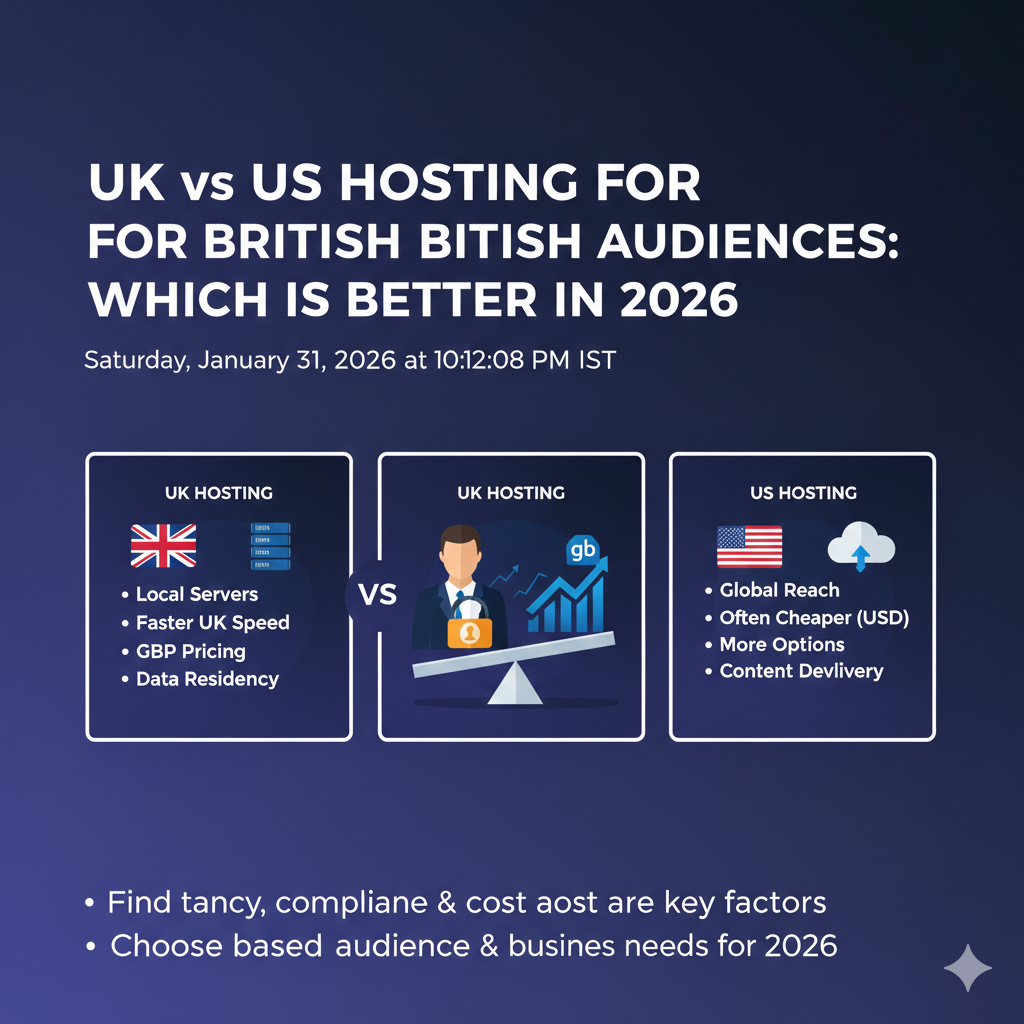
| Feature | UK Hosting 🇬🇧 | US Hosting 🇺🇸 |
|---|---|---|
| Speed for UK Users | Excellent (Low Latency) | Moderate (Higher Latency without CDN) |
| SEO Signals | Strong local relevance | Neutral (requires optimization) |
| Data Privacy (GDPR) | Simplifies compliance | More complex (transatlantic transfer) |
| Cost | Generally higher | Generally lower (economies of scale) |
| Global Connectivity | Good for Europe | Excellent for Global/Americas |
| Support Hours | Aligned with GMT/BST | Often spans US time zones |
FAQs – UK vs US Hosting
Is UK hosting better for UK SEO rankings?
Yes, indirectly. While server location itself is a minor ranking factor, the improved page speed and Core Web Vitals for UK users—along with the strong geo-relevance signal—can help improve rankings in local search results (google.co.uk).
How much speed difference exists between UK and US hosting?
For a direct connection, expect a difference of about 70-150ms in latency. In terms of full page load, a US-hosted site without a CDN can take 1-2 seconds longer to load for a UK user compared to a locally hosted site.
Does Google care about server location?
Google cares about the user experience. If a server location causes slow load times for users, Google will notice the poor performance metrics (via Chrome User Experience Report) and may rank the site lower.
Can CDN replace local hosting for UK audiences?
For static content (images, CSS), yes. A CDN brings that content to a UK edge server. However, the initial connection (TTFB) and any dynamic database requests (like logging in or buying an item) must still travel to the US origin server, so a CDN cannot fix all latency issues.
Is US hosting cheaper than UK hosting?
generally, yes. Due to lower energy costs, cheaper real estate, and massive competition, US hosting providers often offer more storage, RAM, and bandwidth for the same price as UK providers.
Should UK businesses always choose UK hosting?
Not always. If a UK business targets a global market (e.g., a software company selling to the US and Asia), hosting in the US or using a distributed cloud architecture might be better. However, for local service businesses (e.g., solicitors, shops), UK hosting is strongly recommended.
Can I move hosting location later?
Yes, server migration is a standard procedure. However, it involves technical work (moving files and databases) and DNS changes, which can cause temporary downtime or SEO fluctuations. It is better to choose the right location from the start.
Conclusion
In the debate of UK vs US hosting for British audiences, the winner in 2026 is usually UK hosting.
For businesses primarily targeting customers in London, Manchester, or Glasgow, hosting your data on British soil offers the trifecta of benefits: superior speed, simplified legal compliance, and stronger local SEO signals. The slight premium in price is easily justified by the increase in conversion rates and user satisfaction.
However, US hosting remains a powerful contender for those with tight budgets or global ambitions, especially when paired with a high-performance CDN.
Final Recommendation:
- Choose UK Hosting if: You are a UK business, an online store, or operate in a regulated industry.
- Choose US Hosting if: You are a global content publisher, a boot-strapped startup, or your audience is primarily international.
Don’t let latency kill your growth. Make the infrastructure choice that puts your users first.
Ready to choose?