
10 Hosting Providers for Students and Startups Compared by Budget and Features
Launching a website, whether for a university project or a budding business venture, often starts with a single, crucial question: How much will this cost? For students and early-stage startups, budget isn’t just a constraint; it’s the defining factor. While cloud computing giants dominate headlines, the reality for most beginners is that cost-effective, reliable shared hosting is the true launchpad for innovation.
As we move through 2026, the demand for affordable digital infrastructure hasn’t waned. In fact, with the rise of solopreneurship and the democratization of coding skills, the need for low-stakes, high-value hosting environments is greater than ever. But navigating the sea of “unlimited bandwidth” promises and hidden renewal fees can be treacherous. This guide cuts through the marketing noise to compare ten hosting providers that actually make sense for tight budgets, analyzing them not just by their promotional price tag, but by the features that matter most to students and founders.
Background and Low-Budget Hosting Explained
What defines student- and startup-friendly hosting
When we talk about hosting for students and startups, we aren’t looking for enterprise-grade dedicated servers or complex Kubernetes clusters. The definition of “friendly” in this context revolves around three pillars: affordability, simplicity, and forgiveness.
Affordability is obvious—pricing needs to be low enough that it doesn’t eat into a student’s allowance or a startup’s pre-seed runway. Simplicity means intuitive control panels (like cPanel or proprietary equivalents) that allow users to deploy a WordPress site or upload a Python script without needing a DevOps certification. Finally, forgiveness refers to the provider’s policies. Does the site crash immediately if you get a traffic spike? Is there a money-back guarantee if the project fails to launch? These safety nets are vital for those just starting out.
Typical limitations of entry-level hosting plans
You get what you pay for, and low-budget hosting is no exception. It is essential to manage expectations before swiping a credit card. Most entry-level plans rely on “Shared Hosting.” This means your website lives on a single physical server alongside hundreds, sometimes thousands, of other websites.
The limitations usually manifest in performance and resources. If a “neighbor” on your server goes viral, your site might slow down. RAM and CPU allocation are strictly capped. Additionally, while storage might be advertised as “unlimited,” there is almost always an inode limit (a cap on the total number of files you can store), which can be a bottleneck for file-heavy student projects.
Methodology and Comparison Criteria
Pricing structure and long-term affordability
The hosting industry is notorious for the “introductory cliff.” A provider might advertise $2.99/month, but that rate often requires a 36-month upfront payment. Upon renewal, the price can jump to $12.99/month. In this comparison, we look at the total cost of ownership over the first year and the transparency of renewal rates.
Included features and resource limits
A cheap price is useless if you have to pay extra for necessities. We evaluated providers based on what is included in the base price. Does it come with a free SSL certificate? Is email hosting included, or is it a paid add-on? For startups, are there free daily backups? These “hidden” costs can quickly double a monthly bill.
Ease of setup and platform usability
Time is a resource students and founders rarely have in surplus. We prioritized hosts that offer one-click installers for popular CMS platforms (WordPress, Joomla, Drupal) and have modern, navigable dashboards.
10 Best Hosting Providers for Students and Startups
Choosing the right partner for your digital journey is critical. Here is a breakdown of ten providers that balance cost and functionality effectively.
Overview of selected hosting providers
- Bluehost: Often the first recommendation for WordPress users. It is officially endorsed by WordPress.org and offers a very polished onboarding experience for beginners.
- Hostinger: Known for aggressive pricing and decent performance. Their proprietary “hPanel” is user-friendly, and they have servers globally.
- SiteGround: A slightly more premium option. They are famous for exceptional customer support and speed, though their renewal prices are higher.
- A2 Hosting: Focuses heavily on speed. Their “Turbo” servers (available on higher tiers) are excellent, but even their base plans are optimized for performance.
- DreamHost: A veteran in the industry. They offer month-to-month payment options, which is rare and highly beneficial for students who can’t lock in for three years.
- Namecheap: famous for domain registration, their hosting is incredibly cheap and surprisingly robust for simple HTML/CSS or basic WordPress sites.
- InMotion Hosting: Great for technical students. They offer excellent support for languages like Ruby, PostgreSQL, and other developer-centric tools.
- GoDaddy: The behemoth of the industry. While often criticized for upselling, their introductory offers are often unbeatable, and their ecosystem is vast.
- HostGator: A classic choice for shared hosting. Very unmetered (bandwidth and disk space), making it a forgiving environment for messy student projects.
- DigitalOcean (Droplets): For the more advanced startup or CS student. This isn’t shared hosting; it’s cloud VPS. It requires more technical skill but offers total control starting at very low price points.
Summary of plan features and constraints
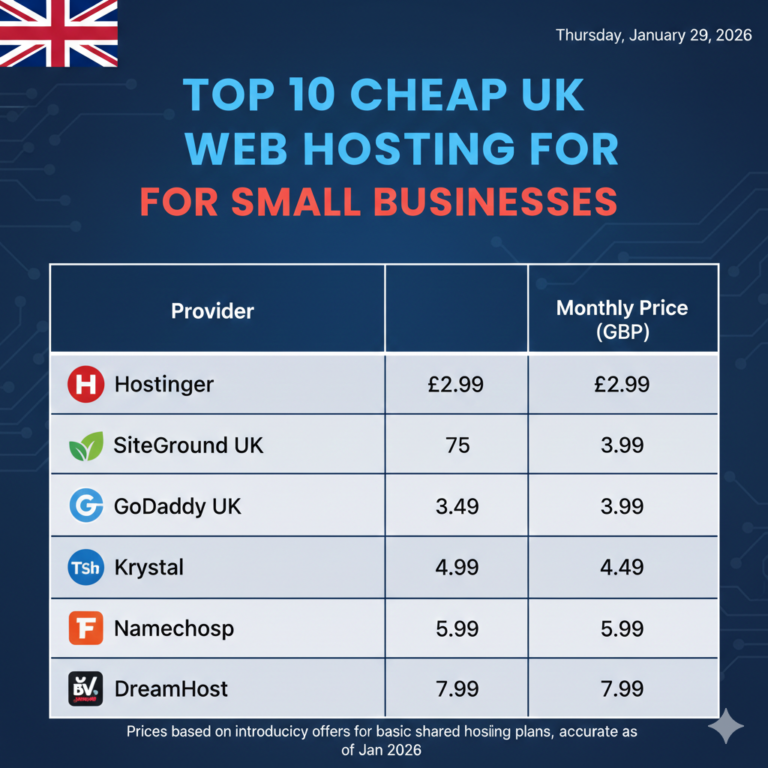
Hostinger is currently the standout for pure value. Their “Single Shared Hosting” often dips below $2/month during sales. It includes free SSL and decent storage, though it lacks a free domain on the cheapest tier.
Bluehost and DreamHost excel in bundling. They almost always include a free domain name for the first year, which saves a startup about $15 upfront. However, DreamHost’s lack of cPanel (they use a custom panel) might be jarring for students learning standard industry tools.
SiteGround restricts storage space significantly (usually 10GB on the startup plan). For a text-based blog, this is fine. For a student photography portfolio, it will fill up fast.
DigitalOcean operates differently. You pay for what you use, often by the hour. There are no “unlimited” promises—you get exactly 1GB of RAM and 25GB of SSD storage for the base price. The constraint here is knowledge; you need to know how to manage a Linux command line to get the most out of it.
Key Factors to Consider When Choosing Budget Hosting
Performance expectations at lower price points
You cannot expect sub-second load times on a $3/month plan if you have heavy images and unoptimized code. Budget hosting relies on caching to be fast. Providers like A2 Hosting and SiteGround have built-in caching mechanisms that essentially save a static version of your site to show visitors, reducing the strain on the server. If your startup involves a dynamic app (where content changes for every user), budget shared hosting will likely struggle under load.
Scalability options for growing projects
Students graduate, and startups (hopefully) scale. You need a host that allows you to upgrade seamlessly. Moving a website from one host to another is a headache. Ideally, your chosen provider should have a VPS (Virtual Private Server) or Managed WordPress tier that you can upgrade to with a single click once your traffic exceeds the limits of shared hosting. Hostinger and Bluehost handle this vertical scaling very well.
Customer support and learning resources
When your site goes down at 2 AM before a deadline, you need help. Support quality varies wildly. SiteGround is the gold standard here, with highly responsive 24/7 chat. In contrast, budget options like Namecheap or HostGator might have longer wait times. For students, a robust knowledge base (tutorials, forums, guides) is just as valuable as live support. DigitalOcean has perhaps the best library of technical tutorials on the internet, valuable even if you don’t host with them.
Why Affordable Hosting Matters for India and Emerging Markets
Cost sensitivity among students and founders in India
In markets like India, price sensitivity is acute. A difference of $2 per month can be the deciding factor for a student in Mumbai or Bangalore launching their first portfolio. The currency exchange rate often exacerbates the cost of US-based hosting. Consequently, providers that accept local payment methods (like UPI in India) or offer regional pricing tiers gain a significant advantage. Hostinger has been particularly aggressive in localization, offering specific portals and pricing for the Indian market.
Role of low-cost hosting in digital skill development
Affordable hosting is an educational tool. It is the sandbox where the next generation of full-stack developers and digital marketers learn their trade. By lowering the barrier to entry, these hosting companies enable students to move beyond localhost and understand DNS propagation, FTP management, and live server environments. This real-world experience is invaluable for employability in the global tech market.
Current Trends in Student and Startup Hosting
Extended introductory pricing and discounts
We are seeing a shift in how discounts are structured. Previously, the best deals were reserved for 36-month lock-ins. Now, recognizing the volatility of the startup world, some hosts are offering competitive 12-month deals. Furthermore, “student packs”—bundles that include GitHub access, hosting credits, and free domain names—are becoming more common, often verified through .edu email addresses.
Increased focus on beginner-friendly tools
The technical barrier is lowering. “No-code” and AI integration are the current trends. Hosts are embedding AI website builders directly into their onboarding flows. A student can now type “I want a portfolio for my graphic design work,” and the host’s AI will generate a WordPress template, install the necessary plugins, and write generic copy. While advanced users might disable this, it massively speeds up the “Time to Hello World” for beginners.
Expert Insights and Data-Backed Analysis
Industry pricing benchmarks for entry-level hosting
If you are paying more than $5/month for a basic shared hosting plan (on an annual term), you are likely overpaying. The industry benchmark for a solid entry-level plan currently sits between $2.50 and $4.00 per month. Anything lower usually comes with severe performance compromises; anything higher should include premium features like daily backups or a dedicated IP address.
Common trade-offs between cost, performance, and flexibility
There is an “Iron Triangle” in hosting: Cheap, Fast, Reliable. You usually only get two.
- Cheap + Reliable: It will likely be slow (or strictly resource-capped).
- Cheap + Fast: It might have frequent downtime or poor support.
- Fast + Reliable: It won’t be cheap.
For students and early startups, prioritizing Cheap + Reliable is usually the smart move. Speed can be improved later with optimization, but downtime destroys trust instantly.
What to Watch Next
Pricing changes after initial contract terms
The biggest shock for new website owners is the renewal notification. That $2.95/month plan might renew at $11.95/month. Always check the “Renewal Rate” in the fine print before signing up. For a startup, this 4x increase in operating costs needs to be factored into the Year 2 budget.
Indicators that signal the need for hosting upgrades
How do you know you’ve outgrown your budget host?
- Slow Backend: The WordPress dashboard takes 5+ seconds to load.
- 503 Errors: Visitors see “Service Unavailable” messages during traffic spikes.
- Timeout Issues: Backup plugins fail to complete because the server kills the process.
When these start happening regularly, it’s time to leave shared hosting and look at a VPS or Managed Cloud solution.
Smart Savings for Digital Growth
The hosting landscape is crowded, but for students and startups, the choice comes down to balancing current budget constraints with future ambition. Whether you choose the raw power of a DigitalOcean droplet or the hand-holding of Bluehost, the most important step is simply starting. The cost of entry has never been lower, and the tools never more accessible. Don’t let the perfect hosting plan be the enemy of a launched website. Pick a provider that fits your wallet today, and worry about scaling when your traffic forces you to.
Meta data
Meta title
10 Best Hosting Providers for Students and Startups (2026 Guide)
Meta description
Compare the top budget-friendly hosting providers for students and startups. We analyze pricing, features, and performance to help you launch for less.
Frequently Asked Questions
Is shared hosting sufficient for student projects?
Yes, absolutely. For portfolios, resume sites, and small class projects, shared hosting provides more than enough resources. It is the most cost-effective way to get online.
What features should startups prioritize in low-cost hosting?
Startups should prioritize uptime guarantees (99.9% or higher), automated backups (to prevent data loss), and scalability (the ability to easily upgrade RAM/CPU as the business grows).
How long can a startup stay on budget hosting plans?
It depends on traffic. Most startups can stay on shared hosting until they reach roughly 10,000 to 25,000 monthly visitors, or until they need custom software configurations that shared environments don’t support.
Are free hosting plans suitable for learning purposes?
Free hosting (like GitHub Pages or limited tiers from commercial hosts) is great for learning HTML/CSS. However, for dynamic sites (PHP/Database) or professional startups, free plans are usually too slow, ad-supported, and unreliable for serious use.