Beyond the CLOUD Act: Why Data Sovereignty Matters for U.S. Companies Hosting Globally
For US-based technology companies, international expansion used to be a straightforward logistics challenge. You spun up servers in a new region, reduced latency for local users, and watched the revenue grow. But as we approach 2026, the landscape of global hosting has shifted from a logistical hurdle to a legal minefield.
Data is no longer just a digital asset; it is a regulated entity subject to the laws of the soil it rests on. The rise of complex regulations has created a difficult environment for US enterprises. On one side, American laws demand access to data regardless of location. On the other, international privacy frameworks demand strict protection against foreign surveillance.
For decision-makers and IT leaders, understanding this conflict is no longer optional. It is a survival requirement. This guide explores the intricate relationship between US surveillance laws and international privacy standards, explaining why data sovereignty is the missing piece in your global infrastructure strategy.
What Is the CLOUD Act? (Simple Explanation)
To understand the current tension in global hosting, you must first understand the Clarifying Lawful Overseas Use of Data (CLOUD) Act. Enacted in 2018, this US federal law fundamentally changed how American law enforcement agencies interact with digital information stored abroad.
Before the CLOUD Act, it was unclear whether a US warrant could force a company like Microsoft or Google to hand over emails stored on a server in Ireland. The CLOUD Act clarified this: if a US-based company has possession, custody, or control of data, they must comply with US warrants, regardless of where the physical server is located.
The Scope of Government Access
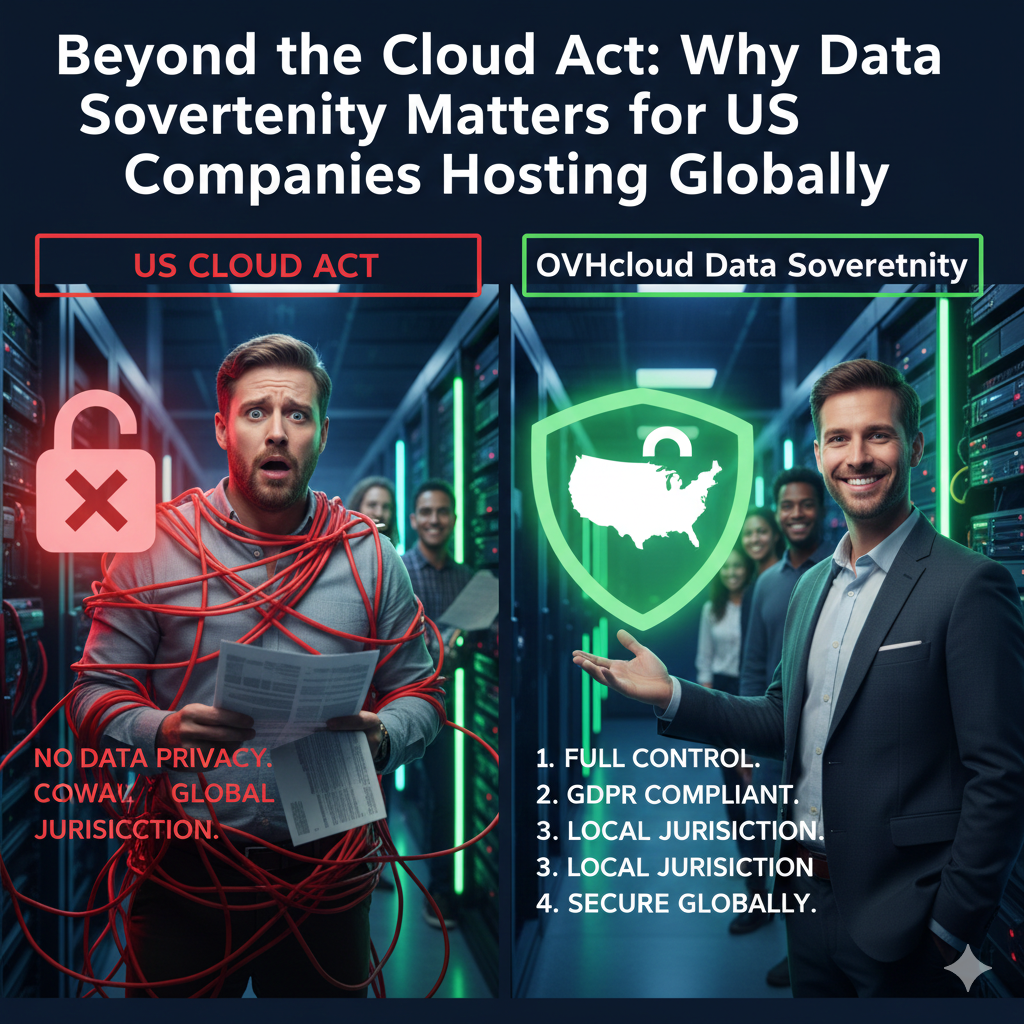
For a US company hosting data globally, the CLOUD Act explained is simple yet sweeping: your corporate passport matters more than your server’s GPS coordinates. Even if you host client data in a data center in Paris or Tokyo, US authorities can legally compel you to hand over that data.
This creates immediate friction with international clients who fear foreign surveillance. For many non-US enterprises, using a US cloud provider—even one with local servers—means their confidential data is never truly private from the American government.
What Is Data Sovereignty?
While frequently used interchangeably with data residency, data sovereignty is a distinct and more powerful concept.
- Data Residency: This refers strictly to the physical location where data is stored. If you store data in a facility in Frankfurt, you have German data residency.
- Data Sovereignty: This refers to the laws and governance structures that apply to that data. What is data sovereignty at its core? It is the concept that data is subject to the laws of the nation in which it is collected and processed.
Legal Jurisdiction Control
True data sovereignty explained involves ensuring that the data is not only stored in a specific country but is also immune to the extraterritorial reach of foreign laws.
For a US company, achieving true data sovereignty is difficult. Because the company falls under US jurisdiction, the data it holds effectively falls under US jurisdiction, too. This is why “sovereign cloud” solutions often involve third-party trustees or distinct legal entities to separate the data from the parent company’s legal obligations.
Why Data Sovereignty Matters for U.S. Companies
Ignoring sovereignty is a liability. As US companies expand, the assumption that “the internet has no borders” is a dangerous fallacy.
Legal Exposure and “Conflict of Laws”
When a US warrant demands data stored in the EU, and EU law (like GDPR) forbids transferring that data to the US, the hosting company is trapped. Comply with the US warrant, and you face massive EU fines. Refuse, and you face US contempt of court. Data sovereignty for businesses is the only strategic way to untangle this legal knot.
Customer Trust and Market Share
International clients are increasingly sophisticated. A German healthcare provider or a Brazilian bank may refuse to sign a contract with a US SaaS vendor if that vendor cannot guarantee the data will stay out of US hands. Implementing global data compliance measures is a competitive advantage that opens doors to enterprise deals in regulated markets.
Key Global Data Regulations Affecting Hosting
The push for sovereignty isn’t happening in a vacuum. It is a direct response to specific regulations that are reshaping the internet.
GDPR and Schrems II
The General Data Protection Regulation (GDPR) set the gold standard for privacy. However, the landmark “Schrems II” court ruling added teeth to these rules regarding international transfers. The European Court of Justice invalidated the “Privacy Shield” agreement, essentially stating that US surveillance laws (like FISA 702 and the CLOUD Act) infringe on the rights of EU citizens. This makes GDPR hosting requirements incredibly strict regarding US providers.
Data Localization Laws
Beyond Europe, countries like India, China, Russia, and Brazil have implemented strict localization laws. International data laws increasingly demand that certain types of citizen data—financial records, health info, biometric data—must remain within national borders and under national control.
Risks of Hosting Globally Without Sovereignty Controls
Operating a global infrastructure without a sovereignty strategy invites three major categories of risk.
Government Access and Corporate Espionage
While the CLOUD Act focuses on law enforcement, the fear among international entities extends to corporate espionage and broad surveillance. Without sovereignty controls, sensitive intellectual property hosted on US-controlled infrastructure is theoretically vulnerable to foreign subpoenas.
Compliance Conflicts
We alluded to this earlier, but the financial implications of cross border data risks are staggering. GDPR fines can reach 4% of global annual revenue. Violating data sovereignty in regions like China or Russia can lead to immediate shutdowns of service and seizure of assets.
Reputational Damage
In the event of a data breach or a forced disclosure of data to a foreign government, the reputational fallout can be terminal. Trust takes years to build and seconds to break. Clients relying on you for cloud compliance risks management will leave if they feel their data is politically exposed.
How Sovereign Cloud Infrastructure Mitigates Risk
To solve these problems, the industry has moved toward sovereign cloud hosting. This is a specialized infrastructure model designed to ensure data stays local—legally and physically.
Local Ownership and Operation
True sovereign cloud often requires that the infrastructure is owned and operated by local entities. For example, a US company might partner with a local French provider to host French data. This creates a legal air gap. Since the local operator is not a US subsidiary, they are not subject to the CLOUD Act in the same direct way.
Data Isolation and Encryption
Secure cloud infrastructure uses technical controls to reinforce legal ones. This includes “Customer Managed Keys” (CMK) or “Bring Your Own Key” (BYOK) encryption. If the cloud provider does not have the encryption key, they cannot technically comply with a subpoena to turn over readable data, adding a layer of protection.
Performance vs Compliance: Finding the Right Balance
A common objection to sovereign strategies is the fear of performance degradation. Historically, routing traffic through specific compliance checkpoints added latency.
Latency Optimization
Modern global hosting performance has evolved. Edge computing and content delivery networks (CDNs) allow companies to cache non-sensitive, static assets globally for speed, while keeping sensitive database queries localized to sovereign data centers.
Regional Deployment
Multi region cloud hosting allows you to spin up isolated environments. You can have a “US Region” for American clients and a completely ring-fenced “EU Sovereign Region” for European clients. While this increases architectural complexity, it ensures that high performance and strict compliance can coexist.
How OVHcloud Supports Data Sovereignty
When discussing sovereignty, the provider matters. OVHcloud has positioned itself as a distinct alternative to the US-based hyperscalers.
As a European-headquartered cloud provider, OVHcloud operates with OVHcloud sovereign cloud principles at its core. Because they are not a US company, they offer a layer of insulation against US extraterritorial laws that American providers simply cannot matching legally.
For US companies looking to host in Europe, using a provider like OVHcloud offers a path to GDPR compliant cloud hosting that simplifies the “Schrems II” problem. Their infrastructure allows for strict data isolation, ensuring that data stored in Europe stays in Europe, under European jurisdiction.
Industries Most Impacted by Data Sovereignty
While every business should care about data privacy, specific sectors face existential threats if they ignore it.
Healthcare and Finance
These are the twin pillars of regulation. Health data (HIPAA in the US, EHDS in Europe) and financial data (GLBA, PCI-DSS) are highly sensitive. Compliance hosting solutions are mandatory here. A bank cannot risk its ledger being subpoenaed by a foreign power.
SaaS and Government Contractors
SaaS platforms serving enterprise clients are increasingly asked to prove their sovereignty credentials during procurement. Furthermore, secure hosting for regulated industries is vital for any company bidding on government contracts, where data leakage is a matter of national security.
How to Build a Data Sovereignty Strategy
Building a strategy for data sovereignty strategy involves three steps:
- Data Classification: Not all data is equal. Public marketing data does not need the same protection as user biometrics. Classify your data to know what requires sovereign protection.
- Region Selection: Map your customer base against the legal landscape. Identify where you have critical mass in regulated markets (like the EU or Canada).
- Vendor Evaluation: Don’t just look at price and CPU speed. Assess your cloud provider’s corporate structure. Are they subject to the CLOUD Act? Do they offer global hosting compliance certifications like SecNumCloud (France) or C5 (Germany)?
Common Misconceptions About Data Sovereignty
Myth: “Encryption Solves Everything”
Encryption is vital, but it is not a silver bullet. If your cloud provider holds the encryption keys, they can be compelled to use them. Even if you hold the keys, a skilled adversary or state actor with physical access to the hardware may find ways to compromise the data. Sovereignty adds legal and physical barriers that encryption alone cannot.
Myth: “My Cloud Provider Handles This”
The “Shared Responsibility Model” is a staple of cloud computing. The provider secures the cloud, but you secure the data within the cloud. Assuming AWS, Azure, or Google handles your sovereignty obligations is a dangerous oversight. You remain the data controller; you remain liable.
FAQ – Data Sovereignty & Global Hosting
Q1: What is the difference between data sovereignty and data residency?
Data residency refers only to the physical geographical location where data is stored. Data sovereignty encompasses residency but also dictates which country’s laws govern that data. Sovereignty determines who can legally access the data.
Q2: Does the CLOUD Act apply to U.S. companies hosting abroad?
Yes. The CLOUD Act applies to any US-based company (and its subsidiaries) regardless of where the physical servers are located. If a US company has “possession, custody, or control” of the data, they must comply with US warrants.
Q3: How does GDPR affect U.S. companies?
GDPR applies to any company processing the personal data of EU residents, regardless of where the company is based. For US companies, this creates a challenge regarding data transfers, requiring strict safeguards (like Standard Contractual Clauses) to prevent US government access.
Q4: Can encryption fully protect against government access?
Encryption significantly strengthens protection, especially if the customer retains sole control of the decryption keys (BYOK). However, without legal sovereignty, a court could potentially compel a company to alter its software or provide backdoor access, though this is legally complex.
Q5: What industries need data sovereignty the most?
Highly regulated industries face the most pressure. This includes healthcare (patient records), finance and banking (transactional data), legal services, public sector/government bodies, and telecommunications.
Q6: Which cloud providers support sovereign hosting?
While US hyperscalers (AWS, Azure, Google) offer “sovereign” controls via local partners, European providers like OVHcloud offer native sovereignty because they are not subject to the US CLOUD Act by default.
Conclusion
The era of borderless data is ending. As we move toward 2026, the digital world is becoming as mapped and regulated as the physical one. For US companies, the CLOUD Act represents a significant hurdle in building trust with international markets.
Data sovereignty is no longer just a compliance checkbox; it is a fundamental component of global business architecture. It requires a shift from thinking only about speed to thinking about jurisdiction.
If you are expanding globally, relying on standard hosting configurations is a risk you cannot afford. It is time to audit your data flows, understand your legal exposure, and build a hosting infrastructure that respects the laws of the land where your customers reside.
Are you ready to secure your global growth? Assess your current architecture today and discover how OVHcloud’s sovereign solutions can future-proof your business against regulatory risk.