OVH Cloud Computing Review 2026: Features & Cost
For years, the cloud computing narrative was dominated by three massive players. But as we move through 2026, the market has shifted. Businesses are no longer just looking for the biggest provider; they are looking for cost predictability, data sovereignty, and performance without the “hyperscaler tax.”
Enter OVHcloud. As Europe’s leading cloud provider, it has aggressively expanded its global footprint, offering a compelling alternative to AWS, Google Cloud, and Azure. But is it the right choice for your infrastructure?
This comprehensive review breaks down OVHcloud’s capabilities in 2026, analyzing its feature set, pricing models, performance benchmarks, and how it stacks up against the competition.
What Is OVH Cloud Computing?
OVHcloud is a global cloud provider that distinguishes itself through vertical integration. Unlike competitors who buy off-the-shelf hardware, OVH builds its own servers and maintains its own fiber-optic network. This allows them to offer industrial-scale cloud solutions at significantly lower costs.
Founded in France, the company has grown into a global powerhouse with over 30 data centers across four continents. In 2026, their focus has sharpened on two key areas: Data Sovereignty (keeping data within specific legal jurisdictions, crucial for GDPR compliance) and Eco-friendly Computing (utilizing proprietary water-cooling technology to reduce energy consumption).
For decision-makers, OVH represents a shift away from complex, opaque billing toward a model that favors raw performance and transparent pricing. They offer a full spectrum of services, from bare-metal servers—their traditional stronghold—to a maturing public cloud ecosystem.
OVH Cloud Key Features in 2026
The OVH of the past was primarily known for dedicated servers. Today, their Public Cloud ecosystem rivals mid-tier and top-tier providers in terms of functionality.
Compute Instances and Flexibility
The core of OVH’s offering remains its compute power. In 2026, they offer a diverse range of instances powered by the latest generations of AMD EPYC and Intel Xeon processors.
- General Purpose: Balanced CPU/RAM ratios suitable for web hosting and microservices.
- CPU Optimized: High-frequency clock speeds designed for batch processing and CI/CD pipelines.
- RAM Optimized: Massive memory pools ideal for in-memory databases like Redis or SAP HANA.
- GPU Instances: Integration with NVIDIA’s latest hardware for AI training and rendering tasks.
Networking and Security Tools
Networking is perhaps OVH’s strongest selling point. They include robust anti-DDoS protection with every server rental at no extra cost—a feature that often costs thousands of dollars per month with other providers.
- vRack: This private networking tool allows you to connect your servers across different data centers globally on a private VLAN, isolating your traffic from the public internet.
- Load Balancers: Fully managed load balancing to distribute traffic and ensure high availability.
Storage Options
Data storage needs have exploded, and OVH has expanded its portfolio to match:
- Block Storage: High-performance NVMe volumes that can be attached and detached from instances instantly.
- Object Storage: S3-compatible storage that is highly scalable, perfect for static assets, backups, and data lakes.
- Cold Archive: An ultra-low-cost solution for long-term data retention, competing directly with AWS Glacier.
Managed Services and Automation
To attract developers, OVH has heavily invested in managed services to reduce operational overhead:
- Managed Kubernetes: A certified Kubernetes offering that handles the control plane for you, allowing you to focus on deploying containers.
- Managed Databases: Support for MySQL, PostgreSQL, MongoDB, and Redis, handling backups, updates, and security patching automatically.
OVH Cloud Pricing Breakdown
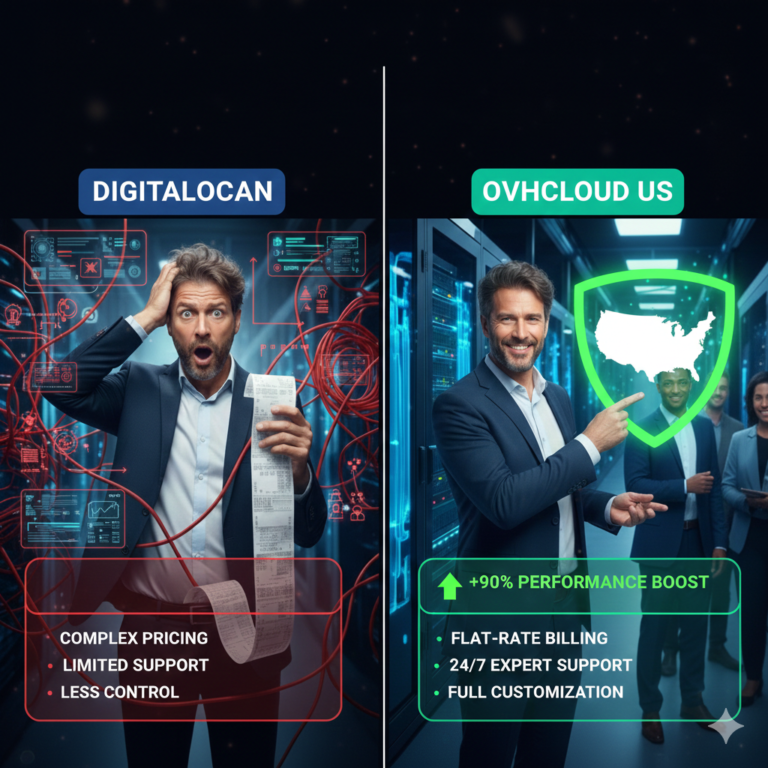
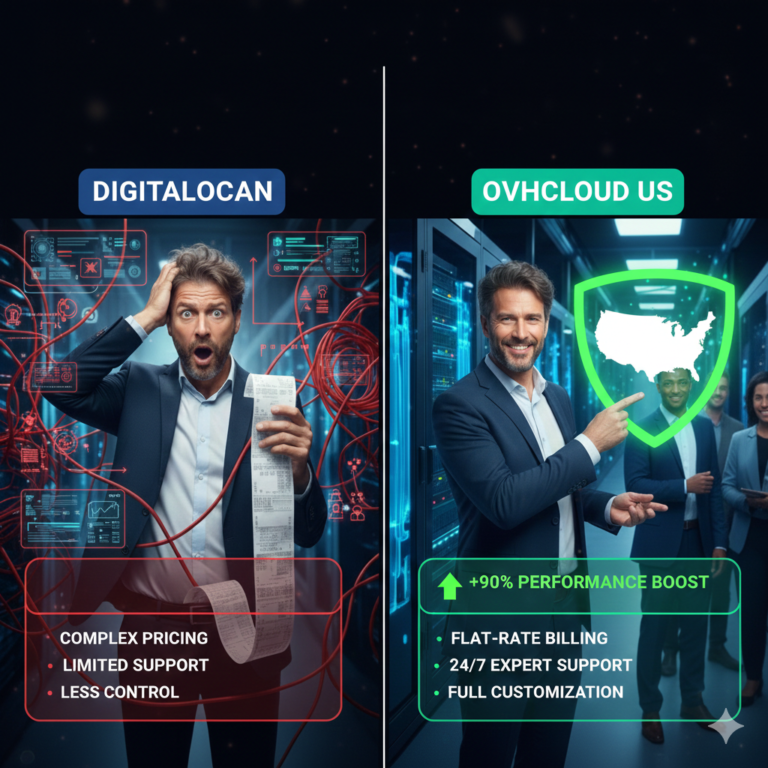
Pricing is where OVH typically wins the argument. The pricing structure is refreshing because it lacks the “hidden fees” notorious in the cloud industry—specifically regarding bandwidth.
Pay-As-You-Go Pricing Explained
OVH operates on a transparent model. You can pay hourly for flexibility or commit to a monthly subscription for a discount (usually around 50% cheaper than hourly rates). There are no complex upfront payments required to unlock these monthly rates.
Bandwidth and Storage Pricing
This is the differentiator. OVH offers unmetered ingress and egress traffic on most public cloud instances.
- Hyperscalers (AWS/Azure/GCP): You pay for every GB of data that leaves their network. A viral app or a heavy backup restoration can result in a bill shock.
- OVHcloud: Bandwidth is included. You know exactly what your bill will be at the end of the month, regardless of traffic spikes.
Cost Comparisons by Instance Types
Note: These are estimated average monthly costs for 2026 based on comparable tiers.
| Instance Tier | Specs (vCPU / RAM) | OVH Cloud (Monthly) | AWS (Estimated On-Demand) | Google Cloud (Estimated) |
|---|---|---|---|---|
| Starter (General) | 2 vCPU / 4GB RAM | $24.00 | $38.50 | $34.00 |
| Growth (CPU) | 4 vCPU / 8GB RAM | $48.00 | $82.00 | $71.00 |
| Enterprise (RAM) | 8 vCPU / 32GB RAM | $130.00 | $210.00 | $190.00 |
Typical Monthly Costs for Common Use Cases
- Small Web Server: For a business running a WordPress site and a small database, you can expect to pay around $25/month.
- SaaS Application: A setup with two load-balanced app servers, a managed database, and 1TB of object storage would cost approximately $180 – $220/month.
- Big Data Cluster: A 3-node cluster with high RAM and NVMe storage would range between $450 – $600/month.
Performance and Reliability
Low cost is meaningless if the server is always down. How does OVH perform?
Benchmark Results
In raw CPU benchmarks (Geekbench and sysbench), OVH instances consistently perform well against similarly priced competitors. Because they do not oversubscribe their hardware as aggressively as some budget providers, the “noisy neighbor” effect—where another user’s activity slows down your server—is minimal.
- Disk I/O: The move to all-NVMe storage across the board has resulted in exceptional read/write speeds, essential for database performance.
Network Speed and Latency
OVH’s proprietary global fiber network provides low latency, particularly within Europe and North America. Their localized peering agreements ensure that data takes the shortest path to the user.
- Speed Test: Public Cloud instances typically come with guaranteed bandwidth (e.g., 500Mbps or 1Gbps) rather than “up to” speeds, ensuring consistent throughput.
Uptime and SLA Overview
OVH provides a Service Level Agreement (SLA) guaranteeing 99.99% availability for Public Cloud instances. If they fail to meet this, they offer service credits. While their historical uptime is strong, they have experienced high-profile outages in the past (such as the 2021 data center fire), which prompted a massive overhaul of their disaster recovery protocols and facility safety standards.
OVH Cloud Use Cases
OVH is a versatile tool, but it fits certain scenarios better than others.
Startups and Small Business Apps
For bootstrapped startups, the zero-egress fee structure is a lifesaver. It allows founders to scale their user base without worrying that success will bankrupt them through bandwidth costs. The predictable monthly billing simplifies financial runway planning.
Scalable Enterprise Workloads
Enterprises use OVH primarily for hybrid cloud strategies. They might keep their proprietary AI logic on AWS to use specific tools but offload their massive bandwidth-heavy workloads (like video streaming or large-scale data processing) to OVH to save millions annually.
Backup and Disaster Recovery
The low cost of storage makes OVH an excellent target for off-site backups. Using Veeam or similar tools, IT managers can replicate their on-premise or primary cloud data to an OVH data center in a different geographic region for a fraction of the cost of main-line providers.
Pros and Cons of OVH Cloud Computing
Pros
- Pricing Predictability: Unmetered bandwidth and clear monthly caps mean no surprises.
- Data Sovereignty: Excellent for companies needing to comply with GDPR or keep data within specific borders without US CLOUD Act interference.
- DDoS Protection: Enterprise-grade Game and Web anti-DDoS included by default.
- Open Standards: Built on OpenStack, meaning you aren’t “vendor-locked” into proprietary technology. Migration in and out is easier.
Cons
- Support Experience: The basic support tier can be slow. To get rapid responses, you must pay for a Premium or Business support plan.
- Documentation: While improving, some documentation can be outdated or translated poorly from French, requiring some digging.
- User Interface: The control panel, while functional, lacks the polish and intuitive flow of the AWS Console or Google Cloud Platform.
OVH Cloud vs Major Competitors
OVH vs AWS
AWS is the supermarket of the cloud; they have a service for everything. If you need advanced serverless functions, complex AI suites, or satellite ground stations, AWS wins. However, if you need raw compute power and storage, OVH is 30-50% cheaper and doesn’t charge for bandwidth.
OVH vs Google Cloud (GCP)
GCP excels in data analytics and machine learning. If your business revolves around BigQuery or TensorFlow, stay with Google. For standard web hosting, microservices, and containers, OVH offers similar performance for a significantly lower price tag.
OVH vs DigitalOcean & Linode (Akamai)
This is the closest fight. DigitalOcean and Linode offer better developer experiences (UX) and easier documentation. However, OVH offers a broader range of enterprise hardware (like bare metal integration) and generally higher bandwidth caps. OVH is for the sysadmin; DigitalOcean is for the app developer.
Who Should Choose OVH Cloud in 2026?
Ideal Users
- SaaS Providers: Who move high volumes of data and want to avoid egress fees.
- European Businesses: Who prioritize data privacy and GDPR compliance.
- Budget-Conscious CTOs: Who need to cut infrastructure costs without sacrificing core performance.
- Gaming Companies: Who need low latency and robust anti-DDoS protection.
Not Recommended For…
- Complete Beginners: If you have never managed a server and need hand-holding, a managed host or a platform like Heroku is better.
- Bleeding Edge Tech Adopters: If you need the absolute latest beta AI tools or proprietary serverless ecosystems, the “Big Three” are better suited.
FAQs – OVH Cloud Computing
Is OVH Cloud cost-effective?
Yes, it is widely considered one of the most cost-effective providers in the market due to its vertical integration and unmetered bandwidth policy.
How reliable is OVH uptime?
OVH guarantees 99.99% monthly availability for its Public Cloud instances. Following infrastructure upgrades between 2022 and 2025, their reliability record has stabilized significantly.
Does OVH Cloud support hybrid cloud?
Absolutely. Through OVHcloud Connect and vRack, you can securely connect your on-premise infrastructure or other cloud providers to your OVH resources.
What support plans are available?
OVH offers four tiers: Standard (included), Premium, Business, and Enterprise. For production environments, upgrading to at least Premium is highly recommended to ensure faster response times.
Is OVH good for enterprise workloads?
Yes, particularly for infrastructure-heavy workloads. Major enterprises use OVH for specific tasks like storage, backup, and high-bandwidth applications, often integrating it into a multi-cloud strategy.
Final Thoughts
In 2026, the cloud market is no longer a monopoly. OVHcloud has matured from a budget-friendly alternative into a serious infrastructure contender. While it may lack the infinite service catalog of AWS, it makes up for it with raw performance, data sovereignty, and a pricing model that respects your bottom line. If you have the technical expertise to manage your environment, switching to OVH could be the smartest financial move your IT department makes this year.