
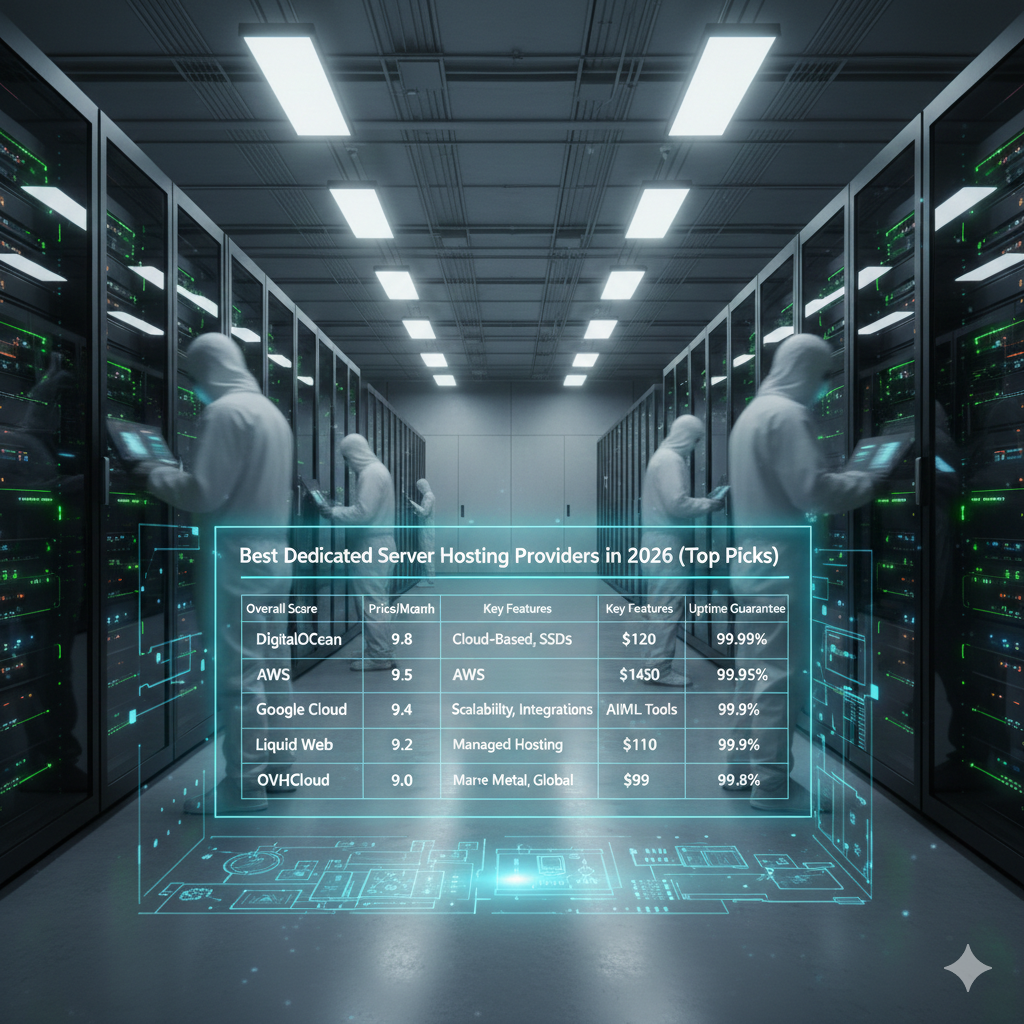
Best Dedicated Server Hosting Providers in 2026: Top Picks & Reviews
Your website has likely hit a ceiling. When page load times start to lag during traffic spikes, or your database queries take seconds instead of milliseconds, it is usually a sign that you have outgrown shared hosting or a Virtual Private Server (VPS). For high-performance websites, SaaS platforms, and growing ecommerce stores, moving to a dedicated server is the only logical step forward.
In 2026, the demand for raw computing power is higher than ever. With search engines prioritizing Core Web Vitals and users demanding instant interactions, the infrastructure behind your site matters just as much as the code on it. A dedicated server gives you exclusive access to physical hardware—no sharing resources with neighbors, no “noisy neighbor” effects, and total control over your server environment.
But finding the right partner is difficult. The market is flooded with hosts promising the fastest speeds and the lowest downtime. This guide cuts through the marketing noise to identify the best dedicated server hosting providers in 2026, helping you make an investment that secures your business’s digital future.
How We Picked the Best Dedicated Server Hosts
To determine the best dedicated server hosting providers, we analyzed the market based on strict criteria essential for modern businesses. We didn’t just look at the specs on paper; we looked at the reliability and value proposition offered to the end-user.
Here are the primary factors we evaluated:
- Performance Benchmarks: We looked for providers offering the latest hardware, including NVMe SSD storage and high-frequency CPUs (Intel Xeon or AMD EPYC).
- Uptime Guarantees: In 2026, anything less than 99.9% uptime is unacceptable. We prioritized hosts offering 99.99% guarantees with solid Service Level Agreements (SLAs).
- Security Features: We assessed built-in DDoS protection, firewalls, and compliance readiness (HIPAA, PCI-DSS).
- Support Quality: We scrutinized the availability of 24/7 technical support and the expertise level of the staff.
- Pricing Transparency: We looked for clear pricing models without hidden renewal fees or misleading entry-level caps.
Top Dedicated Server Hosting Providers in 2026
Below, we review the top contenders in the dedicated hosting space. Whether you need a fully managed solution or a bare-metal server you can configure yourself, these providers represent the best of the best.
1. Liquid Web (Top Overall Pick)
Liquid Web continues to dominate the premium hosting market in 2026. They are renowned not for being the cheapest, but for being the most reliable “hands-off” solution for businesses that cannot afford downtime. Their dedicated servers are fully managed, meaning their team handles the hardware, operating system, and security patching.
Key Features:
- Standard DDoS protection included.
- ServerSecure advanced security.
- InterWorx, Plesk, or cPanel availability.
- 100% Network and Power Uptime SLAs.
Ideal Use Cases:
Liquid Web is the go-to for agencies, mission-critical ecommerce stores, and businesses that need an outsourced IT department.
Pros & Cons:
- Pros: Industry-leading support (response times under 59 seconds), 100% uptime guarantee, high-performance hardware.
- Cons: Higher price point than unmanaged competitors; no server locations in Asia/Pacific (primarily US and EU).
Pricing Overview:
Plans typically start around $169/month for entry-level dedicated servers, scaling up to $500+ for enterprise configurations.
2. InMotion Hosting (Best for Performance)
InMotion Hosting strikes a fantastic balance between raw performance and flexibility. They are a favorite among developers and system administrators because of their customizable “Bare Metal” servers. In 2026, InMotion has doubled down on speed, utilizing NVMe storage and their proprietary UltraStack technology to deliver exceptional load times.
Hardware Specs:
InMotion offers a wide range of configurable RAM (up to 512GB) and multi-core processors. Their use of NVMe SSDs ensures data retrieval is significantly faster than standard SATA SSDs.
Network Speed & Uptime:
They offer a 99.99% uptime guarantee and have heavily invested in their data center infrastructure to ensure low latency across North America and Europe.
Target Audience:
Developers, high-traffic content sites, and large WordPress networks.
3. OVHcloud (Best for Security & Compliance)
If your business operates globally and faces frequent security threats, OVHcloud is a heavyweight contender. As one of the largest hyper-scale cloud providers in the world, they offer massive infrastructure capabilities. They are particularly known for their robust Anti-DDoS infrastructure, which is included standard with all dedicated servers—a feature that costs extra with many other hosts.
Security Stack:
OVHcloud provides hardware-level protection against massive DDoS attacks. They also offer strict data sovereignty compliance, making them excellent for European markets or businesses navigating GDPR.
Compliance Certifications:
They hold numerous certifications including ISO/IEC 27001, SOC 1, and SOC 2 Type II, ensuring your infrastructure meets rigorous standards.
Best Industries:
Gaming (due to low latency and DDoS protection), Fintech, and Healthcare.
4. Bluehost (Best for Small/Medium Business)
Bluehost is often associated with shared WordPress hosting, but their dedicated server offering is a surprisingly strong entry point for growing small businesses. They make the transition from shared/VPS to dedicated hosting seamless, offering an intuitive dashboard that removes much of the complexity of server management.
Price/Value Ratio:
Bluehost offers one of the most affordable entry points for dedicated hosting. While you might not get the enterprise-grade power of Liquid Web, you get a reliable server at a fraction of the cost.
Ease of Setup:
Provisioning is fast—often within 24-48 hours. Their control panel is designed for users who aren’t certified sysadmins.
Support Quality:
They offer dedicated 24/7 support for premium customers, ensuring you aren’t stuck in a queue with shared hosting users.
5. A2 Hosting (Best Managed Dedicated Hosting)
A2 Hosting markets itself on speed, and they deliver. Their “Turbo” server plans feature AMD EPYC processors and NVMe drives that can handle massive concurrent connections. For businesses that want the speed of bare metal but the convenience of a managed team, A2 is a top competitor.
Management Services Included:
Their “Core” and “Managed” plans include HostGuard Management, providing 24/7/365 support for hardware, network, and software updates.
Pros & Cons:
- Pros: Anytime Money Back Guarantee, “Turbo” boost options for 20x faster page loads, developer-friendly (root access available on select managed plans).
- Cons: Renewal rates can be higher than introductory pricing.
Pricing Context:
Aggressive introductory discounts often make A2 Hosting very attractive for the first term, with unmanaged servers starting as low as $100/month.
Dedicated Server Hosting Features to Look For in 2026
When shopping for dedicated server hosting reviews, you will encounter a wall of technical jargon. Here is what actually matters for your business performance in 2026.
CPU & RAM Options
The CPU is the brain of your server. For database-heavy applications, look for high core counts (multithreading). For dynamic web applications, clock speed (GHz) is often more important. In 2026, 32GB of DDR4 or DDR5 RAM should be your absolute minimum entry point, with 64GB recommended for ecommerce.
NVMe SSD Storage
Do not settle for HDD or standard SATA SSDs for your primary drive. NVMe (Non-Volatile Memory Express) drives connect directly to the motherboard’s PCIe interface, offering read/write speeds that are vastly superior. This significantly reduces bottlenecks when your website is fetching data.
Bandwidth & Network
Check the data transfer limits. “Unmetered” bandwidth is ideal, but check the fair use policy. If you have a global audience, ensure the host offers a 1Gbps or 10Gbps uplink port so your server can push data out to the internet as fast as it processes it.
DDoS Protection
Attacks are becoming more frequent and sophisticated. Your dedicated server features must include automated DDoS mitigation that filters out malicious traffic before it hits your server, ensuring legitimate visitors can still access your site during an attack.
Backups & Monitoring
A RAID configuration (mirroring data across two drives) is not a backup. Look for hosts that offer off-server automated backups. If the hardware fails or data is corrupted, you need a restore point located on a different machine.
Dedicated Hosting Pricing Comparison
Understanding dedicated server cost in 2026 requires looking past the sticker price.
| Tier | Typical Monthly Cost | Specs | Best For |
| Entry-Level (Unmanaged) | $80 – $120 | 4 Cores, 16GB RAM, 1TB HDD | Developers, staging environments |
| Mid-Range (Managed) | $150 – $250 | 4-8 Cores, 32GB RAM, NVMe SSD | SMB Ecommerce, High-traffic blogs |
| Enterprise / High Performance | $300 – $600+ | 16+ Cores, 64GB+ RAM, Custom RAID | SaaS platforms, Big Data, Agencies |
Note: Managed hosting generally costs $50-$100 more per month than unmanaged hosting due to the labor costs of the support team.
Performance & Reliability Metrics to Compare
Marketing claims are easy to make; metrics are harder to fake.
- Uptime Guarantees (99.9% vs 99.99%): The difference seems small, but it is significant. 99.9% uptime allows for about 8.76 hours of downtime per year. 99.99% allows for only 52 minutes. For a high-revenue store, that 8 hours could mean thousands of dollars in lost sales.
- Load Handling: A dedicated server’s main job is stability under pressure. Bare metal servers eliminate the “hypervisor” layer used in VPS, meaning 100% of the hardware resources are available to handle traffic spikes.
- Global Data Center Locations: The closer the server is to your user, the faster the site loads. If your customers are in London, hosting on a server in California adds unavoidable latency. Choose a provider with a data center near your primary audience.
Support & Managed Services Comparison
When something breaks at 3:00 AM, dedicated server support is your lifeline.
- Unmanaged Hosting: You are the mechanic. The host ensures the electricity is on and the internet is connected. You fix the OS, install patches, and secure the server. This is cheaper but requires high technical skill.
- Managed Hosting: The host is the mechanic. They handle OS updates, security patches, PHP versioning, and often specific application issues.
- SLA Terms: Read the fine print. Does the SLA cover hardware replacement guarantees? Top providers promise to replace failed hardware components within 1 to 2 hours.
Best Dedicated Server Hosting by Use Case
Ecommerce Stores
High-volume WooCommerce or Magento stores need high-frequency CPUs and managed support. Liquid Web or Nexcess (a Liquid Web brand) are the industry leaders here due to their PCI compliance support and optimized stacks.
SaaS Platforms
SaaS products need scalability and security. OVHcloud or InMotion Hosting offer the customization and API access developers need to deploy complex applications.
High-Traffic Enterprise Sites
For corporate portals receiving millions of hits, reliability is key. Enterprise tiers from A2 Hosting or Liquid Web offer the redundancy and uptime SLAs required by corporate governance.
Gaming & Community Servers
Latency is the enemy. OVHcloud is widely preferred here for its massive global network capacity and specific “Game” server ranges designed to mitigate UDP flood attacks common in gaming.
Agencies & Resellers
If you manage hosting for clients, you need a host that allows virtualization so you can slice one dedicated server into multiple accounts. InMotion Hosting offers excellent virtualization support.
Frequently Asked Questions (FAQ)
Q1. Which are the best dedicated server hosting providers in 2026?
The top providers generally include Liquid Web for managed services, InMotion Hosting for performance, and Bluehost for accessibility. The “best” depends entirely on whether you need a managed or unmanaged solution.
Q2. Is dedicated hosting worth the cost for small businesses?
It depends on revenue and traffic. If your site generates significant income and downtime costs you money, or if you handle sensitive customer data, the investment in security and reliability is absolutely worth the cost.
Q3. What is the difference between managed and unmanaged dedicated hosting?
Unmanaged hosting gives you the hardware, but you are responsible for software, security, and updates. Managed hosting includes a support team that handles system administration tasks, updates, and security monitoring for you.
Q4. How much does dedicated server hosting cost in 2026?
Prices range from $80/month for budget unmanaged servers to over $500/month for high-performance, fully managed enterprise clusters.
Q5. Which dedicated hosting provider has the best uptime?
Liquid Web is famous for its 100% network and power uptime SLAs, making it one of the most reliable options on the market.
Q6. Can I upgrade from VPS to dedicated server hosting?
Yes. Most providers make it easy to migrate from a VPS to a dedicated server. However, because the environment changes, there may be a brief migration window where files and databases are transferred.
Q7. What features should I prioritize when choosing a dedicated server host?
Prioritize NVMe SSD storage for speed, a minimum of 16-32GB RAM, and a provider that offers an uptime guarantee of at least 99.9%.
Final Verdict: Which Dedicated Host Should You Choose?
Choosing a dedicated server is a commitment. Unlike shared hosting, where you might switch providers on a whim, moving a dedicated server is a complex logistical operation. Therefore, buying right the first time is crucial.
- Best for Performance & Customization: Choose InMotion Hosting.
- Best for Budget: Choose Bluehost or A2 Hosting (Unmanaged).
- Best for Security & Global Reach: Choose OVHcloud.
- Best All-Around Choice (Managed): Choose Liquid Web.
In 2026, your hosting infrastructure is the foundation of your digital presence. By selecting a provider that offers the right balance of dedicated server uptime, support, and modern hardware, you ensure your business is ready to handle whatever growth comes next.