
7 Ecommerce Hosting Providers in 2026 Compared for Shopify, WooCommerce, and Magento
If your online store takes more than three seconds to load, nearly half of your potential customers have already left. In 2026, consumer patience is thinner than ever, and the infrastructure supporting your digital storefront is just as critical as the products you sell. Choosing the right hosting provider is no longer just a technical checkbox—it is a foundational business decision that dictates your site’s speed, security, and ability to handle the Black Friday rush without crashing.
The landscape of ecommerce hosting has shifted dramatically over the last few years. We have moved past simple shared hosting plans into an era of edge computing, AI-driven resource scaling, and hyper-localized server clusters. For store owners using platforms like Shopify, WooCommerce, or Magento, the options can be overwhelming. Some platforms handle the hosting for you, while others require you to build a robust architecture from the ground up.
This guide cuts through the technical jargon to compare the top seven ecommerce hosting providers dominating the market in 2026. We analyze them based on real-world performance, scalability, and how well they integrate with the major ecommerce ecosystems. By the end, you will understand exactly which infrastructure strategy aligns with your growth goals.
Background and Ecommerce Hosting Overview
Before diving into specific providers, it is essential to understand why ecommerce hosting requires a different approach than hosting a standard blog or portfolio site. An online store is a dynamic environment where databases are constantly queried, inventory is updated in real-time, and sensitive payment data is transmitted every second.
How ecommerce hosting differs from standard web hosting
Standard web hosting typically focuses on delivering static content—text and images—to a visitor. Ecommerce hosting, however, is resource-intensive. Every time a customer adds an item to their cart or proceeds to checkout, the server must process dynamic requests that cannot be cached in the same way a blog post can.
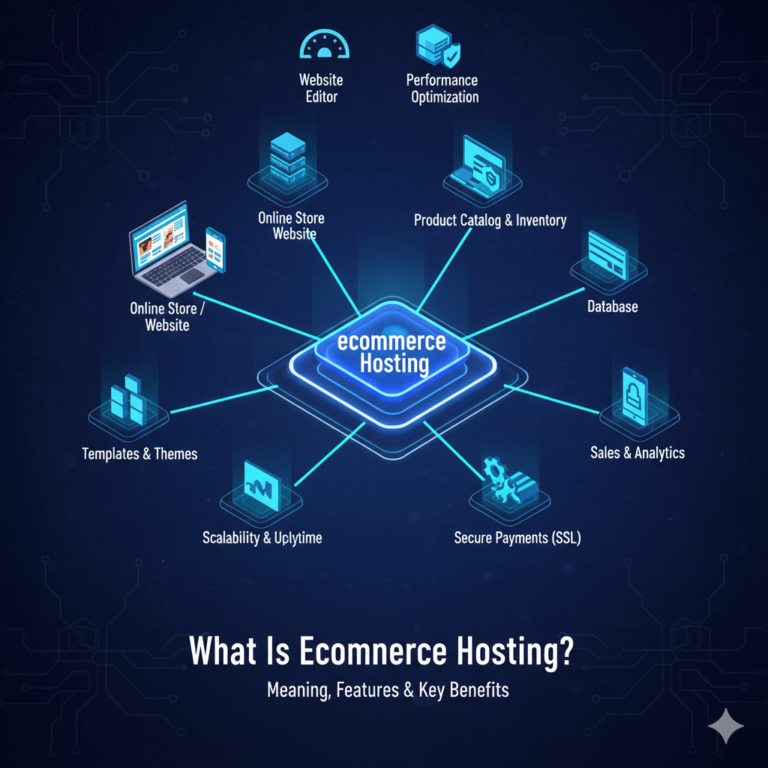
In 2026, premium ecommerce hosting is defined by three non-negotiable pillars:
- High Concurrency Handling: The ability to support hundreds or thousands of simultaneous shoppers without slowing down.
- PCI Compliance: Adherence to the Payment Card Industry Data Security Standard to ensure safe credit card processing.
- SSL and Security: Advanced firewalls and malware scanning to protect customer data from increasingly sophisticated cyber threats.
Platform-specific requirements for online stores
Not all hosting fits all platforms. Your choice of software dictates your infrastructure needs:
- Shopify: As a fully hosted solution, Shopify manages the infrastructure for you. The “hosting choice” here is actually a choice of platform tier (Basic vs. Plus) to access better API limits and checkout customization.
- WooCommerce: Built on WordPress, WooCommerce is resource-heavy. It requires hosting that offers generous PHP memory limits, specialized caching (like Object Cache), and optimized database configurations to prevent sluggish admin panels.
- Magento (Adobe Commerce): Known as a powerhouse for large enterprises, Magento is incredibly demanding. It typically requires dedicated servers or specialized cloud environments (like Varnish caching and Elasticsearch) to run smoothly.
Methodology and Evaluation Criteria
To determine the best providers for 2026, we looked beyond marketing claims and focused on the metrics that impact your bottom line.
Performance testing and load handling
We prioritized providers that utilize the latest hardware standards, such as NVMe SSD storage and PHP 8.3+ support. We also evaluated their architecture for “elasticity”—the ability to automatically allocate more resources during traffic spikes. In our analysis, a host fails if it cannot maintain sub-second load times under the stress of simultaneous user checkouts.
Platform compatibility and optimization
A host might be fast for a static HTML site but terrible for a Magento store. We examined whether the provider offers specialized stacks. For example, does the WooCommerce host include one-click staging environments? Does the Magento host come with pre-configured Varnish caching?
Pricing transparency and scalability
Hidden renewal fees remain a common pain point in the hosting industry. We evaluated providers based on price-to-performance ratio and the clarity of their scaling paths. As your business grows from $10k to $1M in revenue, your hosting bill should grow predictably, not exponentially.
7 Best Ecommerce Hosting Providers in 2026
Based on our criteria, these are the seven providers setting the standard this year. We have included a mix of managed solutions for WooCommerce/Magento and the leading hosted platform.
Overview of the selected hosting providers
1. SiteGround (Best for Growing WooCommerce Stores)
SiteGround continues to be a top recommendation for WooCommerce due to its Google Cloud infrastructure. In 2026, their custom PHP setup (Ultrafast PHP) provides significantly faster execution times for dynamic heavy stores.
- Platform Focus: WooCommerce
- Key Feature: Their SuperCacher technology is pre-configured for WooCommerce, making it incredibly beginner-friendly.
2. Nexcess (Best for Scaling Magento & WooCommerce)
Nexcess, part of the Liquid Web family, excels in auto-scaling. Unlike traditional hosts where you crash if you exceed bandwidth, Nexcess automatically injects resources during traffic surges—perfect for flash sales.
- Platform Focus: Magento, WooCommerce
- Key Feature: Cloud Accelerator for Magento which bypasses the database for static content, drastically improving load times.
3. Shopify (Best All-In-One Hosted Solution)
While not a “host” you rent separately, Shopify is the benchmark for performance in 2026. Their global infrastructure is unbeatable for users who want zero technical maintenance. They handle all caching, security, and scaling implicitly.
- Platform Focus: Shopify (Proprietary)
- Key Feature: Shop Pay’s accelerated checkout, which is hosted on their edge network for instant loading globally.
4. WP Engine (Best Premium Managed WordPress/Woo)
WP Engine remains the gold standard for managed WordPress hosting. Their shift toward “Headless WordPress” hosting has made them a favorite for developers building custom front-ends for WooCommerce in 2026.
- Platform Focus: WooCommerce
- Key Feature: EverCache proprietary caching and a dedicated “eCommerce Solution” tier that optimizes cart fragments.
5. Cloudways (Best for Flexibility & Choice)
Cloudways allows you to choose your infrastructure provider (AWS, Google Cloud, DigitalOcean) while they manage the OS and applications. It is ideal for technically savvy store owners who want enterprise-grade cloud performance without command-line headaches.
- Platform Focus: Magento, WooCommerce
- Key Feature: Vertical scaling that allows you to increase server size with two clicks.
6. Kinsta (Best for High-Performance WooCommerce)
Running exclusively on Google Cloud’s Premium Tier network and C2 machines, Kinsta is built for speed. Their dashboard is arguably the most intuitive in the industry, offering deep analytics on APM (Application Performance Monitoring) to identify slow plugins.
- Platform Focus: WooCommerce
- Key Feature: Hardware-isolated containers ensure your store’s resources are never shared with other users.
7. A2 Hosting (Best Budget Performance)
For startups that need speed without a high price tag, A2’s “Turbo Servers” offer a compelling value proposition. They use LiteSpeed web servers, which handle concurrent connections more efficiently than standard Apache servers.
- Platform Focus: Magento, WooCommerce
- Key Feature: Pre-tuned Magento installs that are surprisingly fast for a shared/VPS environment.
Platform support for Shopify, WooCommerce, and Magento
To summarize the landscape: if you choose Shopify, your hosting is sorted. If you choose WooCommerce, SiteGround and WP Engine offer the best balance of support and speed. For Magento, the complexity requires the robust architecture of Nexcess or the flexibility of Cloudways.
Key Factors Affecting Ecommerce Hosting Performance
Choosing a provider is only half the battle; how that provider is configured makes the difference.
Server locations and global reach
Latency—the time it takes for data to travel from server to user—kills conversions. Top-tier providers in 2026 allow you to choose your data center location. If your primary audience is in London, hosting your site on a server in California adds unnecessary delay. The best hosts utilize Content Delivery Networks (CDNs) like Cloudflare Enterprise to serve static assets from the server closest to the customer.
Security, compliance, and payment readiness
Security in 2026 goes beyond SSL certificates. We are seeing a rise in automated bot attacks that scrape prices or hoard inventory in carts. Your hosting provider must have proactive bot protection and a Web Application Firewall (WAF) configured specifically for ecommerce vulnerabilities (like SQL injection attacks on product search bars).
Support availability and technical expertise
When your checkout page breaks at 2 AM on a Sunday, you do not need a support agent who reads from a script. You need an engineer who understands database queries. Providers like Kinsta and Nexcess are famous for having support teams composed of actual developers who can debug platform-specific errors.
Why Ecommerce Hosting Matters for India and Emerging Markets
As ecommerce penetration deepens in regions like India, Southeast Asia, and Latin America, hosting requirements are shifting to accommodate new user behaviors.
Impact of hosting speed on mobile-first users
In markets like India, the vast majority of ecommerce traffic is mobile. Mobile networks, while improving with 5G, can still be inconsistent in rural areas. Hosting providers must be optimized for “mobile-first” delivery. This means rigorous image compression at the server level and the use of HTTP/3 protocols to ensure fast transmission over unstable connections. If your host is slow, mobile users will abandon the session instantly.
Ecommerce growth and infrastructure considerations in India
The Indian ecommerce sector is projected to reach massive valuations by 2026. However, data sovereignty laws and local infrastructure play a huge role. Hosting providers are increasingly establishing data centers physically located within India (Mumbai, Delhi, Bangalore) to comply with local regulations and reduce latency for domestic shoppers. For international businesses targeting these markets, choosing a host with a physical footprint in the region is no longer optional—it’s a competitive necessity.
Current Trends in Ecommerce Hosting
Managed hosting and platform-specific solutions
The days of “generic” hosting are fading. In 2026, the trend is hyper-specialization. Managed hosting providers are becoming extensions of the platforms themselves. For example, managed WooCommerce hosts now come with plugin vetting services to prevent you from installing code that conflicts with your payment gateway. This shift allows store owners to focus on marketing rather than server maintenance.
Focus on uptime stability and traffic scalability
“Uptime” used to mean the site is accessible. Now, it means the site is functional. A site that loads but cannot process a payment is effectively down. Modern hosting SLAs (Service Level Agreements) are becoming stricter, with guarantees often backing 99.99% uptime. Furthermore, “elastic scaling”—where the server creates copies of itself to handle load—is becoming standard for enterprise plans, ensuring stability during viral social media moments.
Expert Insights and Data-Backed Analysis
Industry benchmarks for ecommerce performance
Data from 2026 suggests that the benchmark for a “good” Time to First Byte (TTFB) is under 200ms. Leading providers like Kinsta and Shopify consistently hit this mark globally. Additionally, Core Web Vitals remain a critical SEO factor; hosting directly impacts the “Largest Contentful Paint” (LCP) metric. Stores that fail to load their main product image within 2.5 seconds are seeing significant penalties in Google search rankings.
Hosting features prioritized by online retailers in 2026
Surveys of ecommerce CTOs indicate a shift in priorities. While price remains a factor, “security automation” and “integrated backups” have moved to the top of the list. Retailers are willing to pay a premium for hosts that offer automated daily backups with one-click restore points, recognizing that data loss is more expensive than monthly hosting fees.
What to Watch Next
Changes in ecommerce platform hosting requirements
As platforms like Magento and WooCommerce evolve, their system requirements increase. We are seeing a move toward requiring persistent object caching (like Redis) as a standard requirement, not just an add-on. Hosts that do not offer this out of the box will likely become obsolete for serious merchants.
Factors businesses should evaluate before upgrading hosting
Before migrating to a new host in 2026, evaluate your traffic patterns. Are your spikes predictable (holidays) or random? If they are random, look for cloud-based or serverless architectures. Also, consider the “vendor lock-in” risk. Proprietary hosting environments can be difficult to migrate away from, whereas standardized setups (like standard cPanel or cloud containers) offer more freedom.
Frequently Asked Questions
Which hosting type is best for Shopify-based stores?
Shopify is a fully hosted platform, meaning you do not need to purchase third-party hosting. Shopify provides secure, unlimited hosting on all its plans. However, if you are running a “Headless Shopify” setup (where the frontend is custom-built), you might host that frontend on providers like Vercel or Netlify.
Is managed hosting necessary for WooCommerce websites?
While not strictly necessary, managed hosting is highly recommended for serious businesses. WooCommerce requires constant maintenance, updates, and database optimization. Managed hosts handle these technical tasks, providing better security and speed than standard shared hosting.
How does hosting affect ecommerce checkout performance?
Hosting is the primary driver of checkout speed. When a user checks out, the server must process the transaction securely and update inventory databases. A slow server or one with low PHP memory limits can cause the checkout wheel to spin, leading to cart abandonment.
Can one hosting provider support multiple ecommerce platforms?
Yes, providers like Cloudways, Nexcess, and A2 Hosting are platform-agnostic. They allow you to run a Magento store on one server and a WooCommerce store on another within the same account dashboard, offering flexibility for agencies or businesses with multiple brands.
Securing Your Digital Storefront
Your hosting provider is the silent partner in your ecommerce business. It does not get the glory of a marketing campaign or the visual appeal of a new logo, but it is responsible for delivering those experiences to your customer. In 2026, the best hosting provider is one you rarely have to think about because it works seamlessly in the background—scaling when you sell, protecting when you sleep, and delivering your products to the world in milliseconds.
If your current site feels sluggish or your support tickets are going unanswered, it is time to audit your infrastructure. The cost of migration is minimal compared to the revenue lost from a slow, unreliable store.