10 Key VPS Hosting Benefits for Silicon Valley Startups in 2026
The year 2026 has brought a sobering reality to the Silicon Valley ecosystem. The days of “growth at all costs” have largely receded, replaced by a mandate for efficiency, lean operations, and a clear path to profitability. For early-stage companies, every line item on the budget sheet is under scrutiny, and technical infrastructure often represents one of the largest expenditures.
While serverless architecture and hyperscale public clouds garnered massive attention in the early 2020s, a reliable workhorse has returned to the forefront of the conversation: Virtual Private Server (VPS) hosting. For a startup CTO or technical co-founder, choosing the right hosting environment is no longer just about raw power; it is about balancing performance, control, and predictable costs.
VPS hosting sits in a unique position between the restrictiveness of shared hosting and the often overwhelming complexity (and cost) of dedicated bare metal or complex cloud clusters. As we move deeper into the latter half of the decade, understanding why VPS remains a critical tool for startups is essential for building a sustainable technical foundation.
Background and VPS Hosting Explained
To understand the value proposition, we must first strip away the jargon. At its core, a Virtual Private Server (VPS) uses virtualization technology to split a single physical server into multiple distinct private environments.
What VPS hosting is and how it works
Think of a physical server as a high-rise building. In a shared hosting environment, residents live in dorm rooms with thin walls; if one neighbor plays loud music (consumes too much CPU), everyone loses sleep. A dedicated server is owning the entire building, which is expensive and requires significant maintenance.
A VPS is the apartment in the middle. You have your own front door, your own kitchen, and your own walls. The hypervisor—the software that creates the virtual machines—ensures that while you share the building’s foundation (hardware), your resources are contractually guaranteed. Your RAM, CPU cores, and disk space are yours alone.
How VPS hosting differs from shared and cloud hosting
The distinction becomes critical when looking at reliability. Shared hosting relies on the hope that other users won’t crash the server. VPS eliminates that hope factor through isolation.
Comparatively, cloud hosting often involves a network of servers where resources are pulled from a pool. While cloud hosting offers infinite scalability, it introduces variable billing—a notorious headache for startups. VPS hosting typically offers a flat monthly fee for a defined set of resources, providing the financial stability that CFOs and investors crave.
Key VPS Hosting Benefits for Startups
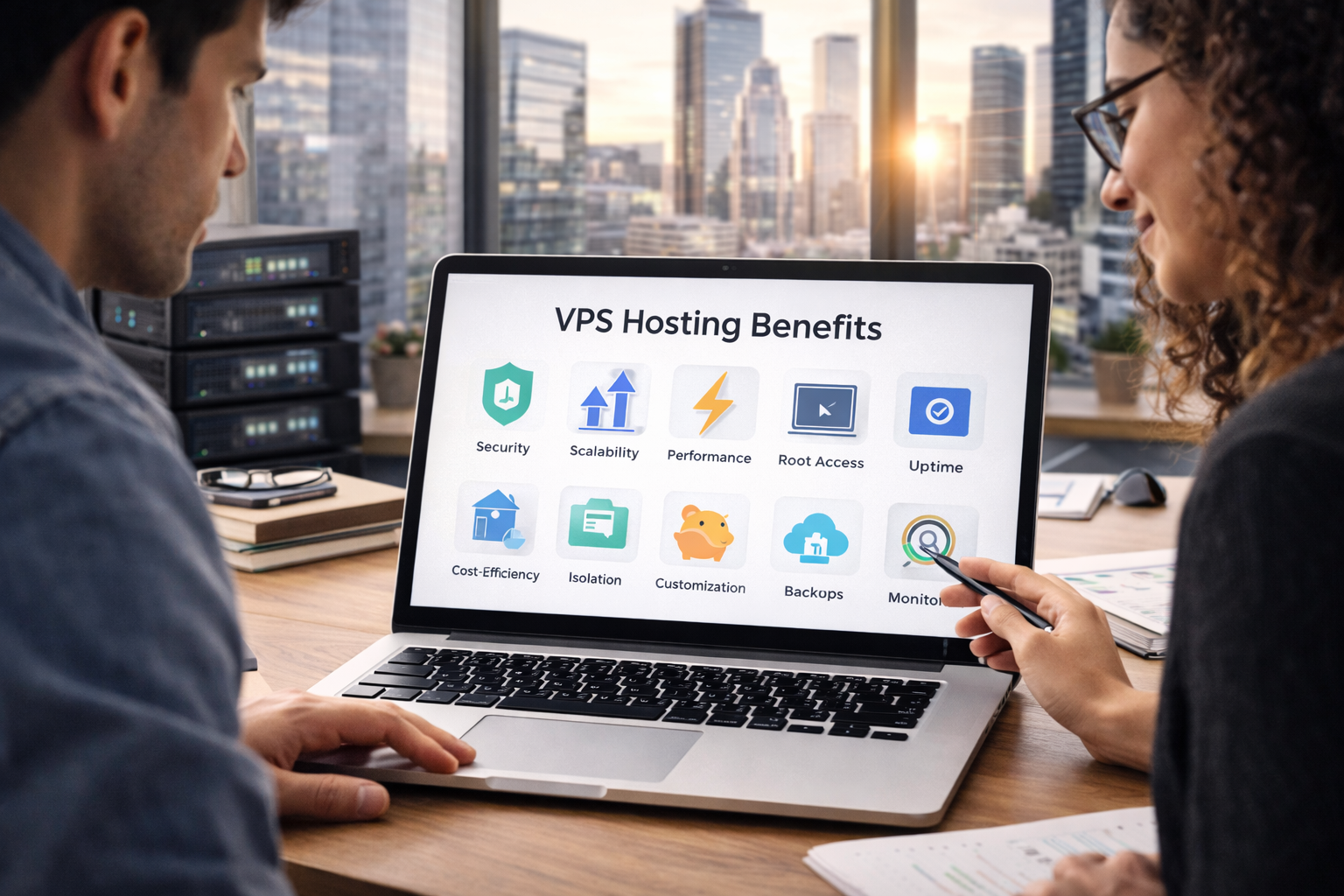
The resurgence of VPS popularity in 2026 isn’t accidental. It is driven by specific operational advantages that align with modern startup needs.
1. Resource isolation and performance consistency
The “noisy neighbor” effect is the enemy of application performance. In a startup environment, where the first impression of your MVP (Minimum Viable Product) is everything, latency kills conversion. VPS hosting ensures that your allocated resources are dedicated solely to your application. If another virtual machine on the same physical node experiences a traffic spike, your operations remain unaffected. This isolation guarantees that your API response times remain consistent, regardless of external factors.
2. Cost predictability compared to dedicated infrastructure
In 2026, “cloud bill shock” is a well-documented phenomenon. Auto-scaling groups and unmonitored serverless functions can lead to bills that fluctuate wildly from month to month. VPS hosting provides a predictable, flat-rate pricing model. For a bootstrapped startup or a Series A company trying to extend its runway, knowing exactly what the infrastructure bill will be at the end of the month ($40, $80, or $200) allows for better financial planning than the pay-per-minute model of public clouds.
3. Flexibility in software and system configuration
Shared hosting restricts you to the provider’s choice of operating system and software stack. VPS hosting hands you the keys. You get root access (on Linux) or Administrator access (on Windows). This means you can install custom software, tweak server configuration files, and set up specific coding environments (like Node.js, Python, or Docker containers) exactly how your developers need them. This freedom is non-negotiable for tech startups building proprietary software that requires specific dependencies.
Scalability and Growth Considerations
Startups are designed to grow, and your infrastructure must handle that trajectory without requiring a complete rebuild every six months.
4. Handling traffic growth and product scaling
One of the myths surrounding VPS is that it cannot scale. Modern VPS providers allow for rapid resizing. If your marketing team launches a campaign that doubles your traffic, you can typically upgrade your plan to add more CPU cores and RAM with a simple reboot. This vertical scaling accommodates growth spurts without the engineering overhead of re-architecting your application for a distributed cloud environment before you actually need it.
5. Upgrade paths without full infrastructure migration
Migrating servers is a risk. Links break, databases corrupt, and downtime occurs. A major benefit of VPS hosting is the ability to upgrade resources in place. You start with what you need—perhaps 2 vCPUs and 4GB of RAM—and as your user base grows, you scale up to 8 vCPUs and 32GB of RAM. You keep the same IP address, the same file structure, and the same configurations, removing the friction of migration during critical growth phases.
Security and Control Advantages
Data privacy regulations have only tightened by 2026. Security is no longer an afterthought; it is a compliance requirement.
6. Improved security isolation for applications
Because each VPS is encapsulated within its own virtual environment, it is significantly more secure than shared hosting. Malware or vulnerabilities affecting one VPS cannot easily spread to others. For startups handling sensitive user data, this isolation is a baseline requirement for passing security audits and gaining customer trust.
7. Administrative access and environment customization
With root access comes the ability to harden the server. You are not at the mercy of the host’s default security settings. Your security team can configure firewalls (like iptables or UFW), install intrusion detection systems, and close unnecessary ports. This granular control allows startups to implement security postures that align with specific industry standards, such as HIPAA or SOC2, which is often difficult or impossible in shared environments.
Why VPS Hosting Matters for India and Emerging Markets
Silicon Valley does not exist in a vacuum. By 2026, the connection between Californian HQs and engineering teams in hubs like Bangalore, Hyderabad, and Pune is stronger than ever.
8. Adoption of startup infrastructure models in India
India’s startup ecosystem has matured rapidly, with infrastructure decisions mirroring those in the US. However, cost sensitivity remains a priority. VPS hosting serves as the backbone for many Indian startups and satellite offices because it offers enterprise-grade power at a fraction of the cost of hyperscale cloud providers. This democratization of computing power allows smaller teams in emerging markets to compete globally without being priced out of the market by infrastructure costs.
9. Cost-efficient scalability for globally focused teams
For Silicon Valley startups with distributed teams, creating mirrored development and staging environments is crucial. VPS hosting allows companies to spin up affordable development servers in Asian data centers. This reduces latency for remote developers in India and provides a cost-effective way to test regional deployment strategies. It enables a “follow the sun” development cycle without the exorbitant costs associated with replicating full cloud environments across multiple regions.
Current Trends in VPS Hosting for Startups
The technology powering VPS solutions hasn’t stood still. The hardware and software stacks of 2026 are vastly superior to those of the early 2020s.
10. Use of NVMe storage and modern virtualization
The standard for storage has shifted entirely to NVMe (Non-Volatile Memory Express) SSDs. These drives offer read/write speeds that are exponentially faster than traditional SATA SSDs. For startups running database-heavy applications or real-time analytics, NVMe-backed VPS hosting eliminates the I/O bottleneck. Furthermore, modern virtualization techniques (like KVM) have reduced the “overhead” of the hypervisor, meaning nearly 100% of the hardware’s performance is passed through to your application.
Integration with cloud services and DevOps tools
The line between VPS and Cloud is blurring. Startups are increasingly using VPS as the foundation for containerized applications. A single robust VPS can host a Docker engine running multiple microservices. This allows startups to adopt modern DevOps practices—CI/CD pipelines, container orchestration—while running on simple, cost-effective VPS infrastructure rather than complex managed Kubernetes services that charge a premium for management.
Expert Insights and Data-Backed Analysis
When we look at the numbers, the case for VPS strengthens. Industry benchmarks for 2026 indicate that early-stage startups spending on “managed” cloud services spend approximately 40% more on infrastructure than those managing their own VPS environments.
Trade-offs between VPS, cloud, and managed platforms
The trade-off is always time versus money. Managed platforms (PaaS) handle the OS updates and patching, but they charge a premium. VPS requires your team to manage the server (updates, security patches). However, for a startup with a competent technical lead, this management overhead is often negligible compared to the 40-50% cost savings. The data suggests that until a startup hits a specific scale—typically usually around Series B or significant user traction—the ROI of VPS outperforms complex cloud architectures.
What to Watch Next
As we look beyond 2026, the role of VPS will likely evolve into “Hybrid VPS” models.
Changes in startup infrastructure strategies
We are seeing a shift away from “cloud-only” to “cloud-smart.” Startups are realizing that not every workload needs to be serverless. Stable, long-running processes (like databases or web servers) are cheaper to run on VPS, while bursty workloads go to the cloud.
VPS hosting developments affecting early-stage companies
Expect to see more AI-integrated VPS management tools. Hosting providers are beginning to offer AI assistants that monitor server health, predict traffic spikes, and suggest optimizations, effectively lowering the technical barrier to entry for managing a VPS. This will make the power of VPS accessible to even non-technical founders.
Frequently Asked Questions
Is VPS hosting suitable for early-stage startups?
Yes. It offers the best balance of price, performance, and control. It allows startups to keep burn rates low while having enough power to run production-grade applications.
How does VPS hosting compare to cloud hosting for startups?
VPS is generally cheaper and offers predictable billing (flat monthly fee). Cloud hosting offers better horizontal scaling (adding more servers instantly) but comes with variable pricing and higher complexity.
What technical skills are required to manage a VPS?
You generally need basic Linux command line skills and an understanding of server administration (SSH, firewalls, installing packages). However, “Managed VPS” options exist where the provider handles the technical upkeep for a higher fee.
When should a startup consider moving beyond VPS hosting?
You should consider moving to a complex cloud architecture when your traffic becomes highly unpredictable, you require instant global auto-scaling, or your application architecture decomposes into hundreds of microservices that require complex orchestration.
Building a Foundation for the Future
In 2026, the allure of the “latest and greatest” tech stack is strong, but the fundamentals of business remain unchanged: control your costs and own your data. VPS hosting offers Silicon Valley startups a way to do both.
By providing a secure, scalable, and cost-effective environment, VPS hosting allows founders to focus their limited capital on what truly matters—product development and customer acquisition. Whether you are building the next AI unicorn or a sustainable SaaS platform, ignoring the benefits of VPS hosting is a strategic oversight you cannot afford to make.