
10 Low-Cost Web Hosting Plans in 2026 Priced Under $3 Per Month
Starting a website shouldn’t require emptying your bank account. In 2026, the demand for affordable digital presence is higher than ever. From students building portfolios to small business owners launching their first online store, the search for quality hosting on a shoestring budget is a universal pursuit.
The web hosting landscape has evolved significantly over the last few years. While premium managed hosting services have their place, the competitive market for shared hosting has driven prices down, often to the benefit of the consumer. However, navigating the sea of “starting at” prices and promotional banners can be confusing. Is a $2.00/month plan actually usable? What features are stripped away to hit that price point?
This guide cuts through the marketing noise. We have analyzed the current market to identify ten hosting providers offering genuine value for under $3 per month. Whether you are launching a personal blog or testing a new business idea, this comparison will help you find a home for your website without breaking the bank.
Background and Budget Web Hosting Explained
Before diving into the specific providers, it is crucial to understand what “budget hosting” actually means in the context of 2026 infrastructure.
What defines a low-cost hosting plan?
Low-cost hosting typically refers to shared hosting environments. In this setup, hundreds or even thousands of websites reside on a single physical server. They share resources like CPU, RAM, and disk space. By splitting the cost of the server among many users, providers can offer plans at rock-bottom prices—often less than the cost of a single cup of coffee per month.
Common limitations of entry-level hosting
While the price is right, users must temper their expectations. Hosting under $3 usually comes with specific constraints:
- Performance: Speed may fluctuate based on the traffic of other sites on the same server (the “noisy neighbor” effect).
- Support: You might not get priority access to support agents or 24/7 phone assistance.
- Scalability: These plans are generally designed for low-traffic sites. If your content goes viral, your site might crash or be temporarily suspended for using too many resources.
Methodology and Price Evaluation Criteria
To compile this list, we looked beyond the big bold numbers on the landing pages. Hosting pricing is notoriously complex, often hiding the true cost in the fine print.
Monthly pricing, renewals, and billing terms
The most critical factor we examined is the “effective monthly cost.” Many hosts advertise a $1.99 rate, but it requires you to prepay for 36 or 48 months upfront. We prioritized transparency regarding these terms. Additionally, we looked at renewal rates. It is standard industry practice for the price to jump significantly—sometimes 200% or 300%—after the initial term expires.
Included resources and feature availability
A low price is meaningless if you don’t get the tools you need. We evaluated plans based on the inclusion of essentials:
- SSL Certificates: Is security included, or is it a paid add-on?
- Email: Can you create a professional email address (@yourdomain.com)?
- Domain Name: Is the first year of domain registration free?
Transparency and plan restrictions
Finally, we looked for hidden caps on bandwidth or storage (often marketed as “unlimited” but governed by strict “fair use” policies) and whether the host pushes aggressive upsells during the checkout process.
10 Cheapest Web Hosting Plans in 2026
Here are ten providers that have managed to keep their entry-level pricing under the $3 mark in 2026.
1. Hostinger
Price: Starts around $1.99/mo (48-month term)
Hostinger remains a dominant force in the budget sector. Their custom-built control panel (hPanel) is user-friendly, and even their cheapest plan includes decent performance optimization.
- Pros: Fast load times for the price, weekly backups, free SSL.
- Cons: No free domain on the absolute cheapest tier; renewal price increases.
2. Bluehost
Price: Starts around $2.95/mo (12 or 36-month term)
A long-time favorite for WordPress users, Bluehost continues to offer a solid starter package.
- Pros: Officially recommended by WordPress.org, free domain for the first year, unmetered bandwidth.
- Cons: No monthly billing option; aggressive upsells in the dashboard.
3. DreamHost
Price: Starts around $2.59/mo (3-year term)
DreamHost stands out for its month-to-month billing options, though the under-$3 pricing requires a longer commitment.
- Pros: comprehensive 97-day money-back guarantee, free domain privacy (which most charge for).
- Cons: No cPanel (uses a custom panel), phone support is callback only.
4. iPage
Price: Starts around $1.99/mo (36-month term)
iPage simplifies things by offering a “one-size-fits-all” plan at a very low entry point.
- Pros: “Unlimited” storage and bandwidth (within fair use), free domain.
- Cons: Performance is generally slower than competitors; the renewal rate is steep.
5. GreenGeeks
Price: Starts around $2.95/mo (36-month term)
For the eco-conscious user, GreenGeeks matches the energy they consume with 300% renewable energy credits.
- Pros: Environmentally friendly, solid performance, free nightly backups.
- Cons: High renewal rates; the cheapest plan is limited to one website.
6. A2 Hosting
Price: Starts around $2.99/mo (12-month term)
A2 is known for speed. Even their budget “Startup” plan benefits from their optimized infrastructure.
- Pros: Excellent speed optimization, anytime money-back guarantee (prorated).
- Cons: The “Turbo” servers (their main selling point) are not included in the sub-$3 plan.
7. HostGator
Price: Starts around $2.75/mo (36-month term)
A veteran in the industry, HostGator’s “Hatchling” plan is a reliable, no-frills option for beginners.
- Pros: Unmetered bandwidth, $100 Google Ads credit included, 45-day guarantee.
- Cons: Constant upselling in the dashboard; servers can be slower during peak times.
8. Namecheap
Price: Starts around $1.98/mo (12-month term)
Primarily a domain registrar, Namecheap’s “Stellar” hosting plan is surprisingly robust for the price.
- Pros: 100% uptime guarantee (rare for shared hosting), 20GB SSD storage, 3 websites allowed.
- Cons: Support can be hit-or-miss; renewal prices can double.
9. InMotion Hosting
Price: Starts around $2.29/mo (36-month term)
InMotion is often favored by small businesses for its reliability and US-based support.
- Pros: Free SSL, hack protection, unlimited bandwidth.
- Cons: Account verification process can be strict and slow; backups are a paid add-on.
10. IONOS (formerly 1&1)
Price: Starts at $1.00/mo (Introductory 12-month term)
IONOS frequently runs a promotion where the first year is incredibly cheap, though standard pricing applies afterward.
- Pros: Lowest initial cost on the list, professional email included, scalable performance levels.
- Cons: Control panel is not intuitive for beginners; support wait times can be long.
Key Factors to Consider With Cheap Web Hosting
When you are paying less than a cappuccino for a month of service, you need to know where the compromises are.
Performance expectations at lower price points
Speed matters for SEO and user experience. With sub-$3 hosting, you are sharing resources. If another site on your server gets a traffic spike, your site might slow down. While providers like A2 Hosting and Hostinger have optimized their stacks to mitigate this, you should not expect enterprise-level speeds. For a simple blog or portfolio, it is usually sufficient. for a media-heavy site, it might struggle.
Storage, bandwidth, and account limits
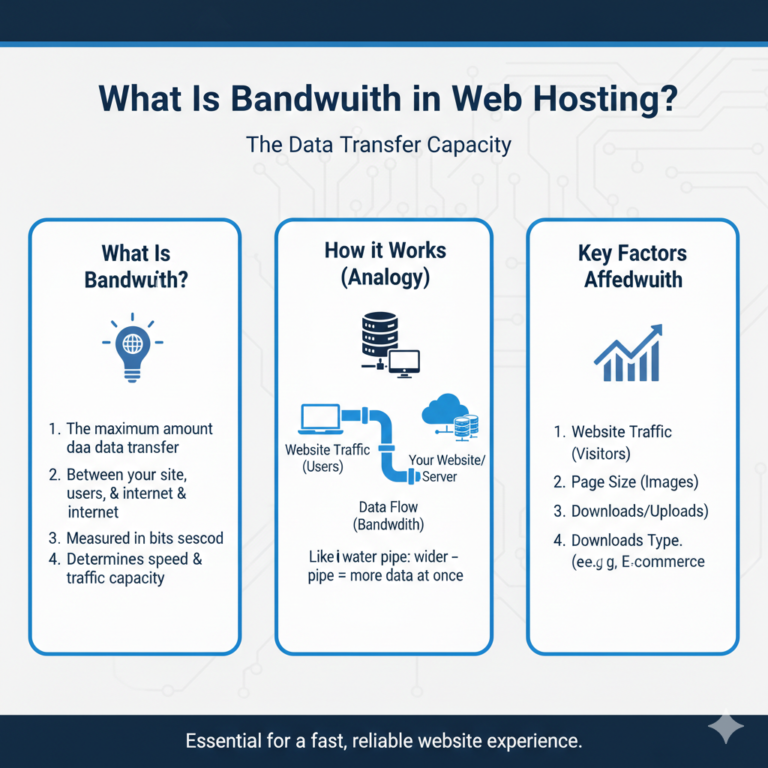
Pay close attention to “inodes.” This is the file count limit. A plan might offer “unlimited storage,” but if you are limited to 150,000 inodes, you can’t host a massive library of small files. Similarly, “unmetered bandwidth” means they don’t count the data transfer, but if your traffic exceeds what the CPU can handle, they will throttle you.
Customer support access and service levels
Cheap hosting often relies on automated support or community forums. Live chat is standard, but wait times can vary. If you are not technical, choosing a host with a reputation for good support (like SiteGround, though they rarely dip below $3, or InMotion) becomes vital.
Why Affordable Web Hosting Matters for India and Emerging Markets
The sub-$3 price point is particularly significant for global digital adoption, specifically in markets like India, Southeast Asia, and Latin America.
Cost sensitivity for startups and individual creators
In regions where the purchasing power parity differs from the US or Europe, a $10/month hosting plan is a significant barrier to entry. Plans priced around ₹200-250 INR (approx. $3 USD) democratize access to the web. It allows students, freelancers, and small local businesses to compete on a global stage without a prohibitive capital investment.
Role of low-cost hosting in digital adoption in India
India’s digital economy is booming. As millions of small and medium enterprises (SMEs) move online, low-cost hosting acts as the infrastructure backbone. It facilitates the transition from brick-and-mortar to e-commerce, enabling local artisans to reach international customers. The availability of these affordable plans is directly correlated to the rate of digital literacy and economic growth in the digital sector.
Current Trends in Budget Web Hosting
As we move through 2026, several trends are shaping the budget hosting market.
Long-term discounts and introductory pricing models
The “lock-in” strategy is intensifying. To get the advertised $1.99 or $2.50 rate, hosts are increasingly requiring 48-month commitments. This benefits the host by reducing churn but requires the consumer to trust a brand they may have never used before. We are also seeing “introductory” rates that apply to the first term only, followed by renewals at standard market rates (often $10+).
Increased use of shared infrastructure and automation
To keep prices low while electricity and hardware costs rise, hosts are leaning heavily on automation. Setup is instant, security scanning is automated, and basic support queries are handled by AI bots before reaching a human. Furthermore, containerization technology (like CloudLinux) is becoming standard, allowing hosts to pack more users onto a server more safely by isolating their resources.
Expert Insights and Data-Backed Analysis
Looking at the broader industry data helps contextualize these offers.
Industry pricing benchmarks for entry-level hosting
Historically, the “floor” for web hosting has hovered between $2 and $4. Despite inflation, this floor has remained stable due to the plummeting cost of SSD storage and fierce competition. However, the “ceiling” for shared hosting has risen, with “Pro” shared plans now reaching $15-$20/mo, creating a wider gap between entry-level and premium tiers.
Trade-offs between cost, reliability, and scalability
There is a direct correlation between price and “uptime reliability.” While premium hosts guarantee 99.99% uptime, budget hosts often aim for 99.9%. The difference sounds small, but 0.1% downtime is about 45 minutes a month. For a hobby site, this is acceptable. For an online store, that 45 minutes could mean lost sales. The data suggests that once a site exceeds 10,000 monthly visitors, migrating away from sub-$3 hosting becomes necessary to maintain performance.
What to Watch Next
If you choose one of these plans, keep an eye on the future.
Changes in pricing after initial contract periods
Set a calendar reminder for 30 days before your hosting term expires. This is when the sticker shock hits. You will need to decide whether to renew at the higher rate (often 3x the original price) or migrate to a new host to take advantage of a different introductory offer.
Indicators for when an upgrade may be necessary
You have outgrown your $3 plan if:
- Your website takes more than 3 seconds to load.
- You receive errors like “503 Service Unavailable” or “Resource Limit Reached.”
- You need to install specific software that requires root access (which shared hosting doesn’t provide).
Frequently Asked Questions
Are web hosting plans under $3 per month reliable?
Generally, yes, for small websites. Major providers like Bluehost and Hostinger maintain decent uptime even on cheap plans. However, they are not designed for mission-critical business applications where 100% uptime is required.
Do cheap hosting plans affect website speed?
They can. Because you share server resources, your site might be slower than if you were on a VPS or dedicated server. However, using a lightweight theme, optimizing images, and using a caching plugin can make a cheap site load surprisingly fast.
What happens when promotional pricing ends?
Your bill will increase. The $2.95/month rate usually jumps to the “regular” rate, which can range from $7.99 to $11.99 per month. Always check the “renewal price” in the fine print before signing up.
Who should consider upgrading from budget hosting?
You should upgrade if your site starts generating significant revenue, if you are receiving over 1,000 visitors a day, or if you need advanced security features for handling sensitive customer data.
Getting Started on a Budget
The barrier to entry for launching a website has never been lower. In 2026, a budget of $3 per month can secure you a capable, secure, and functional hosting environment. While these plans come with limitations regarding resources and support, they are the perfect launchpad for ideas, blogs, and small businesses.
The key to success with budget hosting is managing expectations. Understand that you are renting a small apartment in a busy building, not buying a private estate. By choosing reputable providers like those listed above—Hostinger for value, GreenGeeks for sustainability, or A2 for speed—you can build a professional digital footprint without the premium price tag.
Take the first step. Pick a plan, register your domain, and start building.