
Mistakes to Avoid When Choosing Hosting
Launching a new website is an exciting milestone. You have spent hours perfecting the design, crafting the copy, and planning your marketing strategy. However, there is one technical foundation that often gets overlooked in the rush to go live: your web hosting provider.
Many site owners view hosting as a commodity—a box to check off as cheaply as possible. This is a critical error. Your hosting provider is the engine room of your digital presence. If the engine fails, the car stops, no matter how beautiful the paint job is.
Choosing the wrong host can lead to frequent downtime, sluggish load speeds, security breaches, and a disastrous user experience. Worse, migrating a live site away from a bad host is often a complicated, technical headache that costs more time and money than simply choosing the right provider from the start.
In this guide, we will explore the most common pitfalls site owners face. By understanding these mistakes to avoid when choosing hosting, you can secure a foundation that supports your growth rather than hindering it.
Mistake #1 – Choosing Hosting Based Only on Price
Budget is always a factor, especially for startups and small businesses. However, making price your primary decision-making criteria is the quickest way to run into trouble. Hosting companies are businesses, and if a plan costs less than a cup of coffee per month, corners are being cut somewhere.
The trap of introductory pricing
Most providers offer attractive “introductory rates.” You might see a banner advertising hosting for $2.99 per month. What is often buried in the fine print is that this price requires a three-year commitment paid upfront. Furthermore, when that initial term expires, the renewal rate often jumps by 200% or 300%.
Hidden costs of cheap hosting
Cheap web hosting risks go beyond just the bill. To make a profit on ultra-low-cost plans, providers often overcrowd their servers. This means your website shares resources with thousands of others. If another site on the same server experiences a traffic spike, your site slows down or crashes.
Key takeaway: Beware of hosting pricing traps. Look for transparency in renewal rates and understand that a slightly higher monthly fee often pays for better hardware, less crowded servers, and superior support.
Mistake #2 – Ignoring Website Speed and Performance
In the digital economy, speed is currency. Google’s Core Web Vitals update made page speed a direct ranking factor for SEO. If your site takes more than three seconds to load, over half of your visitors will abandon it before they see a single word.
The server speed impact
Fast web hosting is non-negotiable. Your host’s hardware (using SSDs instead of older HDDs) and server configuration play a massive role in how quickly your server responds to a request (Time to First Byte). You cannot optimize your way out of a slow server response time; if the host is slow, your site is slow.
The role of CDNs
Does the host offer a Content Delivery Network (CDN) integration? A CDN stores copies of your site on servers around the world, ensuring that a visitor in London doesn’t have to wait for data to travel from a server in Los Angeles. This is essential for website speed hosting, particularly for global audiences.
Mistake #3 – Not Checking Uptime Guarantees
Uptime refers to the percentage of time your website is accessible online. A host might promise 99% uptime, which sounds impressive. But let’s do the math: 99% uptime allows for 3.65 days of downtime per year. Can your business afford to be closed for nearly four days?
Reliable web hosting providers should offer an uptime guarantee of at least 99.9%. This reduces permissible downtime to about 8 hours per year.
The Service Level Agreement (SLA)
Always check the Service Level Agreement. A hosting uptime guarantee is only as good as the penalty for breaking it. Does the host offer refunds or credits if they fail to keep your site online? If there is no financial consequence for them, the guarantee is essentially marketing fluff.
Mistake #4 – Choosing the Wrong Hosting Type
Not all hosting environments are created equal. One of the most confusing aspects for beginners is understanding the different types of web hosting explained in marketing materials.
Shared vs VPS vs Cloud Hosting
- Shared Hosting: Think of this as renting a room in a dormitory. It is cheap and adequate for small personal blogs, but you share facilities (resources) with everyone else. It is not suitable for high-traffic business sites.
- VPS (Virtual Private Server): This is like owning a condo. You still share the building (physical server), but you have your own dedicated amenities (RAM and CPU) that neighbors can’t touch. This offers better stability.
- Cloud Hosting: This utilizes a network of servers. If one server fails, another takes over instantly. It offers immense scalability and reliability.
- Dedicated Hosting: You rent the entire house. The physical server is yours alone. This is powerful but expensive and requires technical management.
Failing to distinguish between shared vs VPS vs cloud hosting often leads to businesses crashing their own sites during a successful marketing campaign because their shared plan couldn’t handle the traffic.
Mistake #5 – Overlooking Security Features
Cyberattacks are rarely personal; they are automated scripts scanning the web for vulnerabilities. If your host doesn’t prioritize security, you are leaving the back door open.
Secure web hosting is about proactive defense. At a minimum, your provider should offer:
- Free SSL Certificates: This encrypts data between the user and the server (the padlock icon in the browser). Google flags sites without SSL as “Not Secure.”
- Server-Level Firewalls: To block malicious traffic before it hits your site.
- Malware Scanning: Automated tools that check for infectious code.
Don’t assume these are included. Many budget hosts sell security features as expensive add-ons.
Mistake #6 – Ignoring Customer Support Quality
Hosting problems rarely happen at convenient times. Your site will inevitably go down at 11 PM on a Friday before a major Saturday sale. This is when hosting technical support becomes your most valuable asset.
Chatbots vs. Humans
Test the support before you buy. Is there 24/7 support available? When you open a chat, do you get a bot sending generic articles, or a qualified engineer who can fix the server?
Read reviews specifically looking for comments on support response times. The best hosting customer support teams respond in minutes, not hours. If a host relies solely on a ticketing system with a “24-hour turnaround time,” avoid them for mission-critical business sites.
Mistake #7 – Not Considering Future Growth and Scalability
You might start with 100 visitors a month, but what happens when you hit 10,000? Or 100,000?
Migration is risky and time-consuming. Ideally, you want a host that allows you to upgrade hosting plans seamlessly. This is known as scalable hosting.
The “Unlimited” Myth
Be wary of plans offering “unlimited” bandwidth or storage on shared plans. In reality, if your “unlimited” site starts using too many resources, the host will throttle your speed or ask you to upgrade immediately to a VPS. True scalability means the host has a clear path for you to move from a shared plan to a VPS or Cloud solution with a simple click.
Mistake #8 – Not Reading Hosting Reviews and Terms
The hosting industry is heavily driven by affiliate marketing. Many “Top 10” review sites rank hosts based on who pays the highest commission, not who offers the best service.
How to research effectively
To find the best hosting provider comparison, look for:
- User reviews on independent platforms (like TrustPilot or G2).
- Twitter/X searches for the support handle of the hosting company to see real-time complaints.
- Terms of Service: Check their refund policy. Is there a 30-day money-back guarantee? Are there cancellation fees?
Digging into genuine hosting reviews will reveal recurring issues that polished marketing pages hide.
Mistake #9 – Forgetting Backup and Recovery Options
Data loss can happen to anyone. An update goes wrong, a file gets deleted, or a hacker gets in. If your host doesn’t have a reliable backup system, your website could disappear permanently.
You need website backup hosting that is automated. Manual backups are prone to human error—you will eventually forget to do it.
Automatic backups and retention
Check if the host performs daily automatic backups hosting services. More importantly, ask how easy it is to restore them. Some hosts take backups but charge a hefty fee to restore your site from them. You should have one-click restore functionality accessible from your control panel.
Mistake #10 – Choosing Hosting Without SEO Considerations
We touched on speed, but hosting affects SEO in other ways too. Search engines look for signals of trust and performance.
Server Location
The physical location of the data center matters. If your customers are in New York but your server is in Singapore, the data has to travel halfway around the world, causing latency. The best hosting for SEO allows you to choose a data center location closest to your primary audience.
Additionally, consistent downtime signals to Google that your site is unreliable, which can result in your pages being de-indexed or pushed down in search rankings.
How to Choose the Right Hosting Provider (Quick Checklist)
Ready to make a decision? Use this checklist to evaluate potential providers.
- Uptime: Is it 99.9% or higher with a financial guarantee?
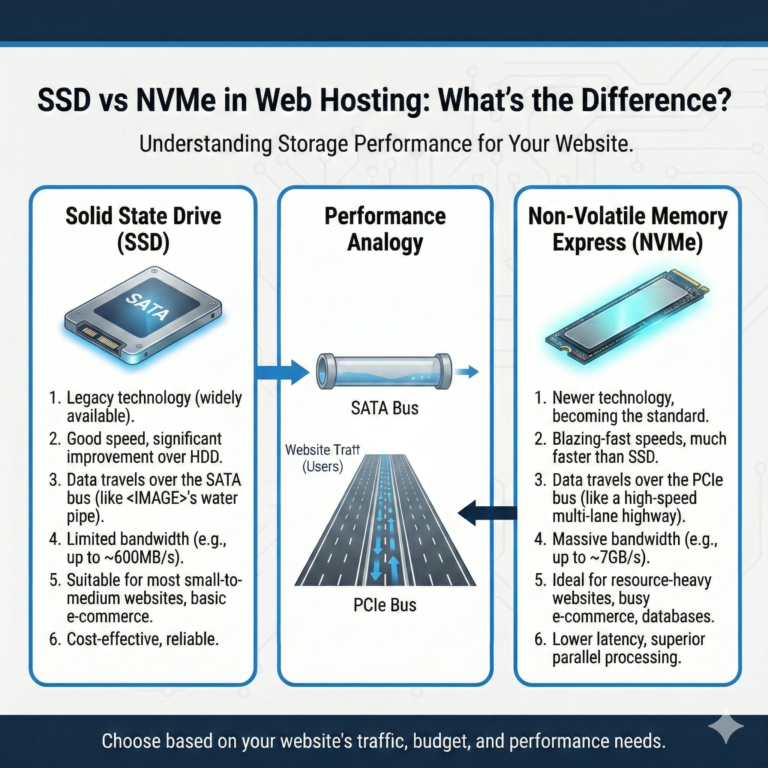
- Speed: Do they use NVMe SSD storage and offer server-level caching?
- Support: Test their live chat. Is it 24/7 with real humans?
- Scalability: Can you upgrade CPU/RAM without migrating?
- Security: Are SSL and daily backups included in the price?
- Server Location: Can you choose a data center near your audience?
- Budget: Have you checked the renewal price, not just the intro price?
Knowing how to choose web hosting boils down to balancing these features against your budget. For most new business owners, the best hosting for beginners is a managed WordPress host or a reputable cloud provider that handles the technical heavy lifting for you.
FAQ – Choosing Web Hosting
Q1: What is the biggest mistake when choosing hosting?
The biggest mistake is choosing a provider solely based on the lowest price. This often leads to poor performance, lack of support, and hidden costs later on.
Q2: Is cheap hosting bad for websites?
Not always, but cheap hosting risks include overcrowding servers, which leads to slow speeds and security vulnerabilities. It is acceptable for hobby sites but risky for businesses.
Q3: Which hosting is best for beginners?
The best hosting for beginners is typically “Managed Hosting.” Whether it’s Managed WordPress or another platform, the provider handles technical updates, security, and backups, allowing you to focus on content.
Q4: How do I know if a hosting provider is reliable?
Check independent reviews for comments on downtime. Look for a publicly available “System Status” page and an SLA (Service Level Agreement) that guarantees at least 99.9% uptime.
Q5: Does hosting affect website speed and SEO?
Yes, absolutely. Slow server response times hurt your Core Web Vitals score, which is a ranking factor for Google. Hosting affects SEO significantly if the site is slow or frequently offline.
Q6: Can I change hosting providers later?
Yes, you can change providers, but website migration can be technical and risky if not done correctly. It is better to choose the right host from day one to avoid downtime during a future switch.
Build Your Site on Solid Ground
Your website is a digital asset that works for you 24 hours a day. It deserves a home that is secure, fast, and reliable. By avoiding these common mistakes—like falling for pricing traps, ignoring security, or compromising on support—you save yourself future frustration and protect your brand’s reputation.
Don’t rush the decision. Compare reputable providers, read the fine print, and choose a plan that offers room for your business to flourish.
Ready to secure your website’s future? Start by comparing the top-rated hosting providers today and choose a plan that guarantees speed, security, and growth.