
How Much Does Web Hosting Cost in 2026? Plans, Pricing & Hidden Fees Explained
Starting a website in 2026 is easier than ever, but navigating the financial landscape of web hosting remains a challenge. You might see ads promising hosting for the price of a cup of coffee, only to find your final bill is significantly higher. With new technologies like AI-driven server management and green energy data centers influencing the market, pricing models have shifted.
Understanding the true web hosting cost in 2026 is critical for anyone—from a hobbyist blogger to a scaling startup—to ensure they aren’t overpaying for resources they don’t need or underpaying for a service that will crash at the first sign of traffic.
This comprehensive guide breaks down exactly what you should expect to pay for shared, VPS, cloud, and dedicated hosting this year. We will uncover the industry’s most common pricing tricks, expose hidden fees, and help you find the sweet spot between performance and affordability.
Average Web Hosting Cost in 2026
The hosting market has matured, leading to more competitive pricing at the entry level, but higher costs for premium, performance-optimized services. So, what is the baseline?
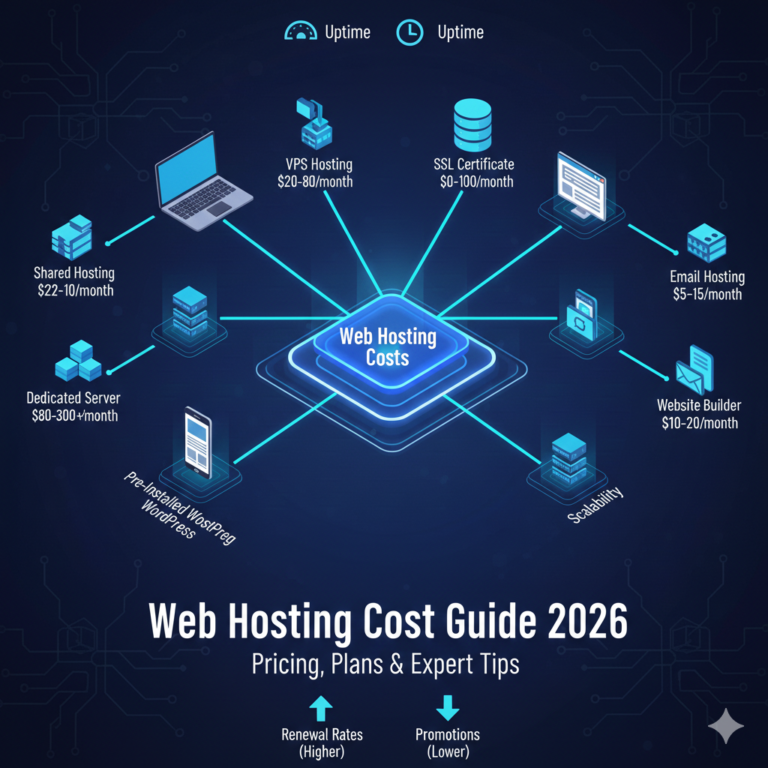
In 2026, the average cost for web hosting ranges from $2.99 to $15.00 per month for shared plans, while more robust VPS and cloud solutions can range from $20 to $100+ per month.
It is important to distinguish between “promotional pricing” and “renewal pricing.” Most hosts offer a steep discount for your first term (often 12 to 36 months). Once that term ends, the price often jumps by 100% to 300%.
Quick Pricing Snapshot for 2026
Here is a realistic look at what you can expect to pay based on the type of hosting:
- Shared Hosting: $2.99 – $15/month (Best for beginners)
- VPS Hosting: $20 – $80/month (Best for growing businesses)
- Cloud Hosting: $10 – $200+/month (Best for scalability)
- Dedicated Hosting: $100 – $500+/month (Best for large enterprises)
- Managed WordPress: $15 – $50/month (Best for hands-off management)
Shared Hosting Pricing in 2026
For the vast majority of new websites, shared hosting remains the starting point. As the name implies, your website lives on a single server alongside hundreds of other websites, sharing resources like CPU and RAM.
Average Shared Hosting Price
- Introductory Offer: $1.99 – $4.99 per month
- Renewal Price: $8.99 – $19.99 per month
What’s Included?
In 2026, even basic shared hosting plans are more generous than they used to be. Most reputable shared hosting costs now cover:
- A free SSL certificate (essential for security).
- One free domain name for the first year.
- Unmetered bandwidth (though “unmetered” usually has fair usage limits).
- One-click WordPress installation.
Who Should Choose Shared Hosting?
If you are launching a personal blog, a portfolio, or a small local business website that receives less than 20,000 visitors a month, shared hosting is the most cost-effective route. It is the cheapest web hosting 2026 has to offer. However, if your site experiences a sudden viral spike, shared hosting may throttle your speed or take your site offline temporarily to protect other users on the server.
VPS Hosting Pricing in 2026
Virtual Private Server (VPS) hosting is the natural next step when you outgrow shared hosting. It mimics a dedicated server environment within a shared environment. You still share physical hardware, but your portion of the resources (RAM, CPU storage) is strictly allocated to you.
Average VPS Hosting Cost
- Unmanaged VPS: $5 – $20 per month
- Managed VPS: $30 – $100+ per month
Managed vs. Unmanaged VPS Pricing
The price gap here is significant.
- Unmanaged: You get the raw server space. You are responsible for security patches, updates, and configurations. It is cheaper but requires technical expertise.
- Managed: The hosting provider handles the technical backend, including updates and security monitoring. You pay a premium for the convenience and peace of mind.
Best Use Cases
VPS is ideal for e-commerce stores, high-traffic blogs, or businesses that need specific software configurations not allowed on shared plans. If speed and reliability are non-negotiable for your revenue, the extra VPS hosting cost is a necessary investment.
Cloud Hosting Pricing in 2026
Cloud hosting has become the gold standard for reliability. Instead of relying on one physical server, your site data is distributed across a network of connected servers. If one server goes down, another takes over instantly.
Average Cloud Hosting Cost
- Pay-as-you-go: Varies by usage (e.g., $0.05 per hour)
- Fixed Plans: $10 – $80 per month
Pay-As-You-Go vs. Fixed Pricing
One of the biggest advantages of cloud hosting pricing is flexibility.
- Pay-As-You-Go: You are billed only for the resources you consume. This is excellent for websites with unpredictable traffic spikes.
- Fixed Pricing: You pay a flat monthly fee for a set limit of storage and bandwidth, similar to traditional hosting but with better uptime.
When Cloud Hosting is Worth It
If you run a SaaS application, a fast-growing startup, or an online store with seasonal sales (like Black Friday), cloud hosting is worth every penny. It prevents your site from crashing during your most critical sales periods.
Dedicated Hosting Pricing (Optional / Advanced)
Dedicated hosting is the heavyweight champion of the hosting world. You rent an entire physical server exclusively for your website. No sharing, no noisy neighbors.
Average Dedicated Server Cost
- Entry-Level: $90 – $150 per month
- Enterprise: $300 – $1,000+ per month
Entry-Level vs. Enterprise Pricing
Pricing depends heavily on hardware specs. An entry-level server might have 16GB of RAM and a standard 4-core processor. An enterprise server could boast 128GB of RAM, dual high-performance processors, and massive NVMe storage arrays.
Who Actually Needs Dedicated Hosting?
In 2026, fewer businesses need dedicated hosting because cloud hosting has become so powerful. However, dedicated servers are still essential for large enterprises with strict data security compliance requirements, massive databases, or applications that require total control over the hardware environment.
Hidden Web Hosting Fees You Must Know
The sticker price you see on a hosting website is rarely the final price you pay. The industry is notorious for hidden web hosting fees and upsells. To calculate the true cost, you need to look for these common additions.
Domain Renewal Costs
Most hosts offer a “Free Domain” for the first year. However, the renewal price for that domain is often higher than if you bought it from a dedicated registrar. You might get it free today, but pay $20 to $35/year starting next year.
SSL Certificate Charges
While basic SSL certificates (Let’s Encrypt) are free and standard, some hosts still try to sell “Premium SSL” certificates for $50 to $100 a year. Unless you are a major financial institution processing heavy transactions, the free standard SSL is usually sufficient.
Backup & Restore Fees
You assume your host backs up your site, right? Often, they do—but they might charge you to restore it. Some budget hosts charge a monthly fee (e.g., $2.99/mo) for automated backups, or a steep one-time fee (e.g., $50) to restore your site if it crashes.
Email Hosting Costs
In the past, email was almost always included. In 2026, many hosts have separated email services, encouraging you to pay extra for Google Workspace or Microsoft 365 integration. This can add $6 to $15 per user per month to your bill.
Migration & Setup Fees
Moving from one host to another? While many offer “Free Migration,” read the fine print. It often covers only one basic WordPress site. If you have a complex site or multiple domains, you might be hit with a migration fee ranging from $50 to $150.
Renewal Price Shock
This is the most common complaint. You sign up for $2.95/mo for 3 years. When that term ends, the auto-renewal kicks in at the standard rate of $12.95/mo. Always check the “Regular Rate” before signing up for the “Promo Rate.”
Monthly vs. Yearly Hosting Plans
How you pay affects how much you pay. Web hosting pricing plans incentivize long-term commitment.
Pros & Cons of Monthly Billing
- Pros: Lower upfront cash flow; flexibility to cancel anytime without losing money.
- Cons: Significantly more expensive (often 50-100% higher monthly rate); usually involves a setup fee.
Long-Term Discounts Explained
Hosts want to lock you in. A 36-month contract will almost always offer the lowest monthly breakdown. For example:
- 1 Month Term: $14.99/mo
- 12 Month Term: $6.99/mo
- 36 Month Term: $3.99/mo
When Yearly Plans Make Sense
If you are serious about your project and have the budget, paying yearly (or for 3 years) is the smartest financial move. It locks in the low rate for a longer period, delaying the inevitable renewal price hike.
How to Choose Hosting Based on Budget
Navigating the market requires matching your specific needs to your wallet. Here is a breakdown of the best options for different financial tiers.
Best Cheap Web Hosting in 2026
If your budget is tight (under $5/mo), look for reputable shared hosting providers that include a free domain and SSL. Do not just pick the cheapest option; ensure they have good uptime guarantees (99.9%).
- Target: Personal blogs, hobby sites, testing grounds.
Best Value Hosting for Small Businesses
For businesses with a budget of $15–$40/mo, avoid the cheapest shared plans. Look for “Business Shared” or “Entry VPS” plans. These usually offer priority support, daily backups, and faster loading speeds—crucial for maintaining a professional image.
- Target: Local businesses, consultants, small e-commerce shops.
Best Hosting for Scaling Websites
If your budget allows for $50–$100+/mo, prioritize Managed VPS or Cloud Hosting. You are paying for scalability. If a marketing campaign goes viral, your site stays up. You are also paying for “Managed” support, meaning you have a team of experts handling server issues so you can focus on growth.
- Target: SaaS companies, high-traffic media sites, large e-commerce stores.
Cost Comparison Table
To summarize the differences, here is a direct comparison of the typical costs and features you can expect in 2026.
| Hosting Type | Monthly Cost (Promo) | Monthly Cost (Renewal) | Best For | Performance Level |
| Shared | $2.99 – $5.99 | $10.00 – $20.00 | Blogs, Portfolios | Low – Medium |
| VPS | $20.00 – $40.00 | $40.00 – $80.00 | Small Business, E-com | High |
| Cloud | $10.00 – $50.00 | $10.00 – $80.00 | Scaling Startups | Very High |
| Dedicated | $99.00+ | $150.00+ | Large Enterprise | Maximum |
Frequently Asked Questions (FAQ)
Q1. How much does web hosting cost per month in 2026?
On average, expect to pay between $3 and $15 per month for shared hosting, which is suitable for most new websites. For higher performance needs like VPS or cloud hosting, costs typically range from $20 to $80 per month.
Q2. What is the cheapest web hosting option?
Shared hosting is invariably the cheapest option. Providers often run promotions starting as low as $1.99 per month for the first term. However, be wary of extremely cheap hosts that may compromise on security or speed.
Q3. Why do hosting renewal prices increase?
Hosting companies use a “loss leader” strategy. They offer introductory rates below their operating cost to acquire customers, banking on the fact that you will renew at the regular, higher rate once your initial term expires.
Q4. Is free web hosting worth it?
Generally, no. Free hosting usually comes with advertisements on your site, poor security, no customer support, and incredibly slow speeds. It is acceptable for a student project, but never for a professional website.
Q5. Which hosting plan offers the best value for money?
For most users, a mid-tier shared hosting plan or a managed WordPress plan offers the best balance. You get better performance than the entry-level options without the high technical overhead of a VPS.
Q6. Are hidden fees common in web hosting?
Yes. The most common hidden fees involve domain privacy protection, site backups, migration services, and “security essentials” that are often automatically added to your cart during checkout. Always review your cart carefully.
Q7. Can I change hosting plans later?
Yes, web hosting is highly scalable. You can start on a cheap shared plan and upgrade to a VPS or cloud solution seamlessly as your traffic grows. Most providers will help you handle the upgrade process.
Final Verdict: How Much Should You Pay?
Calculating your web hosting cost in 2026 requires looking beyond the bold print on the sales page.
- The Hobbyist: Budget $50 – $80 per year. Stick to shared hosting, pay for a year upfront to get the discount, and don’t buy the upsells.
- The Small Business: Budget $200 – $400 per year. Invest in a high-quality shared or entry-level VPS plan that includes automated backups and strong security features.
- The Growth Company: Budget $600 – $1,200+ per year. Focus on cloud or managed VPS hosting to ensure speed and uptime are never an issue.
Don’t let the fear of hidden fees paralyze you. By understanding the pricing structures outlined in this guide, you can choose a provider that offers transparency and power, ensuring your 2026 digital presence is built on a solid, affordable foundation.