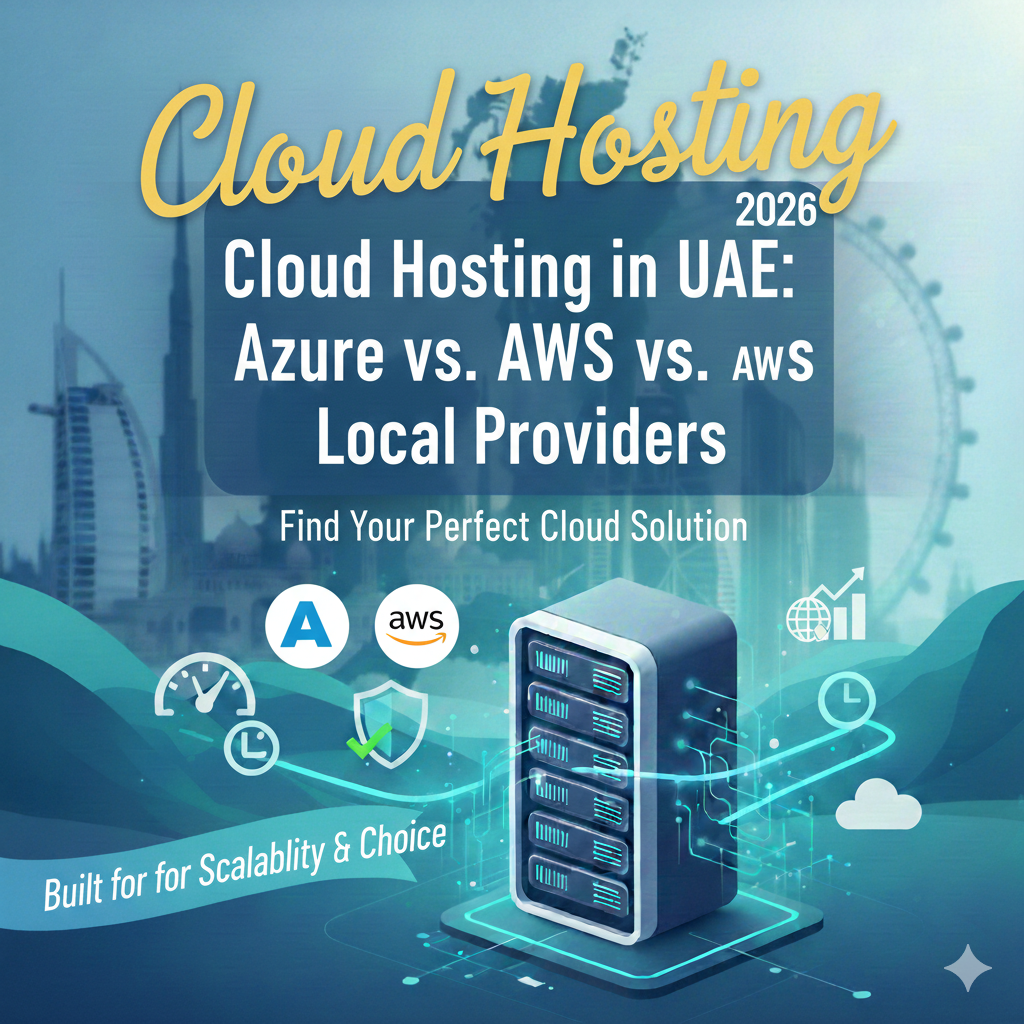
Cloud Hosting in UAE: Azure vs. AWS vs. Local Providers (2026)
The United Arab Emirates has firmly established itself as the digital capital of the Middle East. By 2026, the question for businesses in Dubai, Abu Dhabi, and beyond is no longer if they should migrate to the cloud, but which cloud infrastructure best suits their needs. The market has matured significantly, offering a diverse range of options from global giants to specialized local players.
Choosing the right partner is critical. Whether you are running a multinational enterprise, a high-growth startup, or a government agency, your choice of cloud provider impacts everything from application speed to legal compliance. This guide breaks down the cloud hosting UAE landscape, comparing the titans—Microsoft Azure and Amazon Web Services (AWS)—against the robust ecosystem of local providers. We will analyze performance, pricing, security, and the specific needs of the UAE market to help you make an informed decision.
What “Cloud Hosting” Means
Before comparing vendors, it is helpful to clarify exactly what we mean by cloud hosting in the context of 2026 infrastructure. At its core, cloud hosting replaces the need for a physical server room in your office. Instead, you rent computing resources—servers, storage, and networking—over the internet.
However, modern cloud hosting is rarely just about renting a “box.” It generally falls into three categories:
Infrastructure as a Service (IaaS)
This is the foundational layer. You rent the raw computing hardware (virtual machines, storage, networks) and manage the operating system and applications yourself. This offers maximum control and is the standard for most complex migrations.
Platform as a Service (PaaS)
PaaS removes the need to manage the underlying operating system. Developers simply deploy their code, and the cloud provider handles the maintenance, updates, and scaling. This is popular for app development in the UAE.
Software as a Service (SaaS)
This refers to finished applications delivered over the web (like Microsoft 365 or Salesforce). While not “hosting” in the traditional sense, SaaS relies heavily on the underlying cloud infrastructure UAE providers offer.
Why UAE Server Location Matters
For years, regional businesses had to host their data in Europe or the US. Today, local data centers are a non-negotiable requirement for serious operations. Two primary factors drive the demand for local cloud hosting in the UAE: latency and sovereignty.
Latency and Speed for GCC Users
In the digital economy, milliseconds translate to revenue. If your server is in London and your customer is in Sharjah, the data has to travel thousands of miles back and forth. This creates latency (lag). By hosting in a local data center in Dubai or Abu Dhabi, you reduce that physical distance, ensuring lightning-fast load times for users across the GCC.
Local Compliance and Data Sovereignty
The UAE has stringent data protection laws. Regulations regarding government data, financial records, and healthcare information often mandate that data must physically reside within the country’s borders. Utilizing local cloud hosting UAE services ensures you remain compliant with regulatory bodies like the Dubai Electronic Security Center (DESC) and federal data laws.
Azure Cloud Hosting in UAE
Microsoft was one of the first hyperscalers to commit to the region, launching data centers in 2019. By 2026, Azure’s footprint has deepened, making it a default choice for many large organizations.
Local Datacenter Regions
Azure operates out of two primary regions: UAE North (Dubai) and UAE Central (Abu Dhabi). This dual-region setup allows for robust disaster recovery strategies entirely within national borders. If a natural disaster were to affect Dubai, critical workloads could failover to Abu Dhabi instantly without leaving the country.
Enterprise Features and Hybrid Cloud
Azure’s biggest strength is its seamless integration with the Microsoft ecosystem. For companies already using Windows Server, SQL Server, and Active Directory, moving to Azure is often the path of least resistance. Their hybrid cloud capabilities allow businesses to keep some sensitive data on-premise while bursting to the cloud for extra compute power.
Performance, SLA, and Pricing
Azure offers industry-leading Service Level Agreements (SLAs), often guaranteeing 99.99% uptime. However, pricing can be complex. While they offer cost savings for long-term commitments (Reserved Instances), “pay-as-you-go” models can become expensive if not monitored closely.
AWS Cloud Hosting in UAE
Amazon Web Services (AWS) launched its Middle East (UAE) region in 2022, intensifying the competition. As the global market leader, AWS brings an unmatched depth of services to the region.
AWS Middle East Regions
AWS operates availability zones within the UAE, providing high redundancy. Their infrastructure is designed to support high-performance computing, massive storage requirements, and advanced machine learning workloads closer to the end-user.
Services and Global Integration
The sheer number of services available on AWS is staggering. From serverless computing (Lambda) to managed blockchain and AI, AWS is often the preferred choice for startups and developers who want access to the latest tech tools.
Pricing and Support Structures
AWS hosting in the UAE follows a similar pricing model to Azure—competitive but complex. They offer a vast marketplace of third-party tools that can be deployed instantly. Their support network is global, though they have significantly ramped up their local presence with Arabic-speaking support teams and local account managers.
Top Local UAE Cloud Hosting Providers
While the global giants dominate headlines, local providers play a crucial role. They often offer personalized service, data sovereignty guarantees, and simpler pricing structures that hyperscalers cannot match.
Leading Local IaaS Provider
Major telecommunications and technology groups in the UAE offer robust IaaS solutions. These local UAE cloud provider options often own the fiber networks connecting the data centers, offering distinct advantages in connectivity.
- Focus: Government entities and highly regulated industries.
- Strength: Unquestionable data sovereignty and direct access to local internet backbones.
Managed Cloud & DevOps Specialists
For businesses that lack a large in-house IT team, managed cloud providers fill the gap. These providers don’t just rent you space; they help run it.
- Focus: SMEs and agencies needing technical help.
- Strength: They handle updates, security patches, and backups, allowing you to focus on your business. They are ideal for companies looking for managed cloud UAE solutions.
Cost-Effective Local Cloud
Not every business needs AI integration or infinite scaling. Some just need a reliable VPS to host a website or an accounting system.
- Focus: Small businesses and personal projects.
- Strength: Flat-rate pricing. Unlike AWS or Azure where bills fluctuate, affordable cloud hosting UAE providers often charge a predictable monthly fee.
Cloud Hosting Performance Comparison
When we look at cloud hosting speed UAE benchmarks, the difference between local and international hosting is stark, but the difference between Azure, AWS, and top-tier local providers is minimal.
- Hyperscalers (AWS/Azure): Offer massive bandwidth and sophisticated content delivery networks (CDNs). They are faster for delivering content to a global audience from the UAE.
- Local Providers: Often have direct peering with local ISPs (like Etisalat and du). This can sometimes result in slightly lower latency for users inside the UAE.
For a pure cloud hosting performance comparison, availability zones matter. AWS and Azure offer multiple zones within the UAE, meaning if one building loses power, your app stays online. Smaller local providers may only have a single data center, representing a higher risk of downtime.
Pricing Models Compared (Azure vs. AWS vs. Local)
Cost is often the deciding factor.
- Pay-As-You-Go (AWS/Azure): You pay for every second of compute and every gigabyte of bandwidth. This is great for short-term projects or fluctuating traffic but can lead to “bill shock.”
- Reserved Instances (AWS/Azure): If you commit to 1 or 3 years, you can save up to 70%. This requires upfront capital or a strict contract.
- Flat Rate (Local Providers): Many local hosts offer bundled packages (e.g., 4 vCPU, 16GB RAM, 5TB Bandwidth) for a set price. This predictability is massive for budgeting.
When doing an Azure vs AWS cost comparison, ensure you factor in “egress fees” (the cost of moving data out of the cloud), which both hyperscalers charge, whereas many local providers do not.
Security & Compliance
In 2026, security is not just about firewalls; it is about compliance.
- GDPR & UAE Data Laws: Both global and local providers generally adhere to GDPR. However, for UAE-specific mandates (like the ADHICS for healthcare in Abu Dhabi), you must configure AWS/Azure correctly to be compliant. It is not automatic.
- Local Advantage: Some local secure cloud hosting UAE providers are pre-certified for government use, removing the burden of compliance configuration from your team. They offer “sovereign cloud” environments where no foreign entity has legal access to the data.
Support, SLAs, and Enterprise Reliability
When your server goes down at 2:00 AM Dubai time, who picks up the phone?
- Global Support: AWS and Azure have 24/7 global support, but getting a senior engineer on the phone quickly usually requires an expensive premium support plan.
- Local Support: Premium local providers often market themselves on their personalized support. You might have a direct WhatsApp line to a technician.
Regarding the SLA cloud UAE standards, look for “financial backing.” If a provider guarantees 99.9% uptime but fails, do they refund you? Azure and AWS have automated, contractually binding refund policies. Local providers vary, so read the fine print.
Best Use Cases for Each Provider
- Enterprise Applications (ERP/CRM): Azure. The integration with Office 365 and Windows infrastructure is unbeatable for corporate environments.
- SaaS Marketplaces & Startups: AWS. The breadth of developer tools and scalability makes it the best cloud for enterprise UAE startups looking to grow globally.
- E-Commerce at Scale: AWS or Azure. Both handle traffic spikes (like White Friday sales) effortlessly. Cloud hosting for ecommerce UAE requires this elasticity.
- Government & Highly Regulated Data: Local Sovereign Cloud. When data absolutely cannot be subject to the US CLOUD Act, a local provider is often required.
- Small Business Websites: Local VPS Provider. Cost-effective, simple, and sufficient performance.
Pros & Cons Summary Table
| Feature | Microsoft Azure (UAE) | AWS (UAE) | Local UAE Providers |
|---|---|---|---|
| Speed (Local) | Excellent | Excellent | Excellent (Direct Peering) |
| Pricing | Complex, High potential | Complex, High potential | Predictable, Lower |
| Features | Extensive (Enterprise focus) | Extensive (Developer focus) | Core Services Only |
| Compliance | High (Requires Config) | High (Requires Config) | High (Often Pre-configured) |
| Support | Tiered (Paid) | Tiered (Paid) | Personalized (Often Included) |
FAQs – Cloud Hosting in UAE
What’s better for UAE businesses — Azure or AWS?
There is no single winner. Azure is generally preferred for organizations relying on Microsoft software (Windows, SQL, .NET). AWS is often preferred by startups, developers, and those needing a vast array of cutting-edge services.
Are local cloud providers faster for UAE users?
Marginally, yes. Because they often peer directly with local telecom networks, the “hops” data takes to reach the user can be fewer. However, for the average user, the difference between AWS UAE and a local provider is negligible.
How much does cloud hosting cost in the UAE?
A basic VPS from a local provider might start at AED 50/month. Enterprise-grade hosting on Azure or AWS varies wildly based on usage but typically starts around AED 300/month for a production-ready server, scaling up to thousands.
Does cloud hosting improve SEO and speed?
Yes. Google considers page load speed a ranking factor. Hosting your website in the UAE for a UAE audience reduces latency, improves load times, and can positively impact your local SEO rankings.
What compliance issues matter for UAE cloud?
Data residency is the big one. You need to know where your data is stored physically. Sectors like finance and healthcare have strict rules preventing customer data from leaving the UAE.
Can startups use cloud hosting instead of VPS?
Absolutely. Cloud hosting allows startups to start small (low cost) and scale up resources instantly as they grow, without needing to migrate to a new server.
How does CDN integration affect UAE cloud performance?
A Content Delivery Network (CDN) caches your static content (images, CSS) on servers around the world. Even if you host in the UAE, using a CDN ensures that if a user visits from London, they still get a fast experience.
Conclusion
The landscape for cloud hosting in the UAE in 2026 is robust, competitive, and diverse. For most enterprises, the choice will likely come down to their existing software stack—Microsoft shops will lean toward Azure, while those building new digital products may prefer AWS. However, the rise of capable local providers offers a compelling third option for those prioritizing data sovereignty, personalized support, and predictable billing.
Your data is your most valuable asset. Choosing where it lives is a strategic business decision. Don’t just look at the price tag; look at the connectivity, the compliance, and the long-term scalability.
Ready to optimize your infrastructure? Compare cloud plans & check performance benchmarks today to find the perfect home for your data.