VPS and Cloud Growth Plans: Compare Architecture, Cost and Work
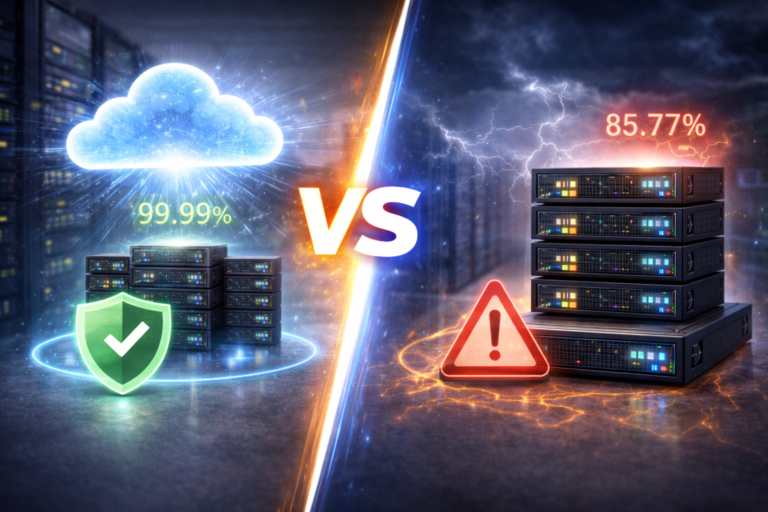
A VPS can be part of a cloud platform. Comparing VPS and cloud as if they were opposite architectures can obscure the actual decision: which service and design meet your application’s growth requirements?
The earlier article assigned fixed billing and resource behavior to every VPS and described unsupported hybrid-adoption trends. Those claims have been removed. Compare concrete proposals instead.
Describe the growth event
Separate sustained demand, short campaigns, storage growth and more complex application work. Each can require a different change. More visitors do not automatically mean a proportional increase in every resource.
Identify the limiting component with evidence. A database, queue or external service may constrain growth even when the web server has unused capacity.
Compare capacity changes
A resize changes a machine’s allocation; adding replicas changes the application arrangement. Either can involve quotas, stock, restart, data movement and configuration work.
Ask how the specific service behaves and test the mechanism. An autoscaling feature does not prove the application can use extra capacity immediately or without errors.
Design for failures separately
Record what happens when a node, storage service or dependency becomes unavailable. A cloud label does not itself provide multi-location recovery or a consistent application state.
The backup guide covers recovery checks. Backups, replication and failover solve different problems and need their own operating owners.
Compare complete billing scenarios
VPS and cloud products can use different commitments and consumption models. Even a fixed server fee may sit alongside variable storage, transfer or support. Avoid assuming either category fixes the entire bill.
Model a normal month, a busy month and an incident with overlapping resources. The cloud forecast guide helps record units, assumptions and ownership.
Include operating work
Compare patching, deployment, monitoring, access and recovery. Replacing a managed component with self-operated software changes responsibility and incident cover.
The management comparison helps price that work. A lower infrastructure line item does not establish a cheaper complete service.
Accept and review the design
Use a protected representative system to verify useful requests, scaling, failures and restoration. Record actual limits and remaining gaps. Keep exports and a supported exit path.
The two-part hosting decision separates allocation from management. Choose the growth arrangement that passes the requirements and that the team can operate, without a universal VPS-versus-cloud performance, cost or resilience winner.