
Best Hosting Providers for Small Business in 2026 (Global Guide)
Every second counts online. For a small business, a slow website isn’t just an annoyance; it’s a lost customer. In 2026, the digital marketplace is more competitive than ever, and the foundation of your online presence—your web hosting—has never been more critical.
Reliable hosting is no longer a luxury; it’s a necessity. Whether you run a local bakery in Berlin, a tech startup in Singapore, or an eCommerce store in New York, your hosting provider determines your site’s speed, security, and uptime. These factors directly influence your SEO rankings and, ultimately, your bottom line.
Choosing the right partner can feel overwhelming with thousands of options available. That’s why we’ve cut through the noise. This guide analyzes the best hosting providers for small business in 2026, focusing on performance benchmarks, global server availability, and pricing transparency to help you make an informed decision.
How We Evaluated Small Business Hosting Providers
To identify the best business hosting worldwide, we didn’t just look at marketing claims. We focused on the metrics that actually matter to business owners who need their websites to work 24/7.
Here are the key criteria used in our evaluation:
- Performance Benchmarks: We looked at server response times (TTFB) and load speeds. In 2026, core web vitals are a major ranking factor for Google, meaning speed equals visibility.
- Global Data Center Availability: A “global” guide requires global infrastructure. We prioritized hosts with data centers across multiple continents (North America, Europe, Asia-Pacific) to ensure fast loading times for local audiences.
- Pricing Transparency: Hosting providers are notorious for low introductory rates that skyrocket upon renewal. We analyzed the true cost of ownership over a 3-year period.
- Security Features: For a business, security is non-negotiable. We checked for included SSL certificates, automated backups, DDoS protection, and malware scanning.
- Customer Support Quality: When your site goes down on Black Friday, you need immediate help. We evaluated support channels (live chat, phone, ticket) and response efficiency.
Quick Comparison Table – Best Small Business Hosting Providers
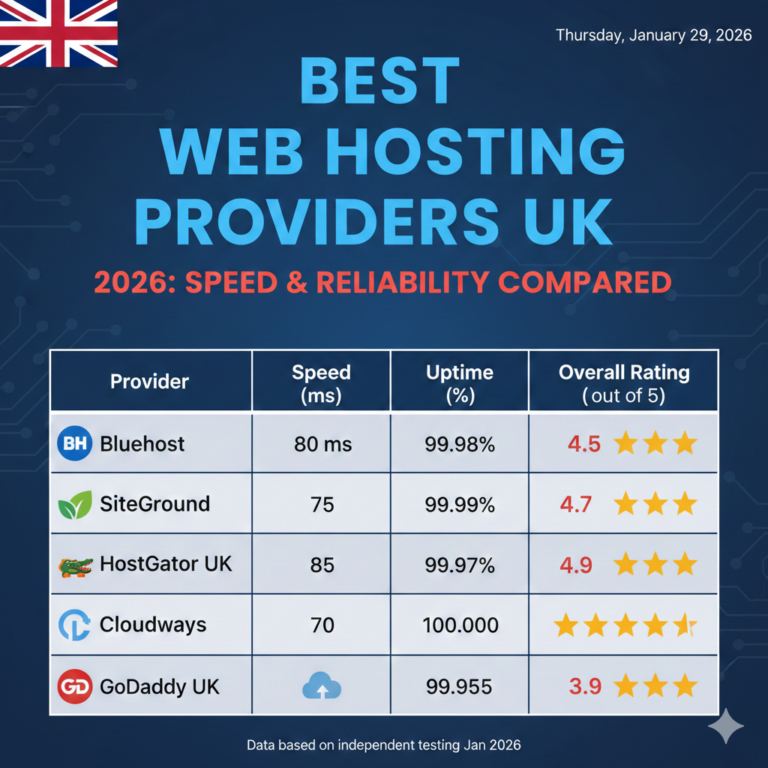
If you are in a rush, here is a snapshot of the top contenders for small business web hosting in 2026.
| Provider | Starting Price (approx.) | Uptime Guarantee | Support Channels | Best For | Global Reach |
|---|---|---|---|---|---|
| Bluehost | $2.95/mo | 99.9% | 24/7 Chat & Phone | WordPress Beginners | Good |
| Hostinger | $2.99/mo | 99.9% | 24/7 Chat | Budget & Speed | Excellent |
| SiteGround | $3.99/mo | 99.9% | 24/7 Chat, Phone, Ticket | Service & Support | Excellent |
| Cloudways | $14.00/mo | 99.99% | 24/7 Chat | Scalability & Speed | Superior |
| A2 Hosting | $2.99/mo | 99.9% | 24/7 Chat & Phone | High-Speed Shared | Good |
| DreamHost | $2.59/mo | 100% | 24/7 Chat | Month-to-Month | Good |
| IONOS | $1.00/mo | 99.9% | 24/7 Phone | Enterprise/Agencies | Excellent |
| GreenGeeks | $2.95/mo | 99.9% | 24/7 Chat | Eco-Friendly | Good |
[Compare Hosting Plans Now]
Best Hosting Providers for Small Business in 2026
Below, we dive deep into the specific features, pros, and cons of the top hosting providers suited for small businesses.
1. Bluehost
Bluehost remains a giant in the industry, particularly for those using WordPress. It is officially recommended by WordPress.org, making it a safe, reliable starting point for many new businesses.
Best Use Case: New businesses building their first WordPress site.
Performance & Features:
Bluehost has significantly upgraded its infrastructure in recent years. Their plans now include NVMe SSD storage on higher tiers, which boosts data retrieval speeds. They offer a free domain for the first year and a free CDN (Content Delivery Network) integration to help distribute your content globally.
Pros:
- Extremely beginner-friendly dashboard.
- One-click WordPress installation.
- 24/7 customer support via phone and chat.
Cons:
- Renewal rates are significantly higher than intro rates.
- Site migration usually costs extra (unless using a plugin).
Global Reach:
Bluehost primarily utilizes data centers in the USA, but through Cloudflare integration, they serve global audiences reasonably well.
2. Hostinger
Hostinger has taken the market by storm by offering arguably the best price-to-performance ratio in the industry. It is the go-to choice for affordable business hosting that doesn’t compromise on speed.
Best Use Case: Budget-conscious businesses that need high speed.
Performance & Features:
Hostinger uses LiteSpeed web servers, which are known for handling high traffic loads efficiently. Even their cheaper plans come with a custom-built hPanel (an alternative to cPanel) that is intuitive and fast. They offer data centers in the USA, UK, France, India, Singapore, Brazil, Lithuania, and the Netherlands.
Pros:
- Incredible loading speeds for the price.
- Servers available in 4 continents.
- Weekly or daily backups included (depending on plan).
Cons:
- No phone support (chat only).
- The cheapest plan lacks a free domain.
Global Reach:
Excellent. You can choose your specific server location during setup.
3. SiteGround
If customer service is your top priority, SiteGround is the industry leader. Their support team is technically proficient and incredibly fast. They run on Google Cloud Platform, ensuring top-tier reliability.
Best Use Case: eCommerce stores and businesses needing premium support.
Performance & Features:
SiteGround creates custom software solutions for speed and security, such as their “SuperCacher” technology. They offer a free daily backup for all plans—a crucial safety net for small businesses. Their security suite is robust, with real-time monitoring that blocks millions of threats daily.
Pros:
- Top-tier customer support (fastest response times).
- Built on Google Cloud infrastructure.
- Free daily backups and restores.
Cons:
- Higher renewal prices than most competitors.
- Storage limits are strictly enforced (e.g., 10GB on the StartUp plan).
Global Reach:
Excellent, leveraging Google’s global network with data centers in the USA, Europe, Asia, and Australia.
[Check Latest Pricing for SiteGround]
4. Cloudways
Cloudways is not a traditional host; it is a managed cloud hosting platform. It allows you to use infrastructure from giants like DigitalOcean, AWS, and Google Cloud without needing to be a system administrator.
Best Use Case: Growing businesses and online stores needing scalability.
Performance & Features:
Because you are utilizing dedicated cloud resources, the speed is often superior to shared hosting. You can scale your server resources (RAM/CPU) up or down with a few clicks. It includes an optimized stack with built-in caches (Varnish, Memcached, Redis).
Pros:
- Pay-as-you-go pricing model (no long-term lock-ins).
- Exceptional scalability for traffic spikes.
- Dedicate resources mean your neighbor’s traffic won’t slow you down.
Cons:
- Slightly steeper learning curve than standard shared hosting.
- Email hosting is an paid add-on (not included).
Global Reach:
Superior. You have access to 60+ data centers worldwide through their partners.
5. A2 Hosting
A2 Hosting brands itself on speed, specifically their “Turbo” servers which claim to be 20x faster. For small business web hosting 2026, speed is a major competitive advantage.
Best Use Case: Businesses prioritizing raw loading speed on a shared plan.
Performance & Features:
Their Turbo plans utilize NVMe drives and LiteSpeed servers to handle traffic efficiently. They also offer “perpetual security,” which includes free HackScan protection to keep your business data safe.
Pros:
- Anytime money-back guarantee (pro-rated).
- Excellent speed performance on Turbo plans.
- Developer-friendly features.
Cons:
- Turbo features are only available on more expensive plans.
- Uptime rates can occasionally fluctuate compared to Cloudways or SiteGround.
Global Reach:
Good, with data centers in Michigan, Arizona, Amsterdam, and Singapore.
6. DreamHost
DreamHost is known for fair pricing and privacy. They are one of the few reliable hosting providers worldwide that offer a true month-to-month payment option without a massive setup fee.
Best Use Case: Businesses that want flexible billing and privacy.
Performance & Features:
They offer a 100% uptime guarantee, which is bold in this industry. Their custom control panel is clean, and they include a free domain and privacy protection (WHOIS privacy) in their plans, which usually costs extra elsewhere.
Pros:
- Month-to-month billing available.
- 97-day money-back guarantee.
- Free privacy protection included.
Cons:
- No cPanel (they use a custom panel).
- Live chat support is not 24/7 (available 5:30 AM – 9:30 PM PT).
Global Reach:
Focused primarily on US-based servers, which is ideal for businesses targeting North America.
7. IONOS
IONOS (formerly 1&1) is a massive European provider that caters well to both small businesses and enterprise needs. They are often the most affordable entry point.
Best Use Case: Agencies and businesses looking for the absolute lowest introductory price.
Performance & Features:
IONOS offers a personal consultant for your account, which is a unique touch for business hosting. Their infrastructure is geo-redundant, meaning your data is mirrored in two different data centers for safety.
Pros:
- Dedicated personal consultant.
- Extremely low introductory offers (sometimes $1/mo).
- Scalable performance levels.
Cons:
- The backend interface can be cluttered and confusing.
- Upselling in the checkout process is aggressive.
Global Reach:
Excellent, with a massive presence in Europe and the US.
8. GreenGeeks
For the eco-conscious brand, GreenGeeks is the best web hosting for small business. They match 300% of the energy they consume with renewable energy credits.
Best Use Case: Environmentally conscious businesses.
Performance & Features:
Despite the eco-focus, they don’t skimp on performance. They use LiteSpeed servers, offer free nightly backups, and provide a free CDN.
Pros:
- 300% green energy match.
- Free nightly backups.
- Good performance for shared hosting.
Cons:
- Renewal prices are high.
- Support is good but not as technical as SiteGround.
Global Reach:
Good, with data centers in the US, Canada, and Europe.
[Start Your Business Website Today]
Pricing Comparison – Entry vs Renewal Costs
One of the biggest pain points in hosting comparison for small business is the difference between the “sign-up” price and the “renewal” price. Most providers offer a deep discount (up to 70%) for the first term (1–3 years), after which the price reverts to the standard rate.
To help you budget for the long term, here is a breakdown of estimated costs. Note: Prices are in USD and subject to change.
| Provider | Intro Price (Monthly) | Renewal Price (Monthly) | Commitment for Best Deal | Hidden Fees? |
|---|---|---|---|---|
| Bluehost | $2.95 | $11.99 | 12 or 36 Months | No, but add-ons selected by default |
| Hostinger | $2.99 | $6.99 | 48 Months | No |
| SiteGround | $3.99 | $14.99 | 12 Months | No |
| Cloudways | $14.00 | $14.00 | Monthly (No contract) | No |
| A2 Hosting | $2.99 | $12.99 | 12 Months | No |
| DreamHost | $2.59 | $7.99 | 36 Months | No |
Key Takeaway: Always check the renewal rate. If you plan to be in business for more than three years, Cloudways or DreamHost may offer better long-term value despite higher (or similar) upfront costs.
Speed, Performance & Global Reliability
For a small business in 2026, “fast” is relative to where your customers are. If your bakery is in London but your server is in Los Angeles, your local customers will experience lag. This is known as latency.
The Role of CDN and Server Locations
To combat latency, you need a host with a wide network of server locations or a robust Content Delivery Network (CDN).
- Server Locations: Choose a host that allows you to pick a data center near your primary customer base. Hostinger and SiteGround excel here.
- CDN: Services like Cloudflare cache a version of your site on servers worldwide. Bluehost and GreenGeeks integrate this automatically.
NVMe Storage
In 2026, standard SSDs are the baseline. The fastest hosting for business now utilizes NVMe (Non-Volatile Memory express) drives. These are significantly faster than traditional SATA SSDs. If speed is your priority, look for providers like A2 Hosting (Turbo plans) and InMotion Hosting that specifically advertise NVMe storage.
Uptime Guarantees
Downtime costs money. The industry standard is 99.9% uptime, which allows for about 43 minutes of downtime per month.
- 99.9%: Standard (Bluehost, Hostinger).
- 99.99%: Better (Cloudways).
- 100%: The Goal (DreamHost guarantees this, though actual results may vary slightly).
Security & Business-Critical Features
Cheap hosting for small business often cuts corners on security, but this is a risk you cannot afford. Cyberattacks target small businesses frequently because they often lack enterprise-grade defenses.
Ensure your chosen provider includes:
- SSL Certificates: Essential for encryption and Google rankings. All providers listed above include free SSL (Let’s Encrypt).
- Automated Backups: If your site is hacked or an update breaks it, you need a one-click restore. SiteGround and Cloudways are leaders here. Avoid hosts that charge extra for this basic necessity.
- Malware Protection: Hosts like A2 Hosting and SiteGround include proactive scanning to identify malicious code before it harms your site.
- Compliance: If you handle customer data (especially in Europe with GDPR or California with CCPA), ensure your host’s data centers are compliant.
[Compare Secure Hosting Plans]
Scalability for Growing Businesses
Your business today won’t be the same size in two years. Scalable hosting for business means you can upgrade your resources without migrating your entire website to a new provider—a process that is stressful and risky.
- Vertical Scaling: Adding more RAM or CPU to your existing server. Cloudways makes this incredibly easy (one slider to increase server size).
- Cloud Migration: Moving from shared hosting to a cloud environment. SiteGround offers cloud plans that you can graduate to easily.
- Traffic Handling: If you run a seasonal business, ensure your host doesn’t penalize you for traffic spikes. Shared hosting plans (like Bluehost or Hostinger) have “soft limits” on resources. If you exceed them, your site may be temporarily taken offline.
Best Hosting for Different Small Business Needs
One size does not fit all. Here are our specific recommendations based on business type.
Best for Beginners
Winner: Bluehost
If you have never built a website, Bluehost’s onboarding wizard and seamless WordPress integration make it the least intimidating option.
Best for eCommerce
Winner: SiteGround or Cloudways
For online stores (WooCommerce or Magento), speed and uptime are money. SiteGround’s security features and Cloudways’ power are ideal for handling transactions securely.
Best for International Traffic
Winner: Hostinger
With data centers in 8 diverse global locations and excellent speed benchmarks, Hostinger ensures your site loads fast whether your client is in Mumbai, London, or São Paulo.
Best Budget Option
Winner: DreamHost
For keeping costs low without sacrificing privacy or dealing with confusing renewal hikes, DreamHost’s month-to-month plans are unbeatable.
Pros & Cons Summary Table
| Provider | Pros | Cons |
|---|---|---|
| Bluehost | Easy to use, official WordPress recommended. | High renewal rates, aggressive upselling. |
| Hostinger | Fastest budget host, global servers. | No phone support, no cPanel. |
| SiteGround | Best support, high security, free backups. | Expensive renewals, storage limits. |
| Cloudways | High performance, scalable, pay-as-you-go. | No email hosting, technical interface. |
| A2 Hosting | NVMe speed, refund policy. | Uptime can fluctuate, confusing plan tiers. |
| DreamHost | 100% uptime guarantee, month-to-month billing. | Limited support hours, custom panel. |
| IONOS | Cheapest entry price, personal consultant. | Cluttered interface, hard to navigate. |
| GreenGeeks | Eco-friendly, good performance. | Pricey renewals, fewer data center options. |
FAQs – Best Hosting Providers for Small Business
Which hosting is best for small business in 2026?
There is no single “best” provider, but SiteGround is widely considered the best all-around for support and reliability, while Hostinger is the best value for money. Cloudways is the top choice for performance and scaling.
How much should a small business pay for hosting?
For shared hosting, expect to pay between $3–$10 per month on average (accounting for renewal prices). For managed cloud or VPS hosting tailored to eCommerce, budget between $15–$50 per month.
Is shared hosting good for business websites?
Yes, for most service-based small businesses (consultants, local shops, restaurants), shared hosting is sufficient. However, high-traffic blogs or eCommerce stores with large inventories should look at VPS or Cloud hosting for better stability.
Which hosting provider offers best uptime worldwide?
Cloudways and SiteGround consistently rank at the top for uptime reliability because they utilize infrastructure from major cloud providers like Google and DigitalOcean.
Can I upgrade hosting as my business grows?
Yes. Most providers allow you to upgrade from a “Basic” to a “Pro” plan instantly. However, moving from Shared to VPS/Cloud hosting can sometimes require a site migration, which providers like SiteGround can assist with.
Which hosting is best for eCommerce stores?
For eCommerce, avoid the cheapest shared plans. We recommend SiteGround’s GoGeek plan or Cloudways because they offer more simultaneous connections, ensuring your site doesn’t crash when multiple customers checkout at once.
What hosting features are most important for small business?
Prioritize SSL certificates (security), automated daily backups (insurance), uptime guarantees (reliability), and fast customer support.
Conclusion
Choosing the best web hosting for your small business is a foundational decision. In 2026, the market offers incredible options that are faster, more secure, and more global than ever before.
- If you need speed on a budget, start with Hostinger.
- If you need hand-holding and support, go with SiteGround.
- If you are ready to scale aggressively, choose Cloudways.
Don’t let analysis paralysis stop you. Your website is the face of your business—give it a home that is secure, fast, and always online.