
Best Web Hosting for WordPress, Ecommerce & Business Sites in 2026
Your website is your digital storefront, your 24/7 sales representative, and often the first point of contact for potential customers. In 2026, the digital landscape has become more competitive than ever. Users have zero patience for slow-loading pages, and search engines like Google have become ruthless in penalizing sites with poor technical performance.
Choosing a hosting provider isn’t just a technical checkbox; it is a foundational business decision. The infrastructure supporting your site determines its speed, security, and ability to handle traffic spikes. However, the market is saturated with thousands of providers all claiming to be the “fastest” and “most reliable.”
Whether you are launching a personal blog, scaling a high-traffic ecommerce store, or managing a corporate business site, your hosting needs will differ significantly. A solution that works for a portfolio won’t hold up under the pressure of a Black Friday sale.
This guide cuts through the marketing noise. We will analyze the best web hosting 2026 has to offer, breaking down the technical requirements for WordPress, ecommerce, and business websites so you can make an investment that supports your growth.
What Makes Web Hosting “Best” in 2026?
The definition of “quality hosting” has evolved. A few years ago, unlimited storage and bandwidth were the primary selling points. Today, performance metrics and infrastructure quality take precedence. When searching for the best web hosting 2026, there are five critical pillars you must evaluate.
Speed & Core Web Vitals
Google’s Core Web Vitals are now a mature ranking factor. Your hosting provider directly influences “Largest Contentful Paint” (LCP) and “Time to First Byte” (TTFB). If your server takes two seconds just to start sending data to the user’s browser, no amount of on-page optimization will save your search rankings. The top hosts now utilize NVMe SSD storage (which is significantly faster than traditional SATA SSDs) and server-level caching technologies like LiteSpeed or NGINX to ensure near-instant load times.
Uptime & Reliability
Downtime costs money. For an ecommerce store, every minute offline is lost revenue. For a business site, it’s lost credibility. The industry standard used to be 99.9% uptime, but in 2026, premium hosts are pushing for 99.99% or higher. This difference might seem small, but 99.9% allows for nearly 9 hours of downtime per year, whereas 99.99% allows for less than an hour.
Security & Backups
Cyber threats have become more sophisticated, targeting small businesses and blogs just as often as major corporations. The best hosting providers now include proactive security measures at the server level. This includes Web Application Firewalls (WAF), automated malware scanning, and DDoS protection. Furthermore, automated daily backups are non-negotiable. You need the ability to restore your site to a previous version with a single click if something goes wrong.
Customer Support Quality
When your site goes down at 2 AM, you don’t want to talk to an AI chatbot that loops you through support articles. You need a human engineer. The quality of support—specifically the availability of 24/7 live chat and phone support with knowledgeable staff—is often the differentiator between a budget host and a premium partner.
Pricing vs. Value
There is a massive difference between “cheap” and “value.” Many hosts offer introductory rates of $2.99/month, only to renew at $15.99/month. True value comes from transparency and the resources allocated to your account. We will look at pricing structures that offer sustainable long-term value rather than just the lowest entry price.
Best Web Hosting for WordPress Websites
WordPress powers over 40% of the web, and because of its dominance, hosting companies have built specialized infrastructure for it. When looking for the best WordPress hosting 2026, you generally have two paths: Shared WordPress Hosting and Managed WordPress Hosting.
Managed vs. Shared WordPress Hosting
Shared hosting places your site on a server with hundreds of other websites. It is cost-effective and suitable for beginners, but you share resources. If another site on the server spikes in traffic, yours might slow down.
Managed WordPress hosting is a concierge service. The provider handles all technical aspects, including updates, security patching, and server optimization specifically for WordPress. These servers are configured to handle WordPress databases efficiently.
Required Features for 2026
To compete in search rankings this year, your WordPress host should offer:
- One-Click Staging Environments: This allows you to clone your site, test changes (like a new plugin or theme), and push them to live without breaking your actual website.
- Server-Side Caching: Tools like LiteSpeed Cache or Varnish should be built-in, eliminating the need for heavy caching plugins.
- Auto-Updates: WordPress core and plugin vulnerabilities are a top security risk. Your host should offer automated patching.
Top Use Cases
- Blogs: A shared plan with a reputable host like Bluehost or Hostinger is usually sufficient for starting out.
- Content Sites: High-traffic magazines or affiliate sites should look toward managed hosts like WP Engine or Kinsta, which utilize Google Cloud Platform for speed.
- Agencies: If you manage sites for clients, look for hosts that offer “white label” reports and easy collaboration tools.
Best Ecommerce Hosting in 2026
Ecommerce hosting is a different beast entirely. Unlike a blog, where users primarily read content, ecommerce users are interacting with the database constantly—adding items to carts, processing payments, and searching catalogs. This requires more CPU and RAM.
WooCommerce vs. Custom Ecommerce Hosting
If you are using WooCommerce (built on WordPress), generic shared hosting will likely cause your checkout to crash during traffic surges. You need the best ecommerce hosting optimized for database queries.
For those not on WordPress (using Magento or PrestaShop), you will likely need a VPS or Cloud solution to handle the resource load.
Performance for High Traffic & Checkouts
Slow load times correlate directly with cart abandonment. Amazon found that every 100ms of latency cost them 1% in sales. In 2026, specialized ecommerce hosts use “Elastic Scaling.” This allows your server to temporarily access more resources during a traffic spike (like a flash sale) so your site doesn’t crash, and then scale back down afterward.
Security, PCI Compliance & Scalability
If you process credit card data, you must be PCI compliant. While payment gateways (like Stripe or PayPal) handle the heavy lifting, your hosting environment must still meet security standards. Look for hosts that offer:
- Free, auto-renewing SSL Certificates.
- Dedicated IP addresses (often required for certain banking functions).
- Automated backups that run hourly, not just daily, to ensure no order data is lost.
Best Web Hosting for Business Websites
For corporate sites, law firms, service providers, and agencies, reliability is the primary currency. Your website validates your existence. If a potential client visits your URL and sees a “Server Error,” they will likely go to a competitor.
Hosting for Lead-Gen & Corporate Websites
Business web hosting usually focuses on stability over raw power. You may not have the traffic of a viral blog or the database queries of an Amazon rival, but you need 100% availability.
Email Hosting & Uptime Importance
Many business hosting plans include professional email (@yourcompany.com). While many modern businesses offload email to Google Workspace or Microsoft 365, smaller businesses often rely on their host for email. Ensure your host has high deliverability ratings so your emails don’t end up in client spam folders.
SLA & Professional Support Needs
Look for a host that offers a Service Level Agreement (SLA). This is a contract that guarantees a certain percentage of uptime. If they fail to meet it, they owe you credits. This accountability is vital for business hosting.
Hosting Types Compared (Quick Overview)
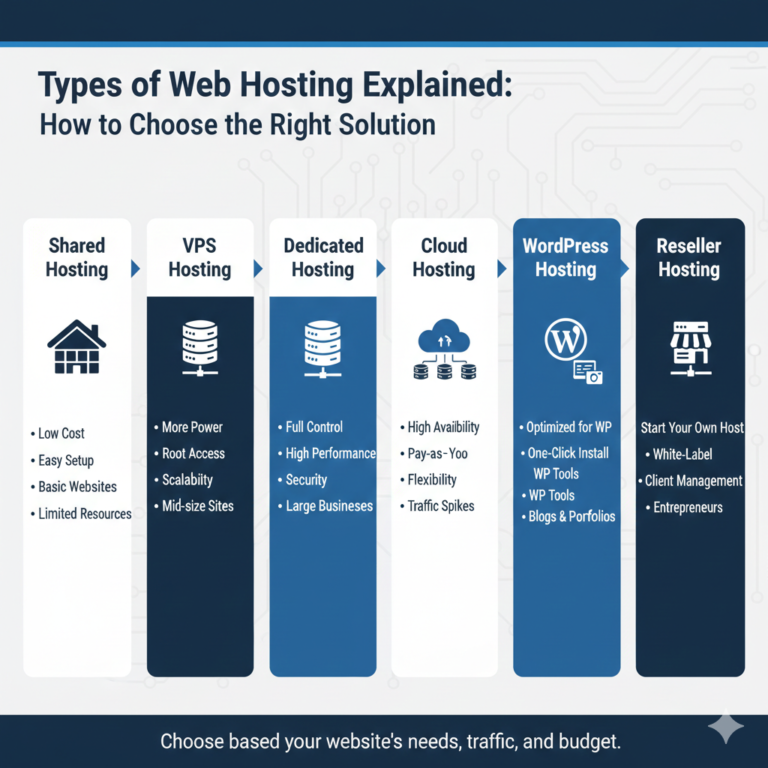
To make the right choice, you must understand the infrastructure. Here is a breakdown of the key architectures when debating shared vs VPS vs cloud hosting.
Shared Hosting (Entry-Level)
Think of this as renting a bedroom in a shared house. You split the rent (cost) and the utilities (resources) with roommates. It is cheap and easy, but if a roommate throws a loud party (traffic spike), you can’t sleep.
- Best for: Personal blogs, small portfolios, new startups.
VPS Hosting (Growing Businesses)
A Virtual Private Server (VPS) is like owning a condo. You are still in a building with others, but you have your own walls and dedicated resources. Your neighbors’ behavior rarely affects you. You have more control and power.
- Best for: Small ecommerce sites, high-traffic blogs, businesses needing custom software.
Cloud Hosting (Scalable Ecommerce)
Cloud hosting is a network of servers acting as one. If one server fails, another takes over instantly. It is infinitely scalable—you can add more RAM or CPU with a click.
- Best for: Fast-growing startups, enterprise sites, volatile traffic patterns.
Managed Hosting (Hands-Off Users)
This is a service layer added on top of any of the above. The host acts as your IT team. They fix bugs, handle security, and optimize speed.
- Best for: Business owners who don’t want to deal with technical maintenance.
Best Web Hosting Providers in 2026 (Category-Wise)
Based on current performance benchmarks and feature sets, here are the top contenders for best hosting providers 2026.
Best Overall Hosting: SiteGround
SiteGround continues to balance performance, support, and price perfectly. They run on Google Cloud Platform, offer custom caching tools, and their support team is consistently rated among the best in the industry. They are suitable for 90% of users, from beginners to small businesses.
Best Budget Hosting: Hostinger
Hostinger has revolutionized the budget market. They offer NVMe storage and LiteSpeed servers at prices that competitors struggle to match. While their support is chat-only, the performance-per-dollar ratio is unbeatable for personal sites and small projects.
Best WordPress-Focused Hosting: WP Engine
For serious WordPress sites, WP Engine remains the gold standard. It is expensive, but you are paying for peace of mind. Their proprietary caching, daily backups, and security focus make them the top choice for brands that cannot afford to be hacked or slow.
Best Ecommerce Hosting: Liquid Web / Nexcess
Liquid Web (and their Nexcess brand) specializes in WooCommerce and Magento. They offer auto-scaling for traffic surges and have specialized support teams that understand the intricacies of online stores.
Best Business Hosting: DreamHost
DreamHost offers strong uptime guarantees and is one of the few recommended directly by WordPress.org. Their plans are straightforward, with no confusing upsells, making them a solid, honest choice for corporate brochures and business listings.
Performance, Pricing & Features Comparison Table
When conducting a web hosting comparison, it helps to see the data side-by-side.
| Provider | Ideal Use Case | Uptime Guarantee | Key Speed Tech | Price Range (Monthly) |
| SiteGround | Small Business & WP | 99.9% | Google Cloud + SuperCacher | $$ (Mid-Range) |
| Hostinger | Budget / Starters | 99.9% | LiteSpeed Servers | $ (Low) |
| WP Engine | High-Traffic WP | 99.95% | EverCache® | $$$ (Premium) |
| Nexcess | Ecommerce | 99.99% | Cloud Auto-Scaling | $$$ (Premium) |
| Bluehost | Beginners | 99.9% | Standard SSD | $ (Low) |
| Kinsta | Enterprise WP | 99.9% | Google C2 Machines | $$$$ (High) |
How to Choose the Right Hosting for Your Website
Choosing requires looking inward at your business goals. Here is how to choose web hosting based on your specific situation.
Based on Traffic
If you have under 10,000 monthly visitors, shared hosting is fine. Between 10,000 and 100,000, you need a VPS or a premium managed WordPress plan. Above 100,000, look strictly at Cloud or Dedicated solutions.
Based on Budget
Be realistic. If your budget is $3/month, accept that support may be slower and performance lower. If your business makes $5,000/month, spending $100/month on hosting to ensure speed and security is a negligible expense for the value returned.
Based on Technical Skill
Do you know how to use a command line? If yes, an unmanaged VPS (like DigitalOcean) saves money. If you get confused by DNS settings, pay extra for Managed Hosting. It will save you hours of frustration.
Based on Future Growth
Don’t just buy for today. If you plan to launch a massive ad campaign next month, ensure your host allows you to upgrade your plan instantly. Some hosts require a site migration to upgrade, which causes downtime.
Common Hosting Mistakes to Avoid in 2026
Even experienced webmasters make errors during procurement. Avoid these pitfalls:
Choosing the Cheapest Plan Only
The “cheapest” plan often lacks critical features like automated backups or sufficient RAM. You end up paying more in developer fees to fix issues than you saved on the subscription.
Ignoring Renewal Pricing
Most hosts offer a massive discount for the first year (e.g., $2.99/mo). However, the renewal price is often 3x or 4x higher (e.g., $14.99/mo). Always check the renewal rate before committing.
Skipping Backups & Security
Never assume the host will save you. If you don’t have a backup plan included, you are one hack or bad update away from losing your entire business.
Overpaying for Unused Features
Do you really need “Unlimited Sites” if you only have one? Do you need a “Dedicated IP” if you aren’t running custom server scripts? tailored plans often perform better than bloated “unlimited” ones.
Frequently Asked Questions (FAQ)
Q1. Which web hosting is best for WordPress in 2026?
For most users, SiteGround offers the best blend of price and performance. For high-traffic sites, WP Engine or Kinsta are the top managed choices.
Q2. What hosting is best for ecommerce websites?
Ecommerce sites require robust resources. Nexcess (by Liquid Web) is highly recommended for WooCommerce due to its auto-scaling features, while Shopify is the best all-in-one hosted solution if you want to leave WordPress.
Q3. Is shared hosting good for business websites?
For a simple informational business site (like a restaurant menu or law firm contact page), shared hosting is sufficient. However, if the site generates leads or sales directly, a VPS or managed plan is safer.
Q4. How much does business web hosting cost in 2026?
Reliable business hosting generally costs between $10 and $30 per month. Premium managed services can range from $30 to $100+ per month depending on traffic.
Q5. Can one hosting plan work for WordPress and ecommerce?
Yes, most WordPress hosting plans support WooCommerce. However, ensure the plan has at least 256MB of PHP memory limit to handle ecommerce processes effectively.
Q6. Is managed hosting worth the price?
If you do not have a dedicated IT person, yes. The time saved on updates, security monitoring, and backups outweighs the monthly cost difference for most business owners.
Q7. Which hosting provider offers the best uptime?
Liquid Web and Kinsta are renowned for their uptime reliability, often exceeding 99.99% thanks to their advanced cloud infrastructure.
Final Verdict: Best Hosting by Website Type
The landscape of 2026 offers incredible technology, but the “best” choice is always relative to your needs.
- Best for WordPress Beginners: Go with Bluehost or Hostinger. They are affordable, easy to use, and offer great onboarding.
- Best for Ecommerce Stores: Choose Nexcess. Their ability to handle traffic spikes prevents lost sales during crucial shopping periods.
- Best for Growing Businesses:SiteGround is the perfect middle ground, offering professional features and support without the enterprise price tag.
- Best Overall Value Pick:Hostinger wins on raw performance per dollar, provided you are comfortable with chat-only support.
Your website is the heart of your digital presence. Treat your hosting not as a utility bill, but as an investment in your brand’s future.