Free Website Hosting: Useful Options and Their Limits
Disclaimer: Some of the links in this post may be affiliate links. If you purchase through them, we may earn a commission at no extra cost to you.
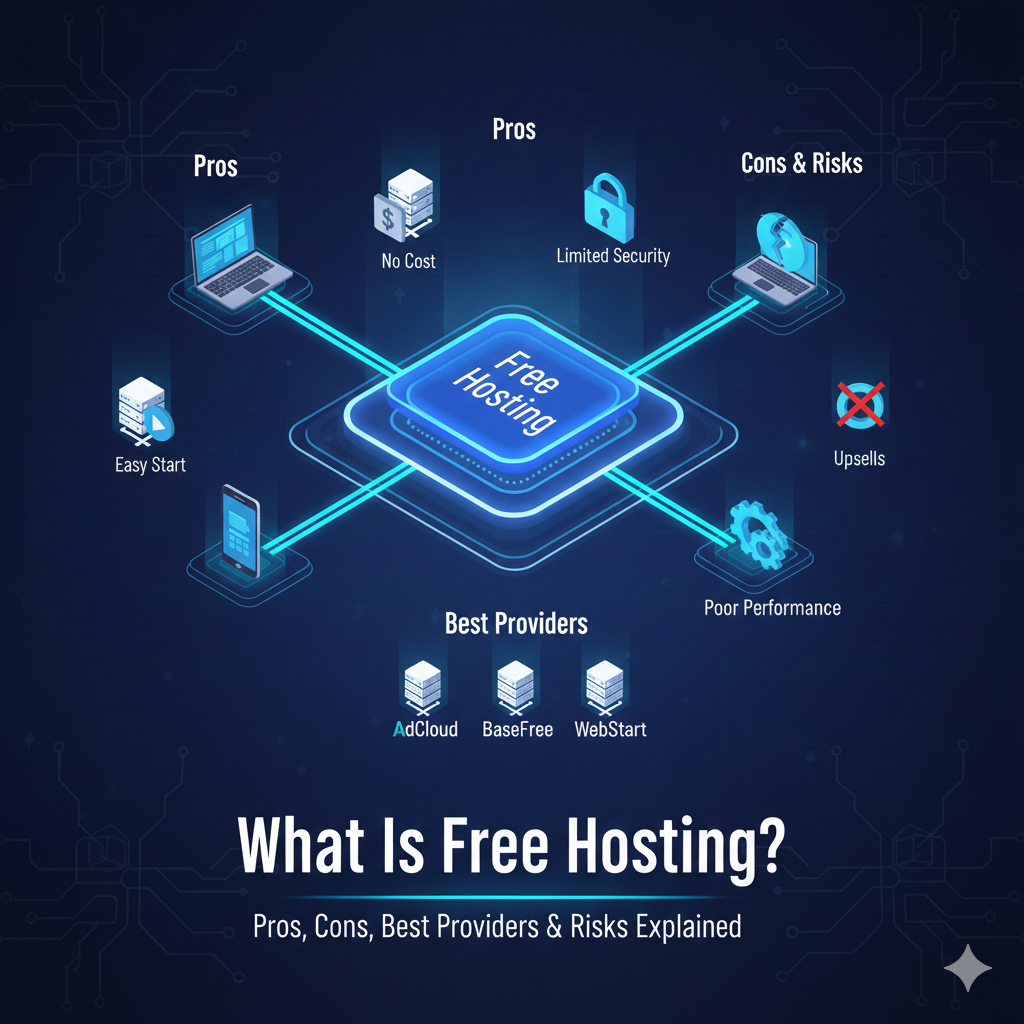
Free hosting can be a useful way to learn, publish a small project or test an idea. The important question is what kind of site the service supports and what happens when you reach its limits.
A free publishing platform, a static-site service and a cloud-server trial are different products. None should be selected only because the starting bill is zero.
Three free options to evaluate
| Service | Appropriate starting point | Important boundary |
|---|---|---|
| WordPress.com Free | Learning the platform or publishing a basic site within its free-plan features. | A WordPress.com subdomain and platform ads; check current upgrade requirements for the features you need. |
| GitHub Pages | Eligible static project pages, documentation or personal publishing. | Usage restrictions include online-business, ecommerce and commercial SaaS hosting; it is not a general shop-hosting solution. |
| Cloudflare Pages Free | Static-site deployment within the service’s current allowances. | Build and platform limits apply; dynamic Functions have separate runtime and usage considerations. |
These examples are documentation-based, checked in October 2026. They are not a performance ranking or a promise that a free tier will retain the same terms indefinitely.
Know whether your site needs a server-side application
A static site serves generated files such as HTML, CSS and JavaScript. Browser-side code may call external services, but the hosting platform does not automatically provide a PHP application and database.
A conventional self-hosted WordPress installation needs a suitable runtime and database. Uploading its files to a static-only service will not make its publishing system run. Exporting a static version is a different workflow with different limits.
WordPress.com is a managed publishing service, rather than a free account on an arbitrary self-hosted WordPress server. Compare the specific plan’s controls and export options before deciding it matches a tutorial for another environment.
Check the domain and branding
Find out whether you receive a provider subdomain, can connect your own domain and must display ads or branding. A custom domain can have a separate registration and renewal cost even when connecting it is supported.
Keep control of any domain you register. Do not assume that free hosting includes ownership of a permanent domain or that a promotional registration remains free at renewal.
Treat cloud credits and trials separately
A free trial or credit balance may expire. Some cloud offers require a payment method and can lead to charges when credits run out or use exceeds the allowance. Read the exact service terms before deploying a workload.
Billing alerts may warn rather than stop usage. If you create trial resources, keep an inventory and follow the documented shutdown and deletion process when finished. An unused application can still leave billable storage or connected services.
Review security and recovery without stereotypes
Free does not automatically mean insecure, and paying does not automatically make a site secure. Check HTTPS, supported software, account protection, data export and available support.
Keep copies of important content and test the export route. Ask what happens after inactivity, a limit breach or account suspension. If losing access would disrupt a business, assess whether the service and recovery arrangements meet that consequence.
When to move to a paid service
Consider an upgrade when you need a feature, operating scope or capacity the free service cannot supply. Examples include a required plugin, reliable assistance, a suitable dynamic runtime or a production recovery process.
Free hosting does not inherently prevent search indexing, and a paid plan does not guarantee rankings. Work on useful content, accessible pages and a service suitable for the website. Use the hosting comparison worksheet and full-cost budget when the project is ready for a larger commitment.