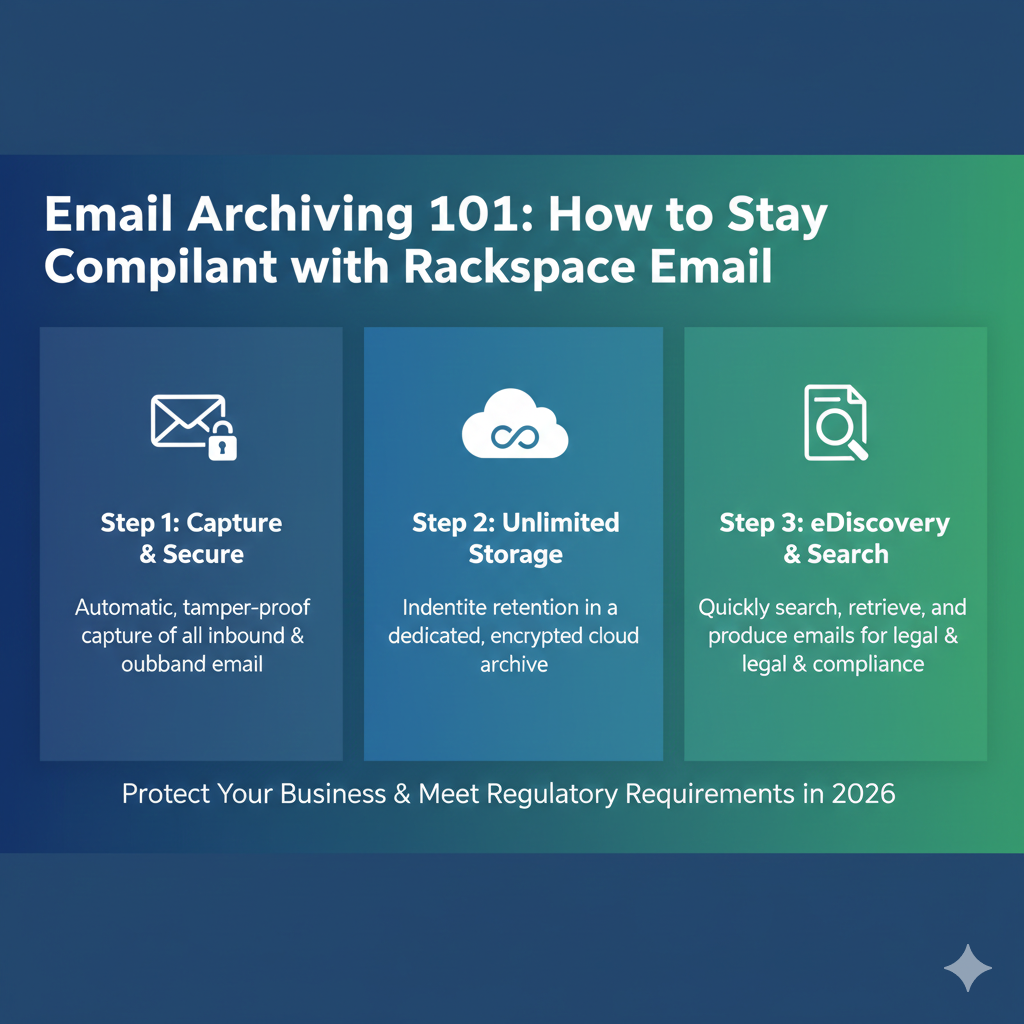
Rackspace Email Archiving: Setup, Coverage and Retention Checks
Email archiving keeps records for later retrieval under a defined policy. It is different from a live inbox, a local export and a disaster-recovery backup. Decide which problem you need to solve before enabling an archive.
The earlier article implied that turning on archiving establishes legal compliance and gave generic retention rules. Those claims have been removed. Your obligations depend on the organisation, records and applicable requirements; obtain qualified advice for the actual policy.
Approve the policy before configuring it
Identify the mail and attachments to retain, the reason for retention, authorised search users and the required disposal process. Decide how a preservation requirement will suspend ordinary disposal when needed.
Do not choose a retention period from an unrelated industry example. Retaining everything indefinitely can create its own privacy and operational issues. Keep approval, ownership and review dates with the policy.
Check the product and price
Confirm the destination is Rackspace Email or another supported product and that the chosen archive arrangement meets your requirements. Obtain the current charge and provisioning scope before ordering.
Rackspace’s enablement guide describes domain selection through the Cloud Office Control Panel, review of the offer and order completion. Use the current instructions and an authorised administrator. This article does not place an order.
Configure access deliberately
Give each person only the search and administrative scope needed. Organisation-wide search can expose sensitive messages. Use separate authorised accounts and verify access removal for departing staff.
Record who can export records and how exports are protected. Check available logging and review procedures. A searchable archive needs governance as well as storage.
Verify capture instead of assuming completeness
Read the documented limitations. Forwarding, aliases, deletion rules and spam handling can affect what is captured or represented. Test the mail routes your organisation actually uses.
Use harmless incoming, outgoing and internal test messages with attachments. Check that expected records become searchable, and investigate missing items. Newly enabled capture does not prove older mail has been imported.
Validate retrieval and preservation
Test an authorised search and export, then verify the retrieved content. Confirm how the selected system implements approved retention and preservation requirements. Do not assume a feature named legal hold or an export format is available without checking the product.
Document the process with the email security checklist. Protect search accounts and exported copies, not just the original mailbox.
Keep recovery and migration separate
The migration plan covers transferring working mail and other items. The backup guide explains recovery principles. An archive may support records retrieval without recreating every mailbox setting or restoring the whole email service.
Review capture, access and policy regularly. No archive product alone certifies that an organisation meets all legal requirements.